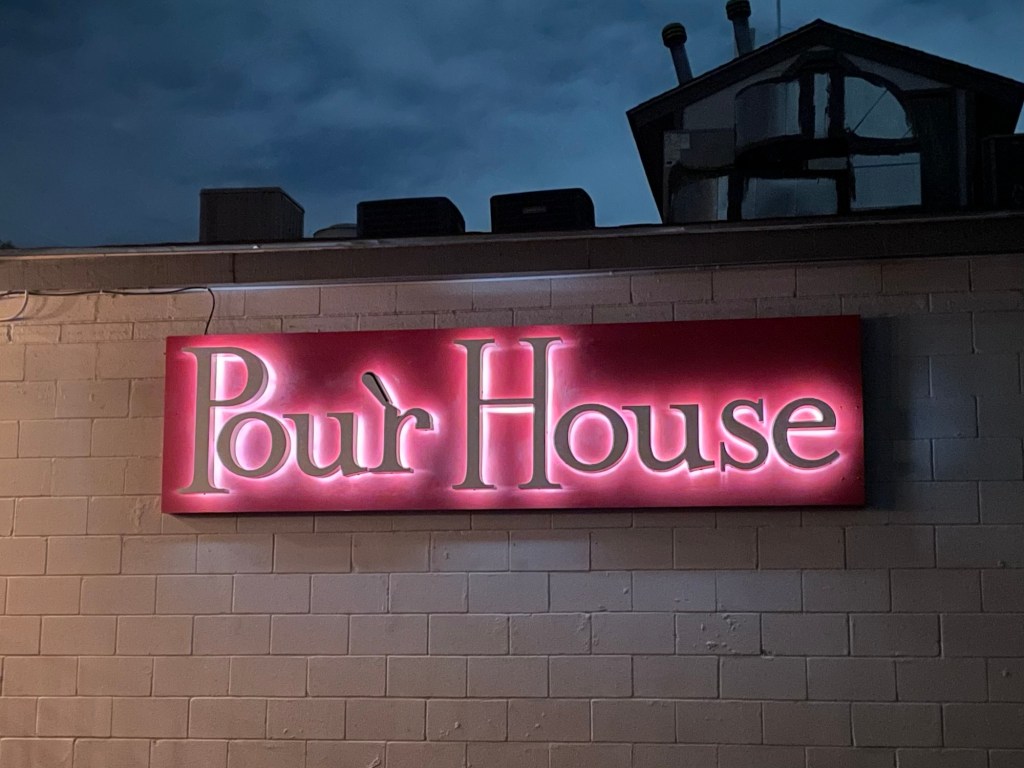
There is a happy Hoosier in the house! We headed to the Pour House for dinner and to watch the Peach bowl last night. Indiana is sure kicking it this season. Hoo hoo hoo Hoosiers!
Monte has a longtime family friend who used to be in the IU Band – the Marching 100, who was reminiscing about playing in the Rose Bowl years ago. He is talking about the last time IU appeared in the Rose Bowl, which was 1968!!
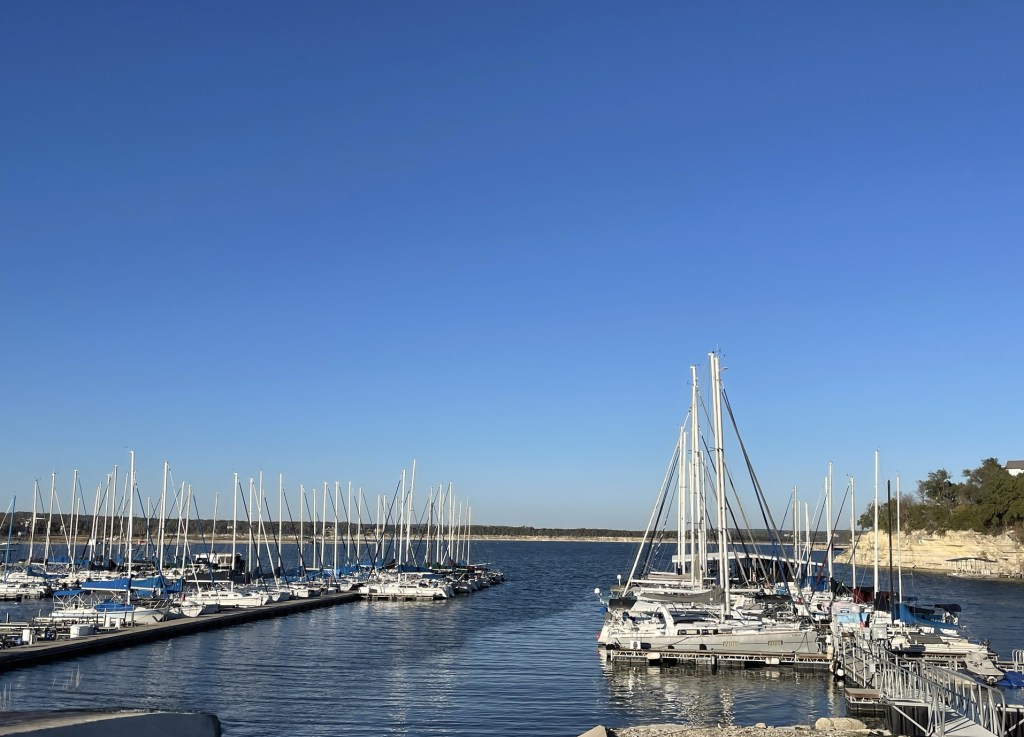
Happy New Year! Yesterday was a good day to be a Lake Travis sailor and a Seahawks fan. Not so great a day if you suffer from cedar fever. But I can take the bad with the good.
We had a really nice sail on Nirvana with Kevin & Edie. Nice winds. A gorgeous sunny January day. Then we made it home in time to watch the late game. My team won and is the number 1 seed in the NFC! 💙💚
Today is the last day of 2025 – a day to reflect on the year. I feel incredibly fortunate to have my family, friends, good health, and all the incredible experiences that I have been blessed with this year.
We had a few visitors; Noreen, David, and Julie visited us in Austin this year. I traveled up to the PNW for a visit with all my sisters, all but one of my siblings’ kids, and all seven of my great-nieces and great-nephews. Sadly, we lost friends Melinda and David in 2025. They are missed and fondly remembered. ❤
The absolute highlight for me is our travels in 2025, which I hope to continue into the new year. The Dominican Republic and Portugal were new countries I visited this year. Our Maine schooner trip was another truly amazing experience. The transatlantic cruise on the Queen Mary 2 was a lifetime memory. Our travels in England introduced me to some incredible new places and scenery, and gave me a deeper understanding of British history. Monte and I also enjoyed getting back to nature on some shorter road trips to see some of Texas’s beautiful parks.
My friends kept me laughing and lifted my spirits. Whatever would I do without them?
For all this, I am truly grateful.
I wish you the very best in the new year. Hug your family and friends. Be kind to yourself. Get out there. Embrace every day.
Happy New Year!
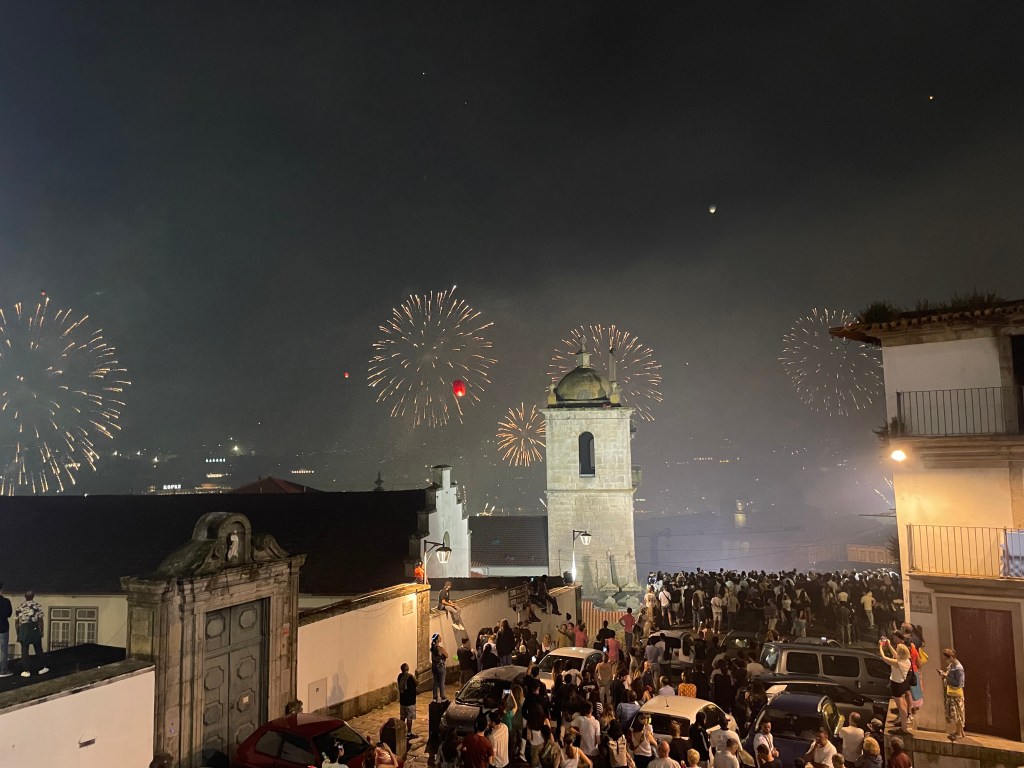
São João Festival fireworks over the Douro in Porto, Portugal. June 2025
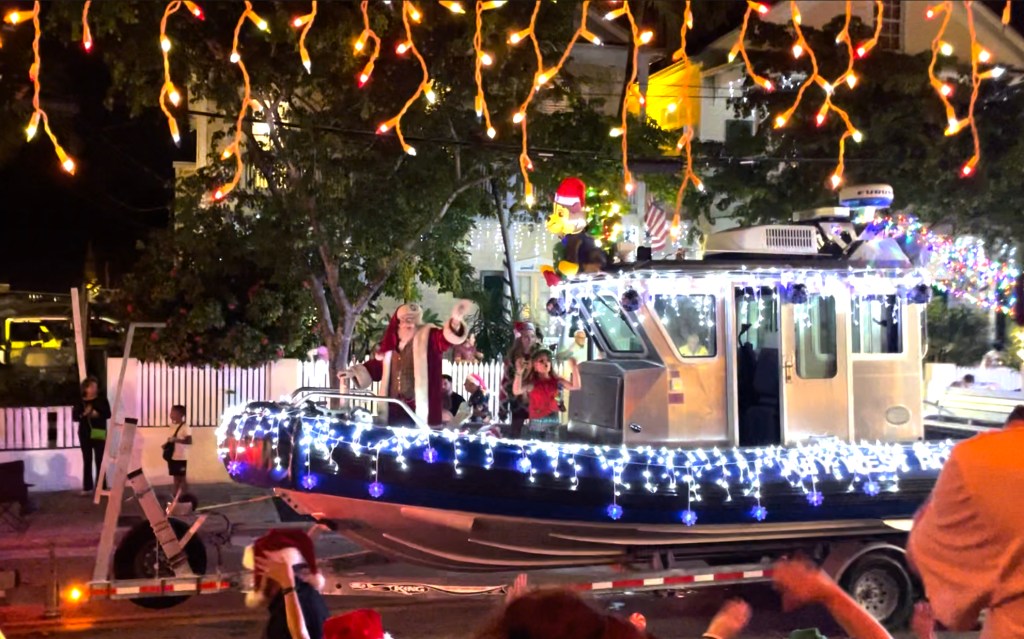
I just returned from a fun girls’ trip to Key West. The reason for the trip was to visit Dry Tortugas National Park. Mission accomplished. Here’s a peek at Key West in December.
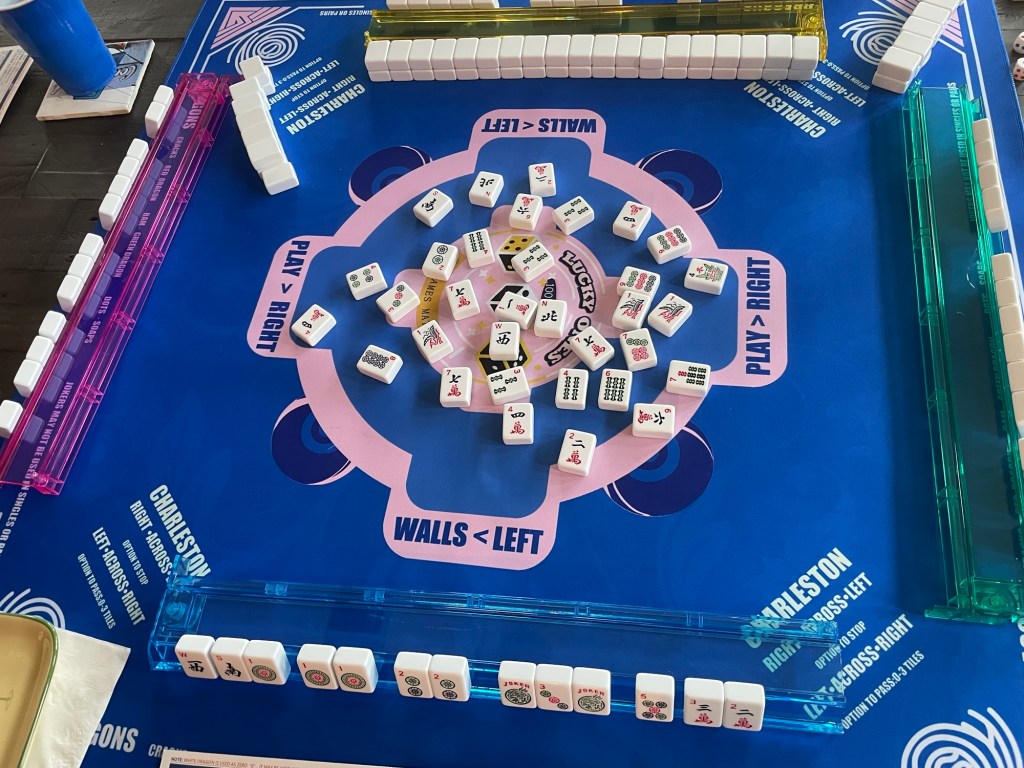
I believe I have entered my mahjong era. Lori bravely started teaching a few of us this game. Very interesting. And challenging to learn. This is not the mahjong tile matching game you may have seen from days of the first desktop computers. It’s more like a complex version of Rummikub on steroids – LOTS of steroids.
We played two games this afternoon. I learned more each time. Very fun. I look forward to more mahjong play. Thanks, Lori!
I love it when Monte wants to experiment with his pizza dough recipe. It’s always excellent, but he always thinks it can be a little bit better. Lucky me.
We took Nirvana out for a sail in Sunday’s beercan. We didn’t win the race, but I won the latest battle in mending the jib. My latest repair held nicely in 20+ knot winds. 👍🏼
I thought I’d share a few takeaways from our trip on the Queen Mary 2 and our 9-day wander through British history.
October is a great month to book on the Queen Mary 2 and walk around southern England. Not too cold. Not too crowded.
Get a starboard cabin if you are on an eastbound transatlantic passage of the QM2, imho. The winds are usually blowing out of the north, so it made for more pleasant balcony experience.
Never leave home without a tiny tube of superglue. 🙂 On day 2 of our trip the earpiece on my eyeglasses broke off. The weld at the metal lens frame just gave way. I was on a boat for 7 days where the only stores sold expensive bags, art, and watches. Fortunately, the QM2 worker in the store who I asked was one of the jewelry designers. She whipped out her toolbox that had some flexible jewelers adhesive. A dab of that got me through the week, when they broke again. I hit the first Tesco on dry land for my own tube of superglue.
It isn’t always raining in England. For us, it only rained on two of our travel days, and one afternoon when we walked around Portsmouth Southsea along the coast. We, and our luggage, are pretty waterproof so it was fine. Ok, I just did the math, turns out it rained one third of the days we were in England. Which, in retrospect, is a lot. Oh well, it was nice to have the beautiful sunny days that we did. I remember them more vividly than the rainy days.
Be flexible.
Check closure schedules ahead of time for the places you plan to visit.
The British National Rail Two Together Railcard paid for itself several times over. A better deal than 2 Senior railcards, if you always travel together. We took the train 6 times.
We couldn’t leave Salisbury without visiting its Cathedral. Salisbury Cathedral construction began in 1220 and was completed in 1258. The pointy bits, the tower and spire, were added by 1330, but 38 years is a very short time to construct a working cathedral!
The western entrance to Salisbury Cathedral.
We took a tour of the Cathedral and saw its copy of the Magna Carta of 1215, one of only four surviving copies.
The Magna Carta was created in 1215 and established core rights for the people to protect them from overreach by the King. Tenets of the Magna Carta exist in British law today, as well as in the US Constitution, such as the idea that no man (or king) is above the law, and rights such as due process and speedy trial by jury.
The document is written on a single piece of sheepskin parchment, in very tiny Latin text. The overall parchment is about 18″ x 24″.
Photos of the Magna Carta were not permitted, but this image of the Magna Carta was available to photograph, so this is what you get 🙂
Salisbury Cathedral is beautiful and built in the Gothic style. It is special in its double transept design. Viewed from above, you’d see two north-south cross bars in the typical cross-shaped layout of a cathedral, instead of one.
View from the north of Salisbury Cathedral. The double transepts can be seen below and to the left of the main tower.
Like other English cathedrals, Salisbury Cathedral experienced some damage during the Reformation and the English Civil War. But, it is said to be not as extensive as what other cathedrals experienced. Likewise, it was spared damage in WWII.
Inside the nave of Salisbury CathedralThe Trinity Chapel on the east end of the Salisbury Cathedral – the oldest portion of the Cathedral.A view looking west from the Choir in Salisbury Chapel
The Cathedral has a beautifully designed modern baptismal font, the design of which is echoed in several altars throughout.
A view looking east with the nave reflected in the baptismal font.A view looking west with a reflection of the nave in the glass top of the main altar.The ceiling of the Charter House, where the Magna Carta resides.
On our way out, we strolled through the Cloisters of the Cathedral as the sun began to set.
After thoroughly exploring two cathedrals in two days, we were glad to head back to the hotel for our last night in Salisbury.
We took one last walk through the market square and found a lovely wine bar with nibblies for dinner.
After Portsmouth, we will stay in Salisbury for a couple of nights. But we decided to make another attempt to see the inside of Winchester Cathedral. So we boarded the train to Winchester again. This time, the Cathedral was open and glorious.
The west entrance of Winchester Cathedral
Inside the Cathedral, we were able to view the 12th-century Winchester Bible. We also took a guided tour and soaked up the history of the place. The Cathedral’s construction began under William the Conqueror in 1079 and was completed in 1532. During that period, architectural techniques evolved. The Cathedral’s construction began with Norman features (rounded arches, thick walls) on the central tower and transepts, later adopting Gothic features (pointed arches and flying buttresses) in its wide open nave.
The view from the south transept looking north shows the Cathedral’s Norman architecture.Looking east from the Cathedral’s west entrance down the massive Gothic nave.
Jane Austen is buried here, though the tribute on her gravestone omits any mention of her literary achievements.
The Cathedral was not damaged during World War II. But it experienced destruction from the British themselves during the English Reformation in the 1500s, when Henry VIII broke with the Roman Catholic Church and created the Church of England. The patron saint of Winchester Cathedral was St. Swithen. During the Reformation, a shrine to St. Swithin in the Cathedral that had become a destination for many religious pilgrims was destroyed and removed. The “Holy Hole” still remains, marking the entrance to his former shrine. I think it would be a great place for a geocache. 😮
The “holy hole” in the wall through which Pilgrims could access the bones of St Swithen.
And more destruction followed in the mid-1600s, after the Parliamentarians defeated the Royalists in the English Civil War. Not only did they execute King Charles I, but they also trashed most religious icons in churches across the country. In Winchester Cathedral, they broke statues and mortuary chests, smashed just about all the stained glass, and used the Cathedral as a stable for the army’s horses. A few years later, Charles II took his father’s throne, restoring the monarchy and a bit of order. In 1660, the current wall of stained glass at the Cathedral’s west entrance was constructed using shards of the broken, original stained glass windows.
The current west window, built using glass shards from windows broken during the English Civil War.
That’s the end of the history lesson, and enough of all the death and destruction, already!
Oh, one other thing I found interesting…. At the beginning of the 20th century, the southern and eastern walls of the Cathedral were found to be sinking under their own weight. This was due to the high water table in the area and being built on peat. Since the water table couldn’t be lowered, someone would have to do the work underwater. A Navy diver named William Walker came to the rescue. From 1906 to 1911, he single-handedly dove down in water up to 20′ deep, to shore up the foundations with bags of cement, concrete blocks, and bricks. He’s remembered as “The diver who with his own hands saved Winchester Cathedral.”
At the end of the tour, we went down into the Crypt under the Cathedral floor. Unlike most other churches, this crypt is virtually empty, due to nearly constant flooding. In the 1980’s a sculpture by Anthony Gormley was installed. The statue is, more often than not, standing in water.
Ok, that is all for Winchester. Since we are bound for Salisbury by nightfall, we headed back to the train station and got back on board. More to follow on our visit to Salisbury.
Portsmouth Harbour lies on the northeast shore of The Solent, on the southern coast of England. We actually sailed by it before dawn as the Queen Mary 2 navigated up into Southampton. It is an important port, naval base, and home to many historic Royal Navy ships – which is the reason for our visit. I’ll share some of our highlights.
The gate to the DockyardThe signal flags on the Portsmouth Historic Dockyard sign spell out D-I-S-C-O-V-E-R. And so we did!
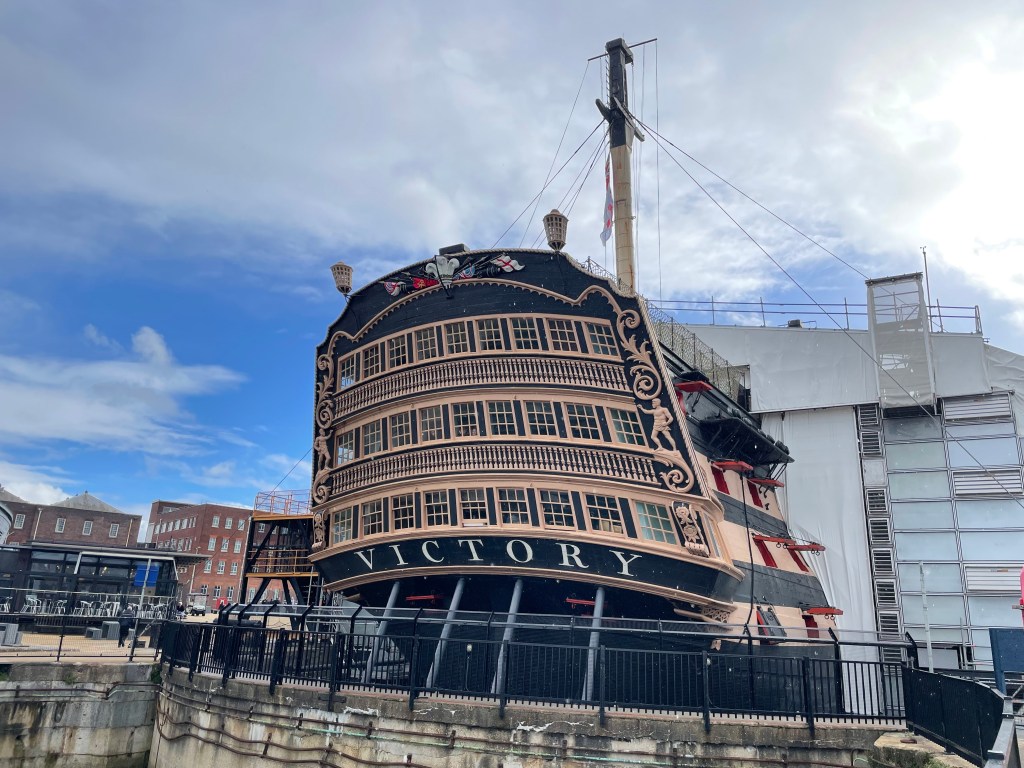
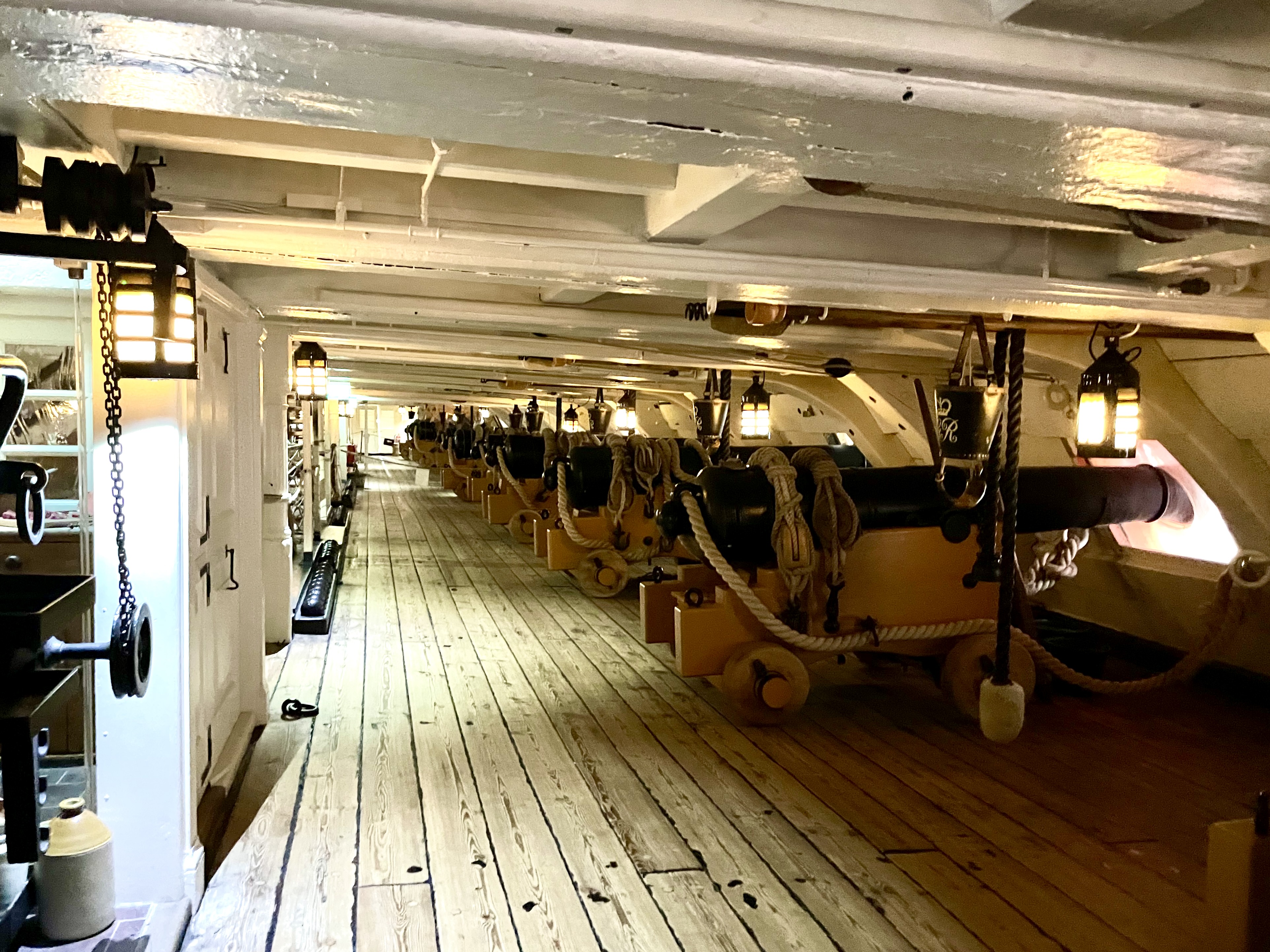
Monte has read novels about real British maritime battles and victories, and so is familiar with the history here. Me, not so much. But after our visits to the fantastic exhibits in the Portsmouth Historic Dockyard, I am now up to date on quite a few details. 🙂 The HMS Victory is probably one of the most well-known ships, and it is in Portsmouth in a drydock at the Historic Dockyard.
The view of the stern of the HMS Victory
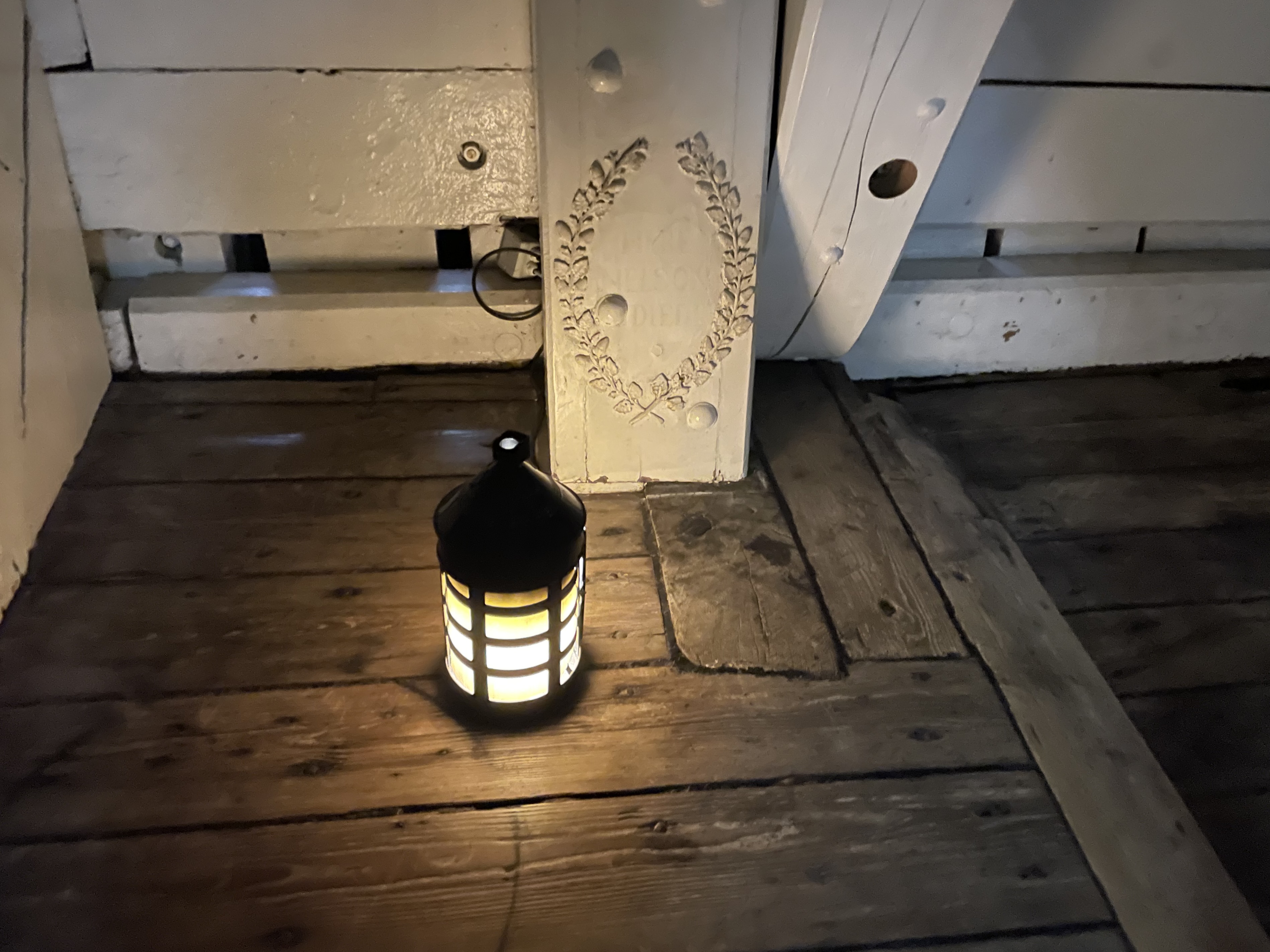
The HMS Victory was launched in 1765, and was the flagship for Admiral Horatio Nelson in the Battle of Trafalgar in October 1805 (when it was already 40 years old!) Trafalgar was the location of the British Navy’s greatest victory. The British fleet decisively defeated the combined fleets of Spain and France in the waters off of Cape Trafalgar, on the southwest coast of Spain. The Battle of Trafalgar was significant not just because it was a victory, but because Admiral Nelson was shot in that battle, died on the ship, and was transported back to England after the battle for a hero’s burial. He was, and still is, England’s most beloved sailor.
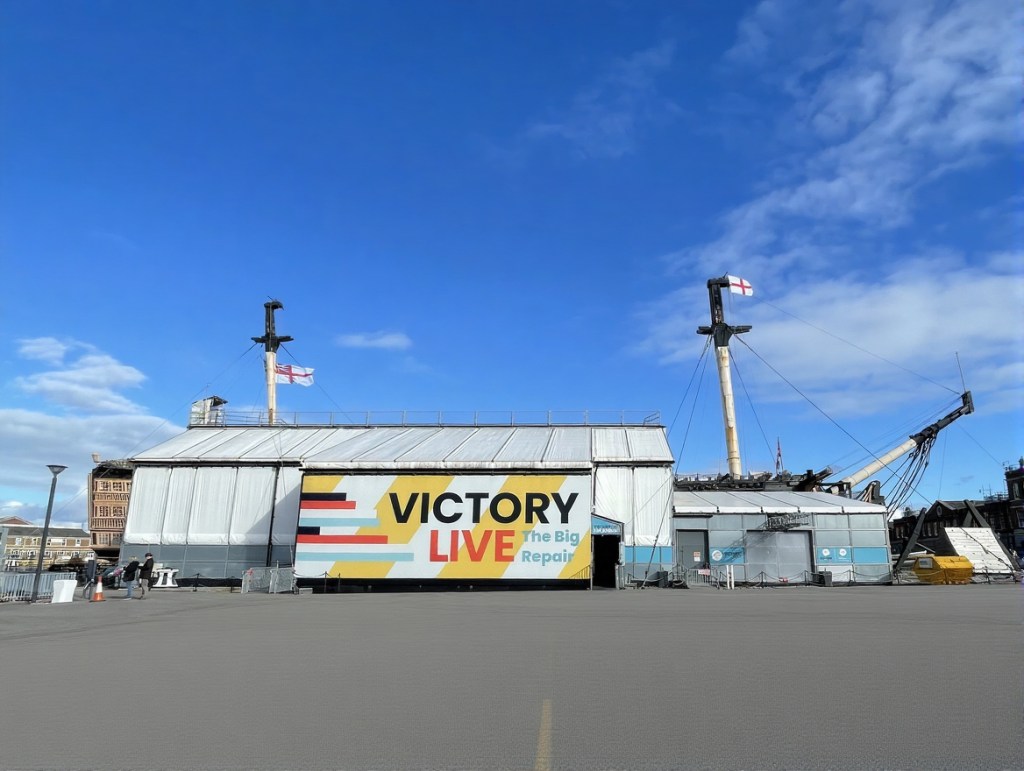
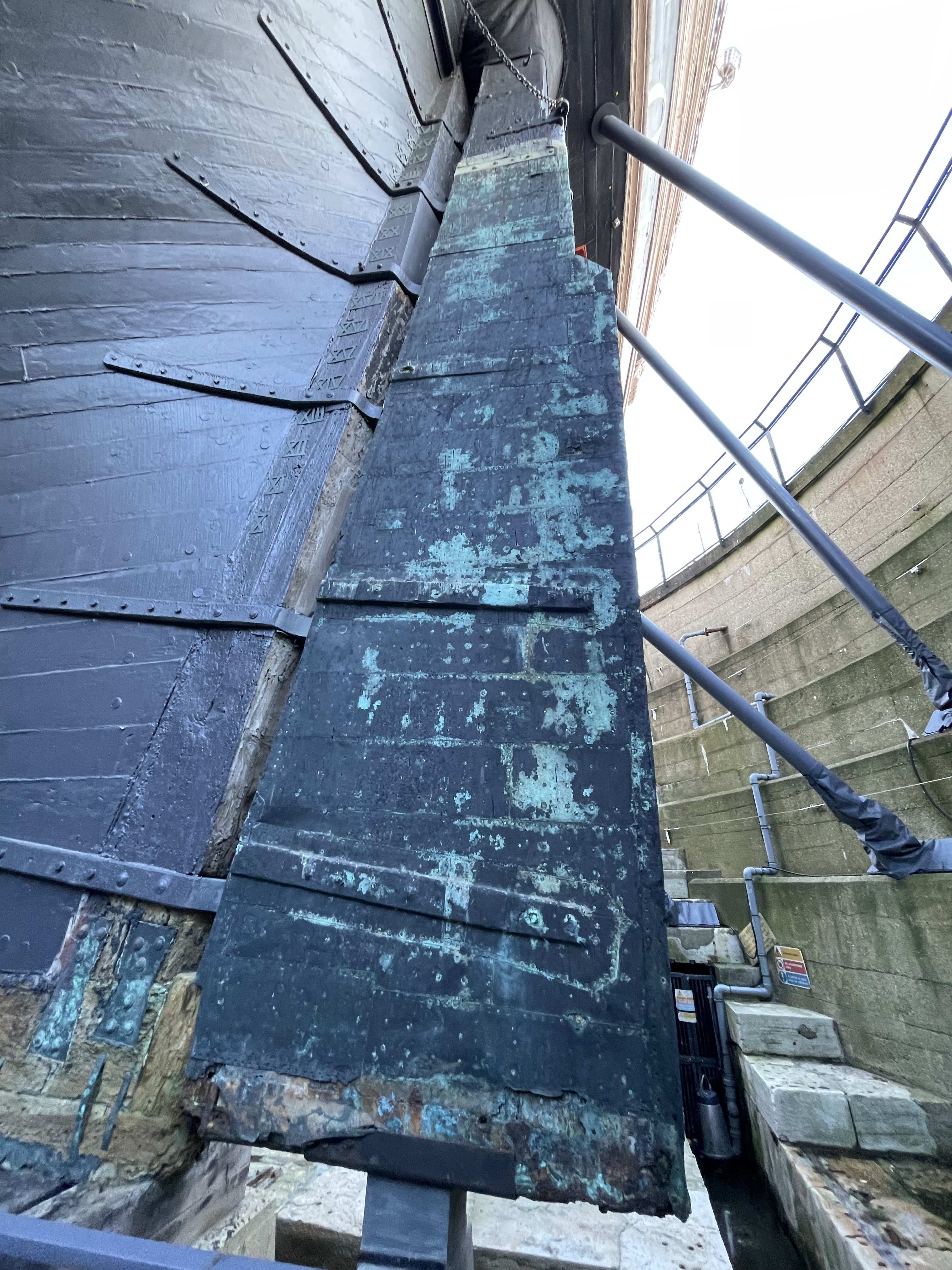
The Victory is midway through a 20 year restoration. The repair work is actually one of the exhibits – Victory Live. It doesn’t hinder seeing and touring the rest of the Victory as the work proceeds.
Most of the HMS Victory is under a tent, and the mast tops have been removed, but that didn’t detract from being able to explore the ship.
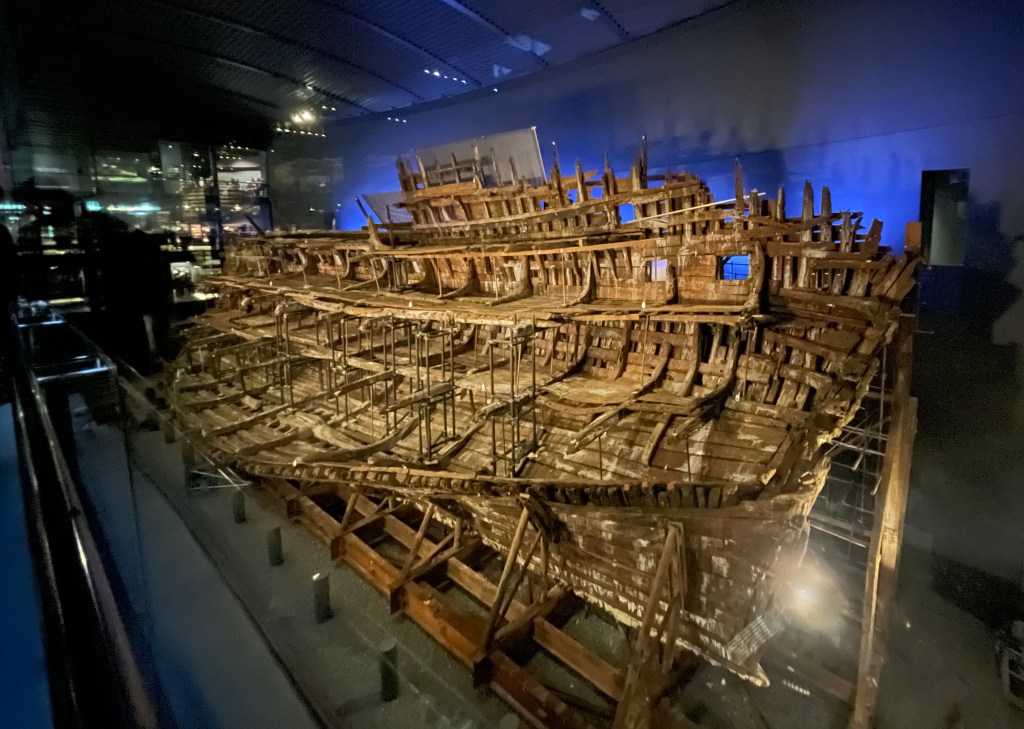
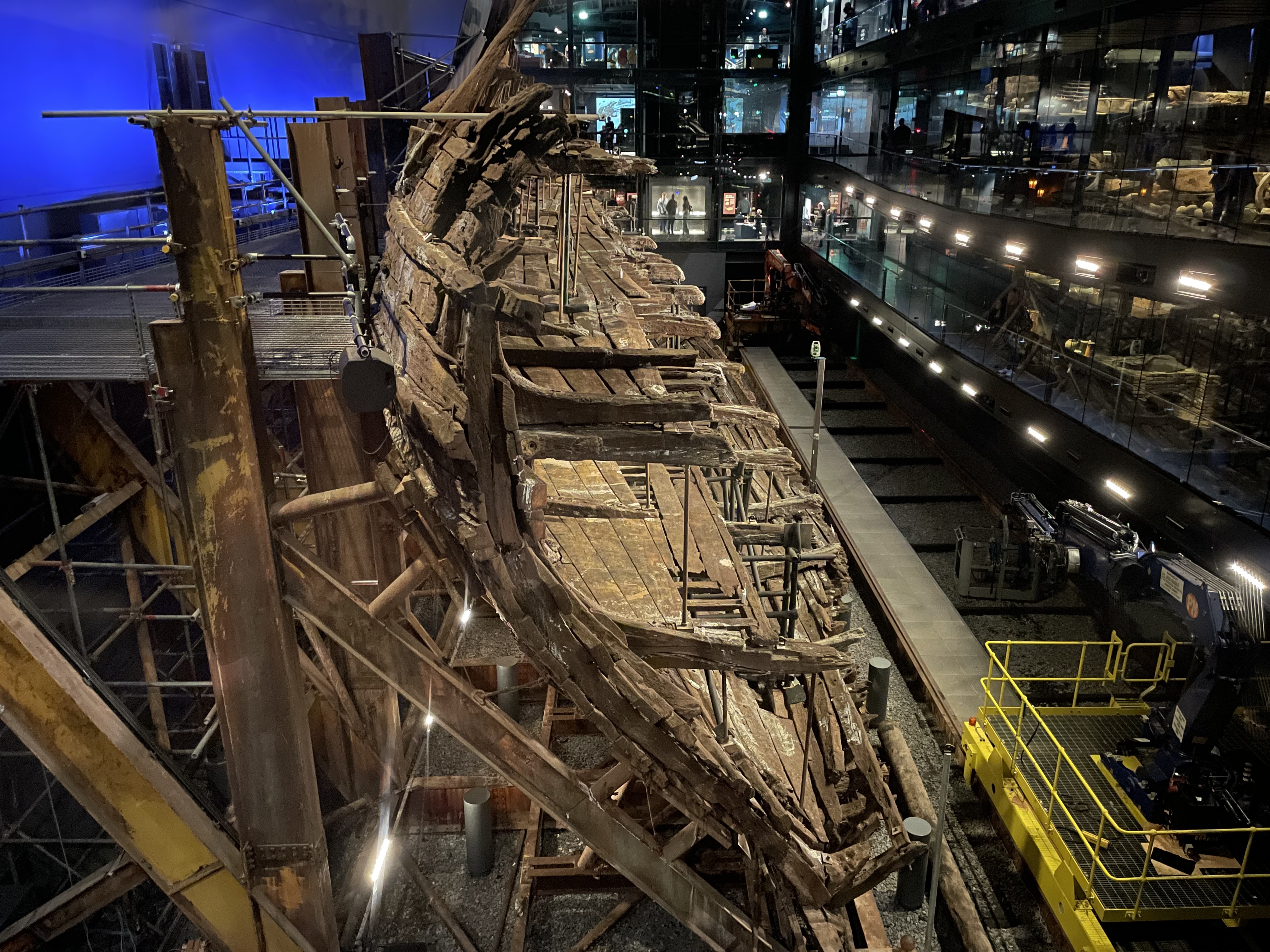
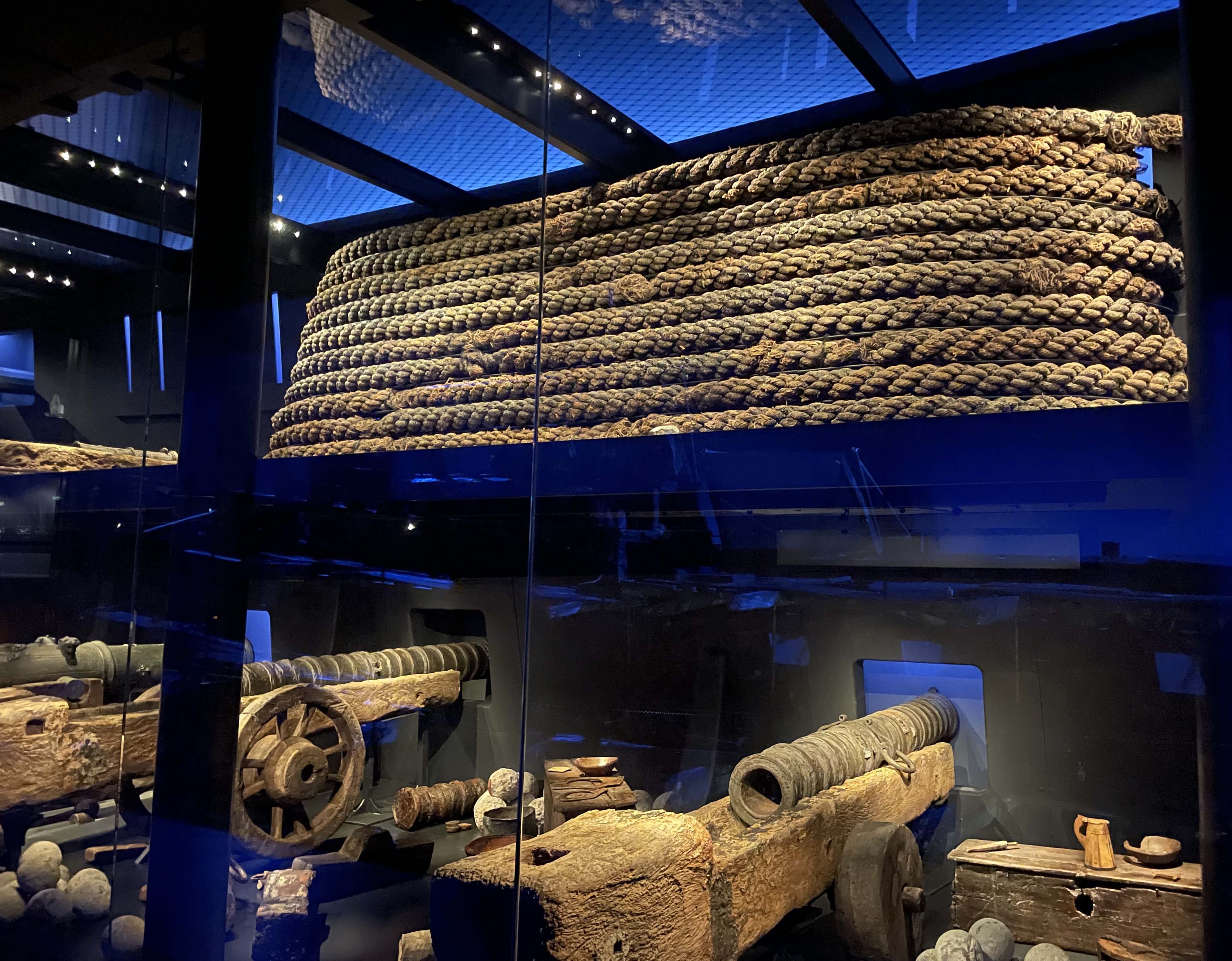
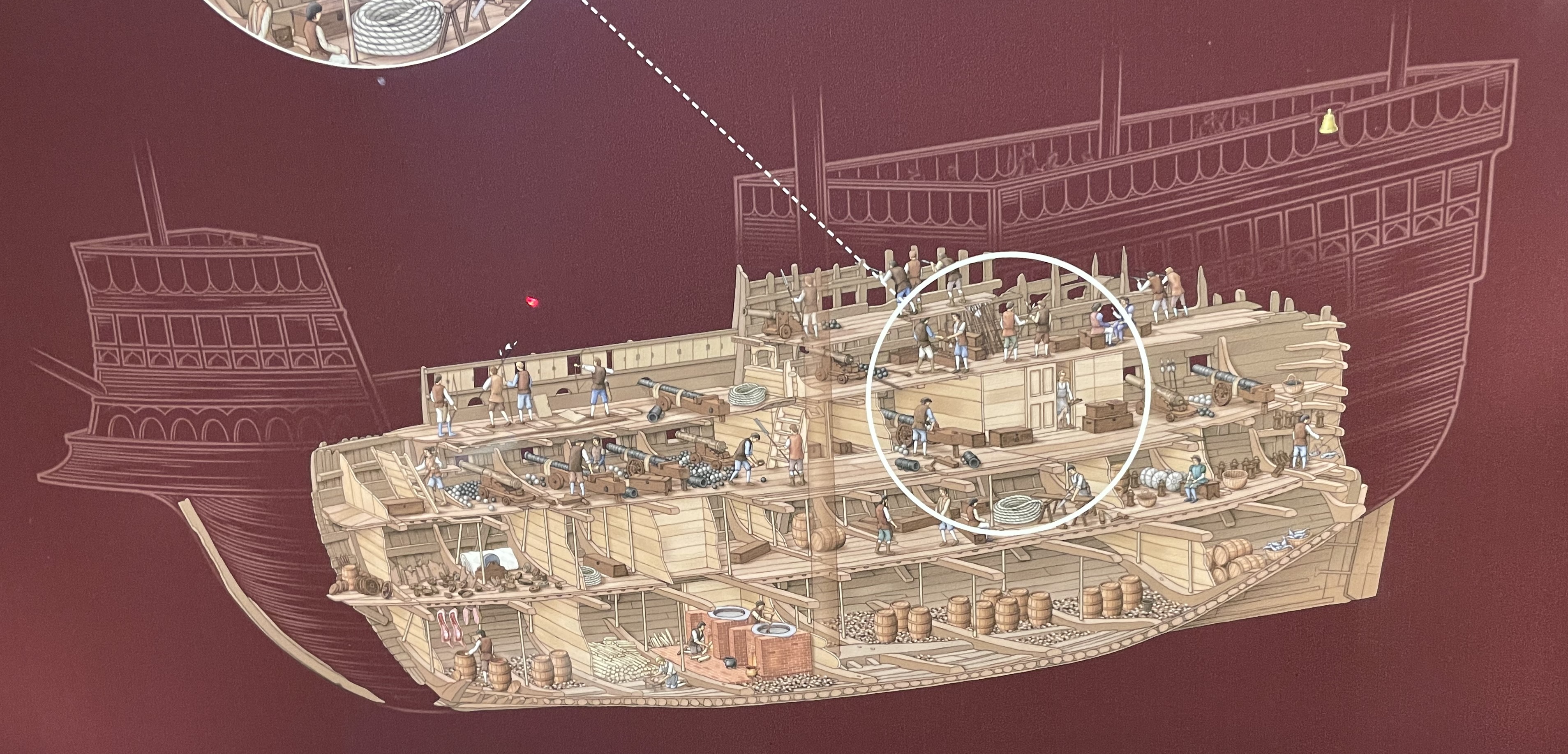
Another fascinating exhibit was of the Mary Rose, commissioned by King Henry VIII in 1510 as a flagship. It sank in 1545 during the Battle of the Solent by the French, just a mile offshore of Portsmouth, in 40 feet of water. It sat on the seabed, half buried in silt until it was discovered and eventually raised in 1982.
The exhibit does a great job of showing just how much of the ship is still intact, and an astounding amount of items that survive.
The HMS Warrier is a battleship built for Queen Victoria’s Navy, launched in 1860. We toured her as well.
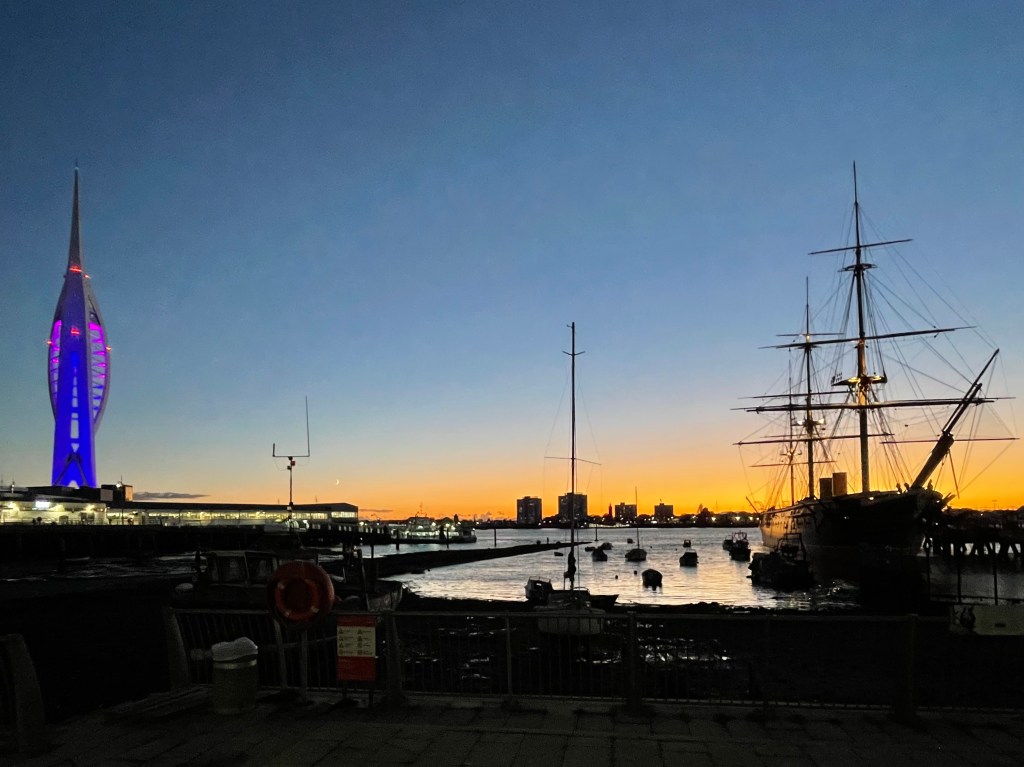
Sunset over Portsmouth Harbour – HMS Warrior on the right, Spinnaker Tower on the left.
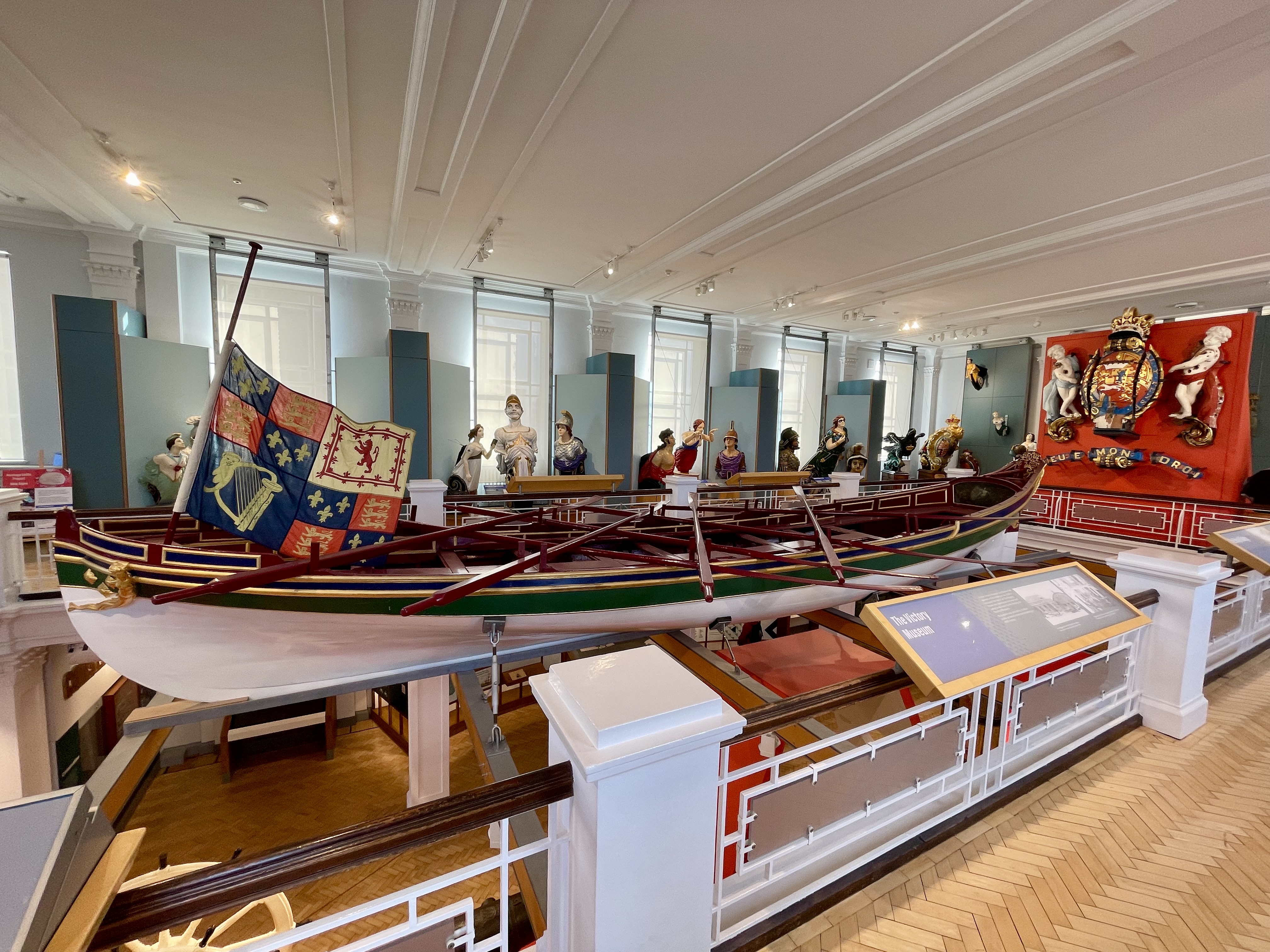
We spent two whole days exploring all the things to see at the Dockyard. We took a harbor tour, water taxi over to Gosport to tour a WWI submarine (Holland 1) and a WWII submarine (HMS Alliance), toured Boathouse 4, a working shop that restores small craft. We walked through the multiple other museums that are there. The weekend we were there it was “half-term” for the school kids, so the dockyard was teeming with British families as well.
We took a city bus down to see Southsea, and Henry the VIII’s castle there, from which he watched the sinking of the Mary Rose. There is also a D-Day Museum there, but we arrived after closing time.
By the time we checked out of our hotel and hopped a train to our next destination, I felt we had spent just the right amount of time in Portsmouth to soak up all the history there.
Links for the curious:
Portsmouth Historic Dockyard visitor info and tickets. They have so much to experience there. The Ultimate Explorer pass includes entry to 13 attractions. We visited 11 of them, and it was well worth it for us.
Where to stay? There are lots of choices nearby. We stayed at the Ship Leopard, which was a great location. Our room overlooked the harbor and had a view of Spinnaker Tower and the HMS Warrior. It is across the street from the Portsmouth Harbour Rail station, and the Isle of Wight Ferries, a block away from Gunwarf Quays, and a block away from the Historic Dockyard gate.
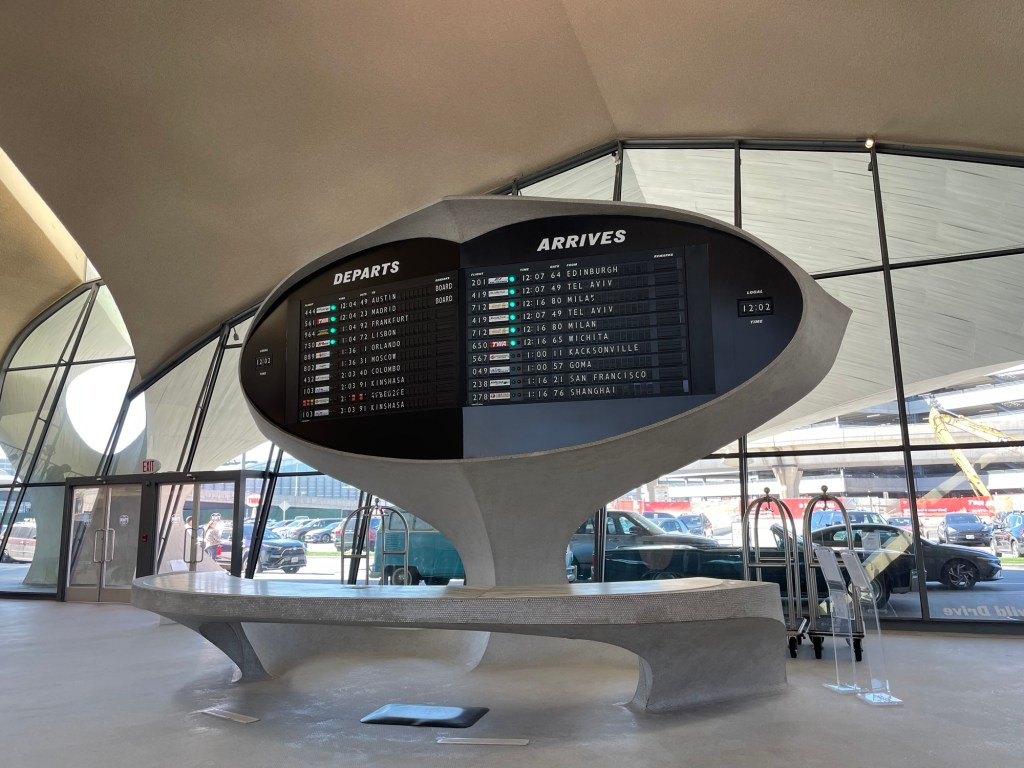
Forty-six years ago, in a galaxy that seems oh so far away, I took my first airplane trip. I remember sitting for hours in the terminal at JFK waiting on our connecting flight. The big board continually clicked and flipped to show flight status and gate updates.
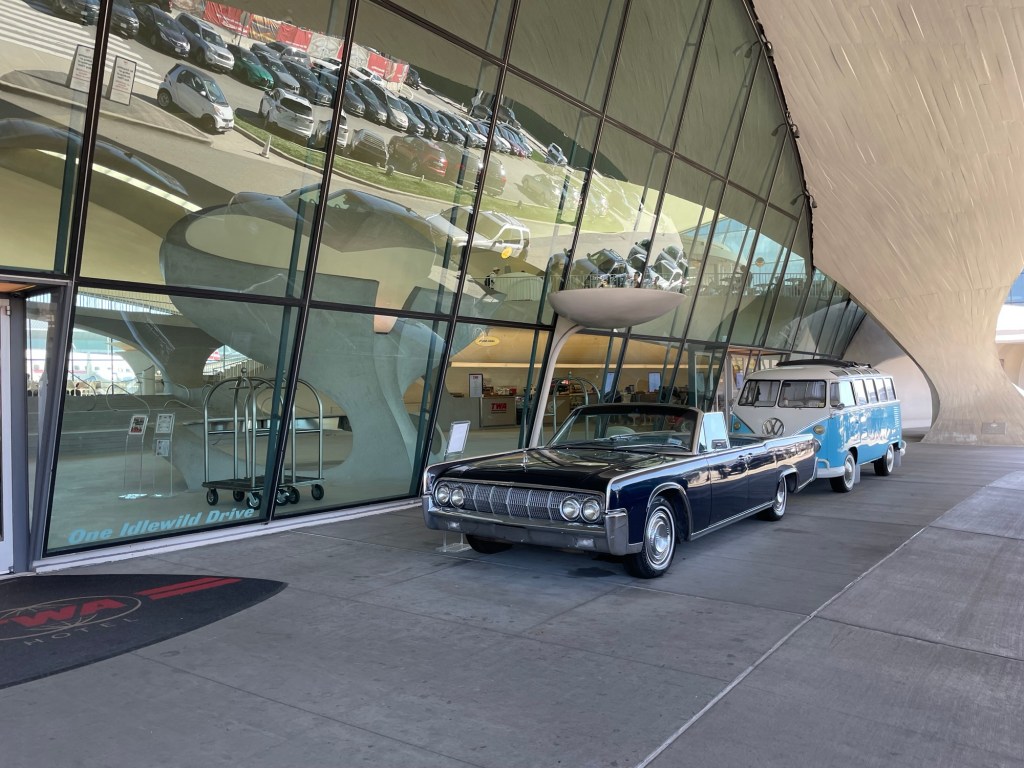
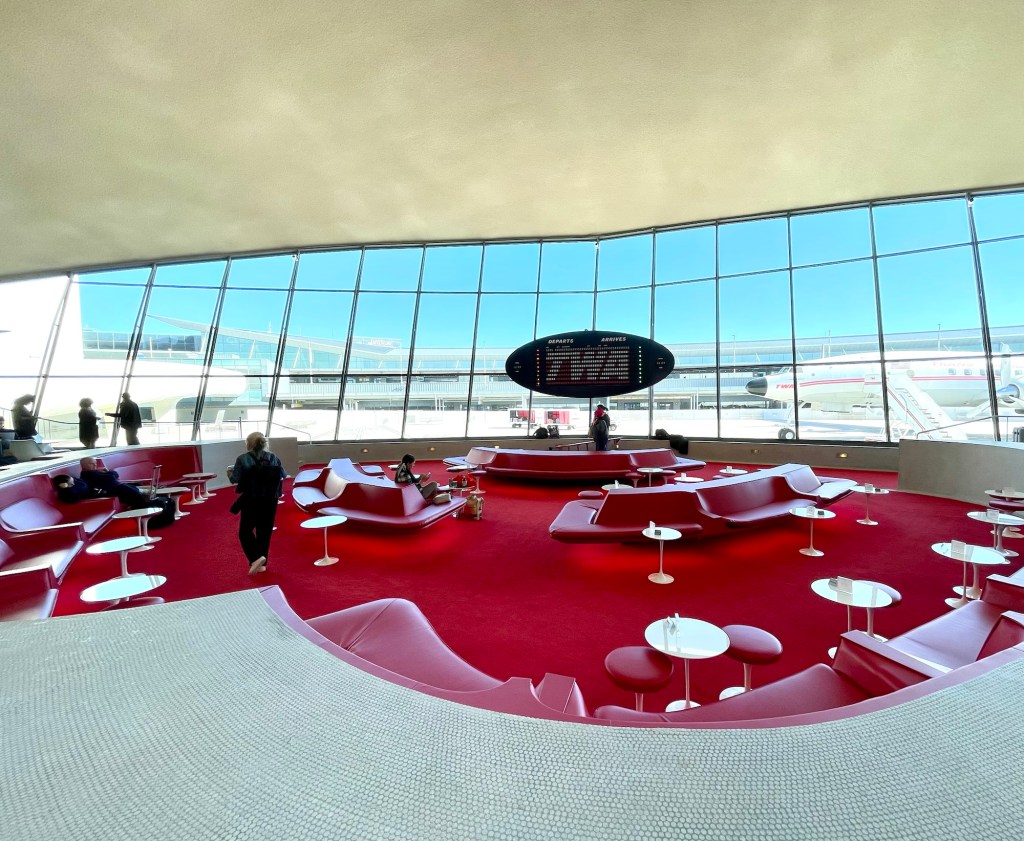
I heard that that old terminal has been preserved and turned into a hotel next to Terminal 5 at JFK.
Today Monte and I flew into Terminal 8 at JFK, and I just had to find this time capsule before we left the airport.
The flight to Madrid is boarding!
It was fun to see those old memories come back to life.












 Sheila365