
We took Nirvana out for a sail in Sunday’s beercan. We didn’t win the race, but I won the latest battle in mending the jib. My latest repair held nicely in 20+ knot winds. 👍🏼

We took Nirvana out for a sail in Sunday’s beercan. We didn’t win the race, but I won the latest battle in mending the jib. My latest repair held nicely in 20+ knot winds. 👍🏼
Up on the hill, behind the Queen’s house, is a large green space called Greenwich Park. I could have spent hours just walking around this park. It’s lovely. At the top of the hill sits the Royal Observatory, commissioned by King Charles II in 1675. This morning, we headed up the hill to see it.
Ok, first, some historical context. You’re a sailor in the late 1600s. Your ship navigates close to shore by piloting using well-documented coastal landmarks, bearings, and charts. When out of sight of land, your ship navigates using dead reckoning, which uses your last known position and your speed and heading to estimate your current position, but that is fraught with potential for error. Better, you can calculate your latitude (your north/south location on the globe) by measuring the angle of the sun at solar noon at your location using a quadrant and declination tables. But accurately determining your east/west position at sea, your longitude, was not yet an easy thing to do. On dry land, one could measure the transit of moons across the face of Jupiter and use celestial tables to calculate longitude. But it’s not easy to do on a boat moving on the sea.
The Royal Observatory was established in 1675 with the express charter to “find out the so much desired Longitude of Places for perfecting the art of navigation.” Work began at the Flamsteed House, by the first Astronomer Royal and his successors, to accurately map the celestial bodies. This culminated in the publication of the first Nautical Almanac in 1767. This aided in estimating longitude based on celestial observations, but still difficult to do at sea.
A second, more desirable method to determine longitude would be based on timekeeping. The Earth is divided into 360 degrees of longitude. The Earth turns 360 degrees in a 24-hour day. 360 degrees / 24 hours = 15 degrees of longitude per elapsed hour. The British Navy arbitrarily established Greenwich as its 0 degrees longitude, for the purposes of maritime navigation and charting. If you know the time at Greenwich when you observe local solar noon where you are, you can calculate your longitude. For example, if it is solar noon where you are (12:00pm), and you know that it is also 2:00pm in Greenwich, you can calculate your longitude as 2 hours x 15 degrees per hour, or 30 degrees earlier than (or west of) Greenwich. In the 17th century, though, to know the time in Greenwich required a timepiece that you set to Greenwich time when you left England, and which kept time accurately while at sea months later. In 1675, such a clock did not exist. That was the longitude problem.
In 1714, the British Parliament introduced the Parliament Act, which put up a prize of 20,000 pounds (about $2M today) to whoever could create a timepiece that met specific criteria of accuracy at sea.
In 1730, a woodworker named John Harrison attempted to build a timepiece to meet the criteria of the challenge. It took him 5 years and required learning the principles of metallurgy, but he did it. His first prototype was called “H1.”

Time trials proved it worked. However, he was paid only 500 pounds of the 20,000-pound prize. Harrison thought he could improve upon it, so he created three more prototypes over the next 25 years.


After H3, he changed his design altogether, from a clock to a watch. The result was H4.

Time trials on the H4 proved its accuracy, and work began on making additional copies, to prove how replicable the design was. Only after entreaties to the king was John Harrison eventually paid the full 20,000-pound prize, when he was in his eighties.
It’s all history now, but the next time you pull out a GPS to find your lat/long position on your boat, think about the work of John Harrison.
So, let’s discuss time a little bit more. By the 1800s, Britain’s nautical charts, which all used Greenwich as the 0 degree meridian, were becoming the global norm, though there were numerous other meridians used by other countries. In 1884, there was a global conference to declare what would become the Prime Meridian going forward. At the end, Greenwich’s meridian was declared as the Prime Meridian, to be used not only for navigation, but to establish a global basis (Greenwich Mean Time) for the 24 global time zones going forward. The location of the Prime Meridian is marked at the Royal Observatory by a metal line that intersects the observatory where the equatorial telescope sat that was used to create all the celestial tables, and proceeds out through the courtyard, and across the globe.

Greenwich Mean Time impacted everyday life beyond navigation at sea. After the Meridian Conference of 1884, the Prime Meridian at Greenwich was used as a global zero degrees longitude for navigation. Prior to that, individual towns maintained their own local times based on local solar noon, with some amount of error, obviously. But the trains must run on time! By 1847, the expanding railways had adopted GMT as their standard for timekeeping as well. By 1855, most public clocks were using GMT as well. To facilitate this, the Royal Observatory established a clock that kept official GMT time, and which emitted electrical impulses that went out on wires, to sync clocks across the country.

A red Time Ball was added to the top of the Royal Observatory that would raise to the top of a mast at 12:55pm each day, and fall at 1:00 pm GMT. It was observed by ships in the Thames below to synchronize their timepieces on board before setting out to sea – so they could reliably calculate their longitude on their journey.

Pretty damn cool.
I have often thought out loud that I have lived during one of the most exciting times – with the evolution of technology, computing, and the internet, and whatever else is happening these days. But as I think about the history I’ve absorbed over the last week, there has been no shortage of innovation across the centuries brought to life by meticulous and hard-working people that just wanted to solve the problem at hand.
By the end of a full day, the clouds were gathering again with rain, so we headed back down the hill to our hotel.

Links for the curious:
Royal Observatory Greenwich website, to plan your visit.
About 10 years ago I read a book by Dava Sobel, called “Longitude.” It tells the story of John Harrison and his quest to solve the longitude problem. Check it out if you’re interested in more information. I enjoy her books, which I would classify as scientific non-fiction (?). She delves into historical figures and science topics. “Galileo’s Daughter” was the first of her books that I read, and I try to read the rest of them as I find them.
I finally got a couple of days to work on our jib. The sailcloth is in good shape for the most part. Except for the section along the leech that gets beat against the shrouds every tack, and pressed tight against the spreaders when close hauled. It has torn in several places.
After a discussion with the sailmaker at Sailrite I decided to go for a repair that replaced the first 30” or so on the leech end of 3 panels of the sail. Also patched the beat up sunbrella sun cover and made new spreader patches. And replaced a few well worn webbing strips at the head and clew as well.

It took me about 2 full days of my slow but steady mode of work. Also using PTFE thread in my LSZ-1 is a huge pain in the aft, but it’s a necessity for the UV-exposed stitching.

But it’s done and I like how it came out. And I have my living room back. Fingers crossed that it does the trick 🤞🏼
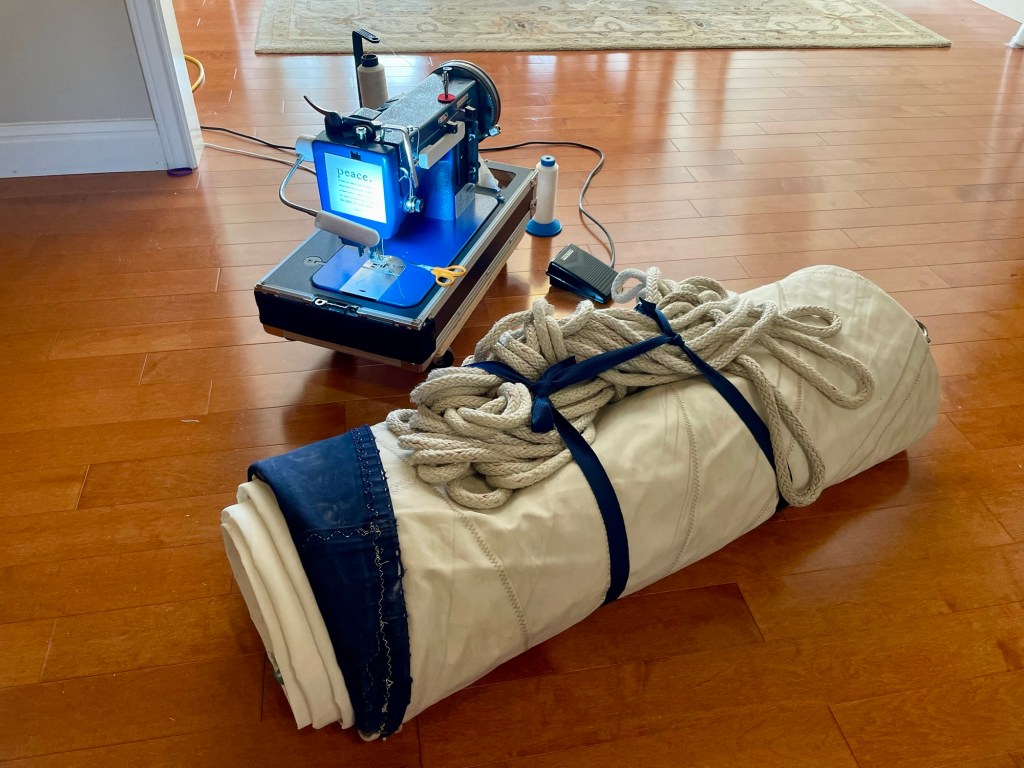
While I was doing this project, Monte was rebuilding and installing our autopilot wheel drive unit. ✅ and ✅
Happy Anniversary to us!

While visiting Washington State a few weeks back, I took a photo of a beautiful wooden carving that was unceremoniously displayed in the corner of a building at the top of some stairs. Today I uploaded it and played around with it a little bit. I love the result. I think I’ll make some notecards with this image. 🙂
Have a great Friday!

And the original:

We loaded up Porter Belle on the trailer yesterday to help John with the dock at his lake house. When the rain came over the July 4th weekend his cove went from high and dry to full in about 24 hours.

His formerly dry dock floated just fine. But its ramp/walkway sank. It’s still attached but hanging straight down. Its flotation block must have broken away in the storms. All the professional dock wranglers are still booked up so we spent the day giving it a shot ourselves.

At the end of the day, we were not successful. But it was fun to row up and down the cove a dozen or so times. And to problem solve different ways to try to raise the walkway. None of them worked. But the best part was that when we packed everything up, the giant flotation block miraculously floated by! We snagged it for when the professionals eventually make it out. There’s a reason they call them professionals 🙂
There are many ways to spend a good day at the lake. This was just one of them.
Happy New Year! I know. I’ve been MIA. Sorry about that. But, I’m still here!
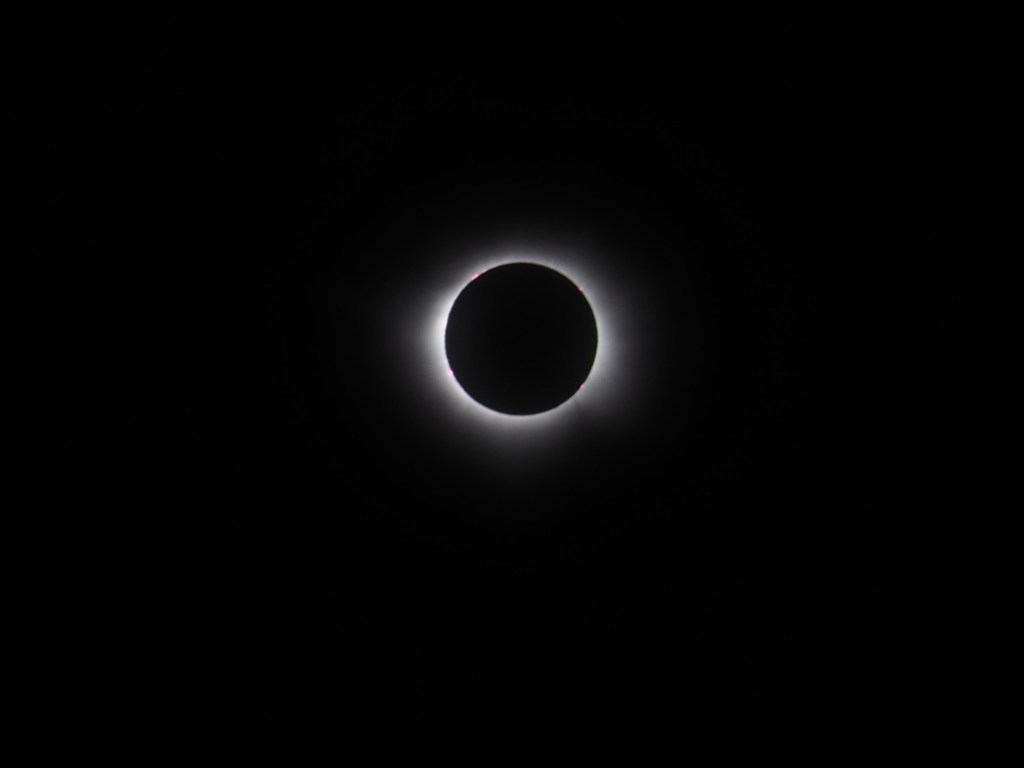
Noreen and David joined us in Austin for the last week or so. They flew down to see the total solar eclipse. Our house and much of Central Texas were in the zone of totality. We wanted to maximize our amount of time in totality. So, Monte picked Lampasas, Texas as our destination, about an hour drive northwest of our house. The forecast was not great for Austin or Lampasas, but we took our chances, and it turned out great.
Lampasas experienced over 4 1/2 minutes of totality, and it was awesome. The clouds cooperated and, like in 2017, the predicted Armageddon didn’t happen. We didn’t hit traffic or crowds.
One thing that was particularly cool, and that I really don’t recall it being as striking during the last eclipse as it was this year, was how upon reaching totality, it was like the lights just turned off. I don’t remember it being that sudden or that dark in 2017.
I guess I’ll have to travel somewhere if I’m going to see another. There’s one in August 2026 in Spain, maybe I’ll make that one!
I wonder how Captain Kirk dealt with software updates on the Starship Enterprise. We experienced our first automatic “over-the-air” software update in the Subaru last week. It was not something we could opt out of. It was going to auto install if we deferred it more than twice. So it did. It said it completed successfully.

HOWEVER, after a couple days, the computer touch screen went into an endless reboot cycle every time we drove the car. And that’s a tad disconcerting in this day of smart cars.
So we took it into the dealer who said we didn’t have the most current level of software. So, they installed it.

I guess we’ll see if this one will work. New 1st World problems…
As Monte likes to say, every time we go to the boat to cross something off the todo list, we add 2 more things to the list.
On Monday we went to the marina to install 3 new halyards and new jib sheets on Nirvana. When we lowered the jib to change the halyard, I found a 2’ long tear along the edge of the sunbrella cover. So we rolled it up and brought it home.
No more over-sheeting the jib against the spreaders, please. It’s not the America’s Cup…


Yesterday I laid it out and mended it; should be good for a while. I ripped off the sunbrella cover, sandwiched the tear between 2 layers of new adhesive-backed 6 oz dacron, sewed it down several times, and then sewed the sunbrella back down.
One step forward…
A month ago, the Universe reached out to remind me that “things are just things.” I was rear-ended in our brand new Subaru Outback (sniffle). The other guy was very remorseful; and uninsured.
Anywho… repairs are now complete, and the Subie is fixed and back home.
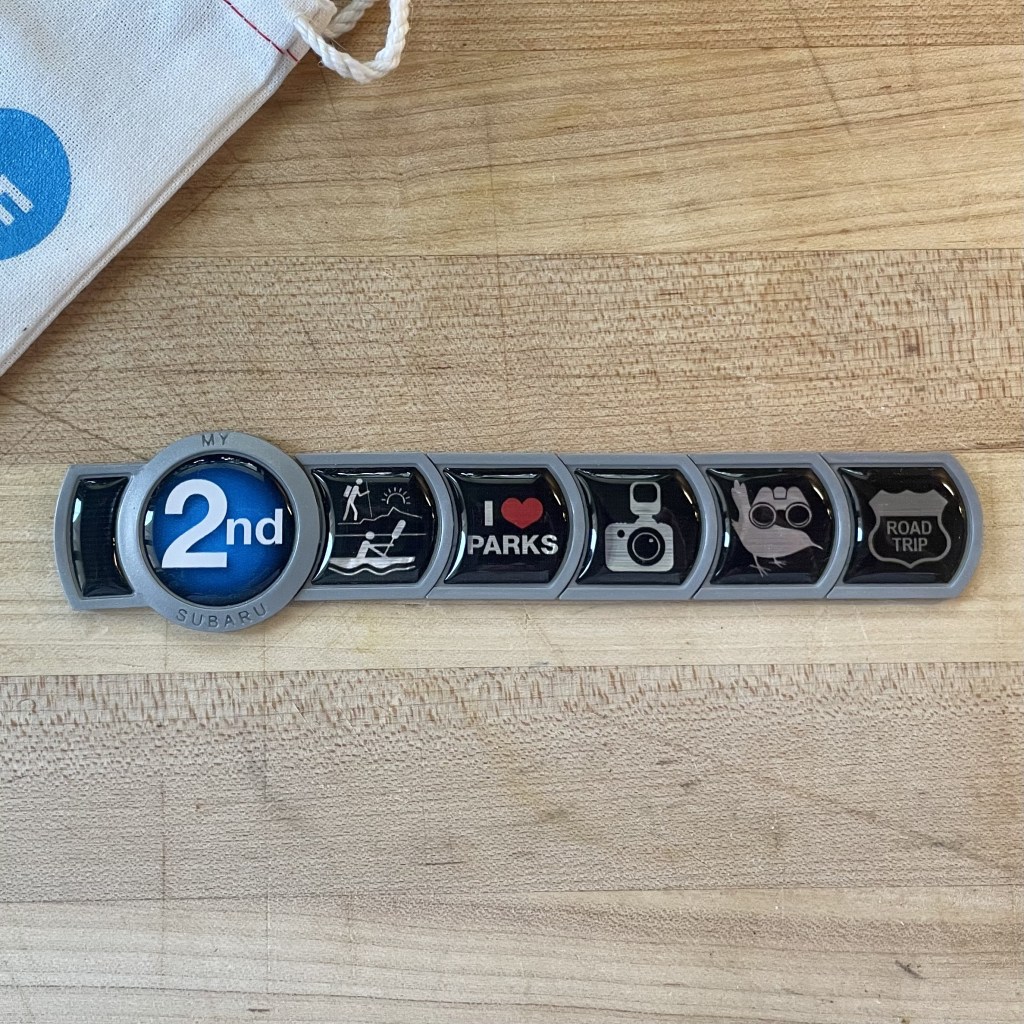
Our Subaru “badge of ownership” also arrived. I’m ready to enjoy many miles and roadtrips.
Many years ago I was gifted a small book called “Who Moved My Cheese,” by Dr Spencer Johnson. It’s a quick read, and I recommend it. It delivers the message that change happens, and when it does, it’s not the end of the world, just keep looking for new cheese.
I’ve recently received impersonal emails regarding changes for two different apps that have become a mainstay for me – my podcaster app, Stitcher, and the My Photo Stream integration which made it easy to wirelessly sync photos between the Photos app on my Macbook and my iPhone. I use both of these capabilities daily.
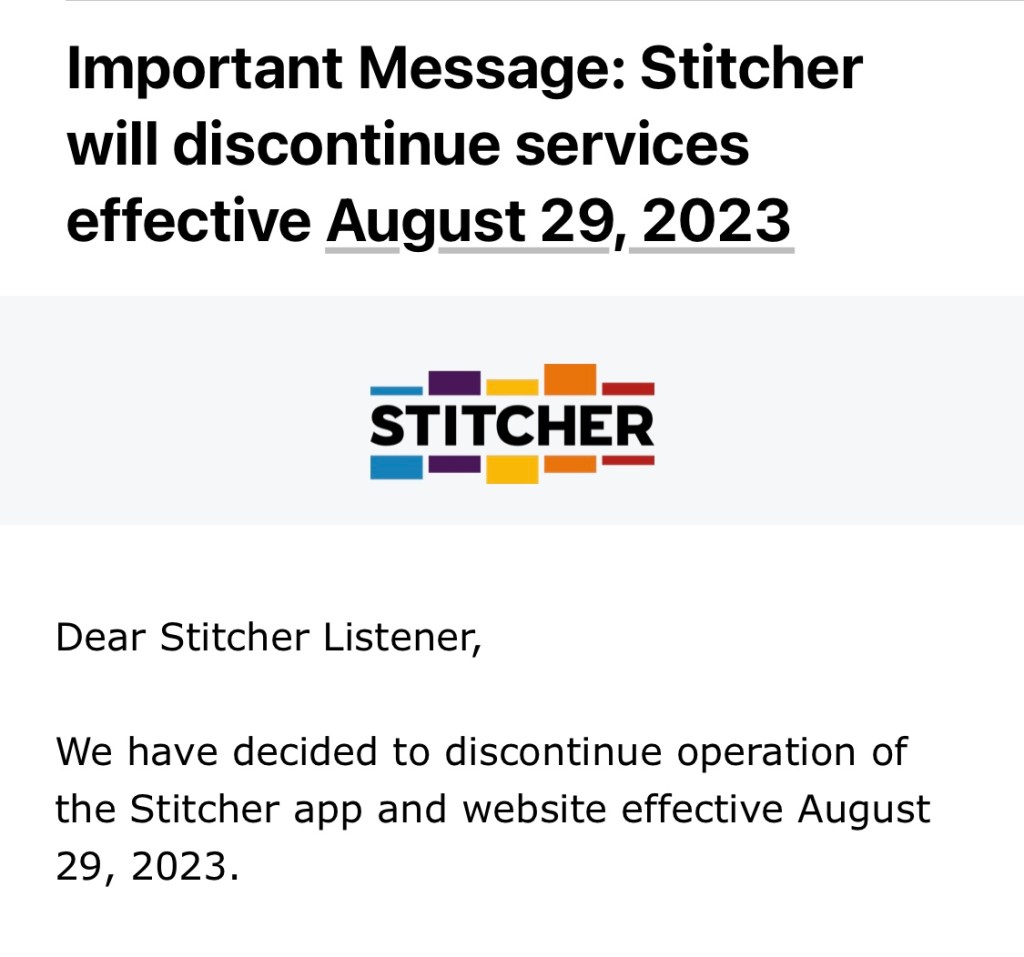
The free Stitcher app is going away at the end of August, to become a monetized asset for its owner SiriusXM. I think I’ve found a replacement piece of free cheese for Stitcher. My Photo Stream is going away at the end of July. I’m still working on finding a new kind of cheese for that, as I’m not fond of using iCloud.
Regarding Stitcher, I found a nice article by PCMag on the top podcast player apps in 2023 and gave it a quick read. I picked one of them to try and installed it today, the Pocket Casts app. It was easy to export the set of podcasts I currently subscribe to on Stitcher in OPML format, and import it to Pocket Casts. My initial impression is thumbs up. It’s free, and it has most of the features I have become accustomed to. If you’re on Android, read the PCMag article to find a candidate for you there.
If your cheese has moved, give the book a quick read. 🙂
I’m enjoying our Chevrolet Bolt EV. It’s an unassuming electric vehicle that is roomier than it looks, holds everything we need, well appointed in features, and fun to drive.
The other day, while on a trip to the post office, I encountered a couple who had a flat tire in the parking lot. They had the car already up on a jack but were standing around on their phones. I asked if they needed help, and they said yes. They asked if they could borrow my lug wrench as the one they had was too large for the lug bolts on their wheel.
I said sure, and upon opening up the spare tire well in the back of the Bolt, I was surprised to find that there was no jack. No spare. No lug wrench. This car didn’t come with a spare?!
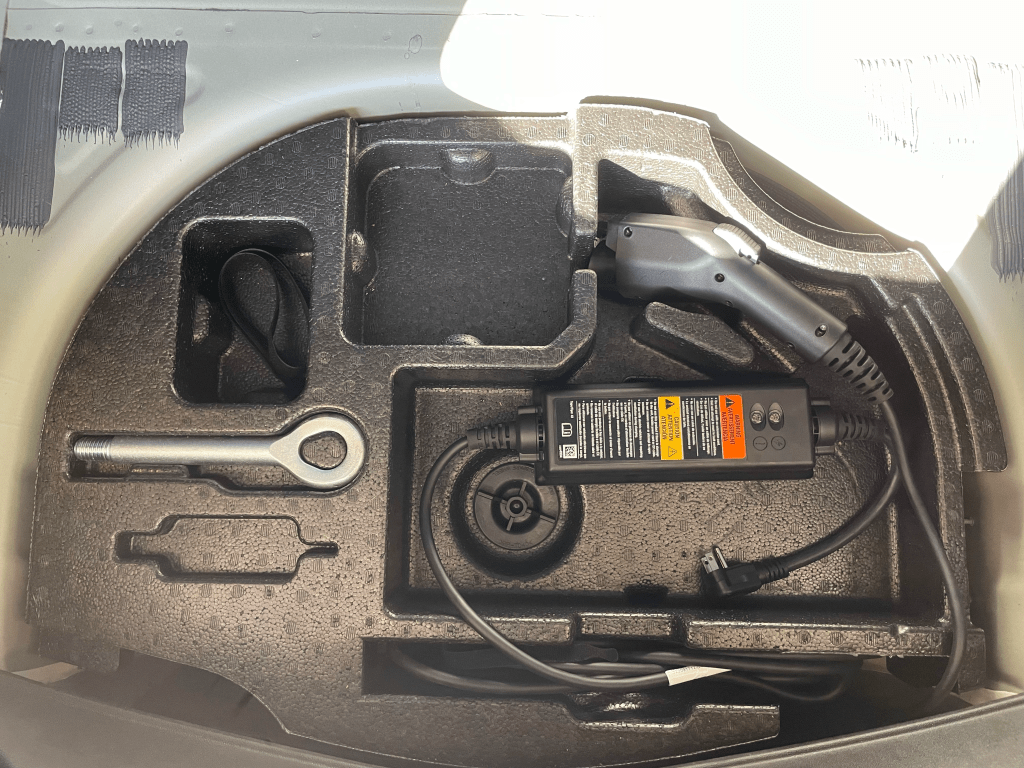

Anyway, I drove home, grabbed a lug wrench, and brought it back to them. They finished the job and went on their way.
After getting home I hit up Google and learned that Chevrolet Bolts, VW ID.4, Teslas, Ford’s Mach-E, and most other EVs don’t come with spares, not even as an option. I did not know this. So now Monte and I are doing some research on what we want to do about it.
We can buy a spare – either a temporary donut spare – or a full sized spare. But a fully inflated one doesn’t fit in the wheel well in the back of the car, so it would have to sit in the cargo space in the back. What is cleverly disguised as the wheel well for a spare tire is actually the place that they install high-end stereo systems if someone ordered the car with one. It is neither round nor big enough for even a donut spare. We could probably fit an under-inflated spare down there, but would need to be able to inflate it to 50 PSI when needed.
We can buy a jack – but one needs to be very careful about where to place a jack under an EV, given that that is where the batteries are.
We can buy a small, portable air compressor, which we probably will do at a minimum.
I have learned that spray-type fix-a-flats are not desirable to use, as they will foul the Tire Pressure Monitor gadgets that are inside each of the tires.
So why is this becoming the new norm? I have to assume it’s a combination of cost savings, weight savings for maximum efficiency/range, space saving, eco-friendly (for those who say it keeps rubber tires out of the landfill). But I suspect it is also related to the target demographic of EV owners, many of whom have probably never changed a tire in their lives.
If I think back to the many times I had a flat tire and changed it, it was due to running over a nail, or something else that led to a slow leak, for which I guess an air compressor would be a temporary fix. I’ve never had a total blowout. So, maybe an air compressor is all we need for now. Perhaps a spare in the boot for longer trips. Our Chevy Bolt EV has self-sealing Michelin Energy Saver All Season tires, which is even more re-assuring.
Anyhow, I’m sure my dad would have something to say about this, were he still around. 🙂
According to Consumer Reports, over a third of all new cars (gas or electric or hybrid) have no spare. It’s a thing. Needless to say, I was pleased to see a spare, jack, and lug wrench when I finally looked in the back of the Subaru.
If you are shopping for an EV and a spare tire is a deal breaker for you, check out this article I found that outlines a dozen or so EVs that come with a spare in the base package or as an option.
And make sure your roadside assistance plan and/or auto insurance covers towing your EV, properly (which generally means putting it on a flatbed tow truck).
Cheers!
When I was a kid, the zipper on my favorite pair of jeans broke. Back then, my solution was to cut and sew buttonholes in the inside of the top zipper placket, and sew buttons on the inside of the bottom zipper placket, ala button-up Levi’s 501 style. It worked, and my favorite jeans lived a while longer.
This week, I mended a pair of waterproof rain paints. The zipper had essentially corroded onto the zipper teeth and was permanently stuck in the down position. I considered the button-up solution again, but that wouldn’t be great for waterproof pants. So, I decided to go for it… replace the zipper. I’ve never done it before. So I stared at it for a very, very long time. There are like 10 different sets of stitching on a zipper placket. I had to figure out which ones to rip out to get the zipper out, which ones to leave in place, and figure out the right order of steps to sew the new one in. So, after mentally reverse-engineering the entire zipper placket assembly, I decided I could do it.
In the end, the amount of time I spent staring at it took much longer than the amount of time it took me to rip the necessary seams, remove the old zipper, and sew in the new one. I used a little waterproofing goo on the inside to waterproof the new exposed seams. And voila!

It’s not exactly Saville Row work, but I learned a new thing. #proudofmyself
Monte and I crewed on Camelot for Kurt & Kevin this weekend during one of the Austin Yacht Club Summer Series races. It was a hot and steamy day on the water but we had a great time.

 Sheila365