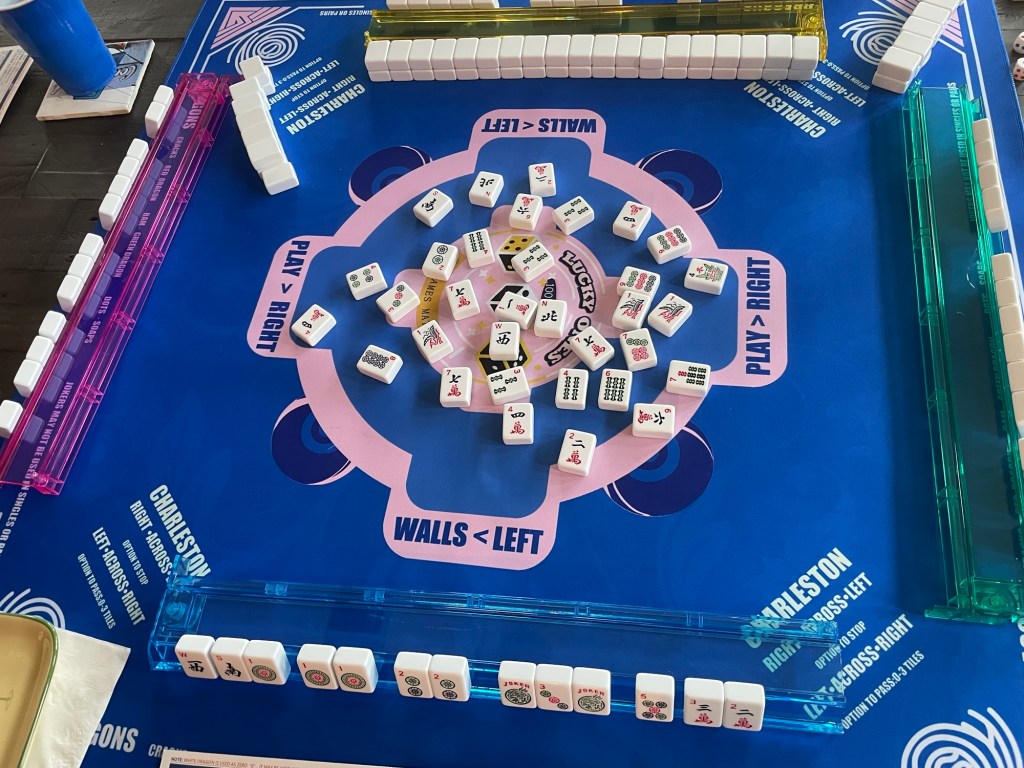
I believe I have entered my mahjong era. Lori bravely started teaching a few of us this game. Very interesting. And challenging to learn. This is not the mahjong tile matching game you may have seen from days of the first desktop computers. It’s more like a complex version of Rummikub on steroids – LOTS of steroids.
We played two games this afternoon. I learned more each time. Very fun. I look forward to more mahjong play. Thanks, Lori!
I love it when Monte wants to experiment with his pizza dough recipe. It’s always excellent, but he always thinks it can be a little bit better. Lucky me.
Ann hosted a brunch today to give us our annual craft challenge. This year it is a pomander! Bonus: it smells great. Thanks to Ann for a fun afternoon. 🧡
We took Nirvana out for a sail in Sunday’s beercan. We didn’t win the race, but I won the latest battle in mending the jib. My latest repair held nicely in 20+ knot winds. 👍🏼
Up on the hill, behind the Queen’s house, is a large green space called Greenwich Park. I could have spent hours just walking around this park. It’s lovely. At the top of the hill sits the Royal Observatory, commissioned by King Charles II in 1675. This morning, we headed up the hill to see it.
Ok, first, some historical context. You’re a sailor in the late 1600s. Your ship navigates close to shore by piloting using well-documented coastal landmarks, bearings, and charts. When out of sight of land, your ship navigates using dead reckoning, which uses your last known position and your speed and heading to estimate your current position, but that is fraught with potential for error. Better, you can calculate your latitude (your north/south location on the globe) by measuring the angle of the sun at solar noon at your location using a quadrant and declination tables. But accurately determining your east/west position at sea, your longitude, was not yet an easy thing to do. On dry land, one could measure the transit of moons across the face of Jupiter and use celestial tables to calculate longitude. But it’s not easy to do on a boat moving on the sea.
The Royal Observatory was established in 1675 with the express charter to “find out the so much desired Longitude of Places for perfecting the art of navigation.” Work began at the Flamsteed House, by the first Astronomer Royal and his successors, to accurately map the celestial bodies. This culminated in the publication of the first Nautical Almanac in 1767. This aided in estimating longitude based on celestial observations, but still difficult to do at sea.
A second, more desirable method to determine longitude would be based on timekeeping. The Earth is divided into 360 degrees of longitude. The Earth turns 360 degrees in a 24-hour day. 360 degrees / 24 hours = 15 degrees of longitude per elapsed hour. The British Navy arbitrarily established Greenwich as its 0 degrees longitude, for the purposes of maritime navigation and charting. If you know the time at Greenwich when you observe local solar noon where you are, you can calculate your longitude. For example, if it is solar noon where you are (12:00pm), and you know that it is also 2:00pm in Greenwich, you can calculate your longitude as 2 hours x 15 degrees per hour, or 30 degrees earlier than (or west of) Greenwich. In the 17th century, though, to know the time in Greenwich required a timepiece that you set to Greenwich time when you left England, and which kept time accurately while at sea months later. In 1675, such a clock did not exist. That was the longitude problem.
In 1714, the British Parliament introduced the Parliament Act, which put up a prize of 20,000 pounds (about $2M today) to whoever could create a timepiece that met specific criteria of accuracy at sea.
In 1730, a woodworker named John Harrison attempted to build a timepiece to meet the criteria of the challenge. It took him 5 years and required learning the principles of metallurgy, but he did it. His first prototype was called “H1.”
Harrison’s H1 prototype timepiece – 1735.
Time trials proved it worked. However, he was paid only 500 pounds of the 20,000-pound prize. Harrison thought he could improve upon it, so he created three more prototypes over the next 25 years.
After H3, he changed his design altogether, from a clock to a watch. The result was H4.
Harrison’s prototype H4 – 1759.
Time trials on the H4 proved its accuracy, and work began on making additional copies, to prove how replicable the design was. Only after entreaties to the king was John Harrison eventually paid the full 20,000-pound prize, when he was in his eighties.
It’s all history now, but the next time you pull out a GPS to find your lat/long position on your boat, think about the work of John Harrison.
So, let’s discuss time a little bit more. By the 1800s, Britain’s nautical charts, which all used Greenwich as the 0 degree meridian, were becoming the global norm, though there were numerous other meridians used by other countries. In 1884, there was a global conference to declare what would become the Prime Meridian going forward. At the end, Greenwich’s meridian was declared as the Prime Meridian, to be used not only for navigation, but to establish a global basis (Greenwich Mean Time) for the 24 global time zones going forward. The location of the Prime Meridian is marked at the Royal Observatory by a metal line that intersects the observatory where the equatorial telescope sat that was used to create all the celestial tables, and proceeds out through the courtyard, and across the globe.
The Prime Meridian at the Royal Observatory. The metal strip proceeds northward through the courtyard.
Greenwich Mean Time impacted everyday life beyond navigation at sea. After the Meridian Conference of 1884, the Prime Meridian at Greenwich was used as a global zero degrees longitude for navigation. Prior to that, individual towns maintained their own local times based on local solar noon, with some amount of error, obviously. But the trains must run on time! By 1847, the expanding railways had adopted GMT as their standard for timekeeping as well. By 1855, most public clocks were using GMT as well. To facilitate this, the Royal Observatory established a clock that kept official GMT time, and which emitted electrical impulses that went out on wires, to sync clocks across the country.
The Shepherd Gate Clock was the first public clock, on the wall of the Royal Observatory that marked Greenwich Mean Time.
A red Time Ball was added to the top of the Royal Observatory that would raise to the top of a mast at 12:55pm each day, and fall at 1:00 pm GMT. It was observed by ships in the Thames below to synchronize their timepieces on board before setting out to sea – so they could reliably calculate their longitude on their journey.
The Flamsteed House at the Royal National Observatory, with the Prime Meridian extending through the courtyard in the foreground.
Pretty damn cool.
I have often thought out loud that I have lived during one of the most exciting times – with the evolution of technology, computing, and the internet, and whatever else is happening these days. But as I think about the history I’ve absorbed over the last week, there has been no shortage of innovation across the centuries brought to life by meticulous and hard-working people that just wanted to solve the problem at hand.
By the end of a full day, the clouds were gathering again with rain, so we headed back down the hill to our hotel.
The Royal Observatory, viewed from the Queen’s House.
About 10 years ago I read a book by Dava Sobel, called “Longitude.” It tells the story of John Harrison and his quest to solve the longitude problem. Check it out if you’re interested in more information. I enjoy her books, which I would classify as scientific non-fiction (?). She delves into historical figures and science topics. “Galileo’s Daughter” was the first of her books that I read, and I try to read the rest of them as I find them.
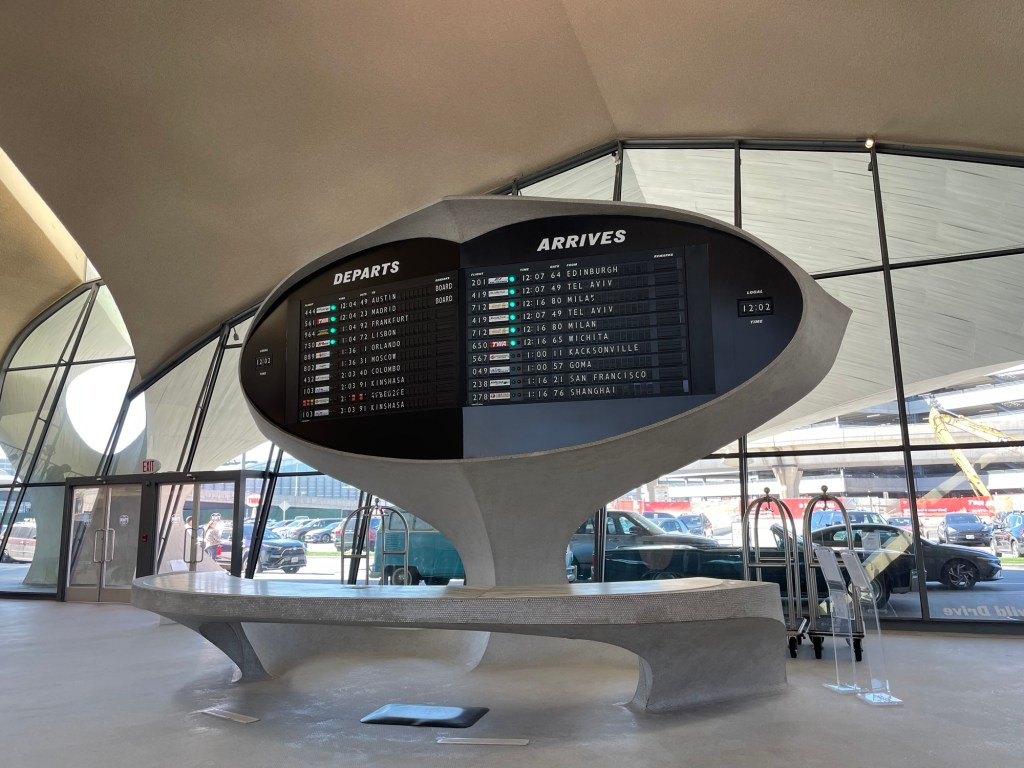
Forty-six years ago, in a galaxy that seems oh so far away, I took my first airplane trip. I remember sitting for hours in the terminal at JFK waiting on our connecting flight. The big board continually clicked and flipped to show flight status and gate updates.
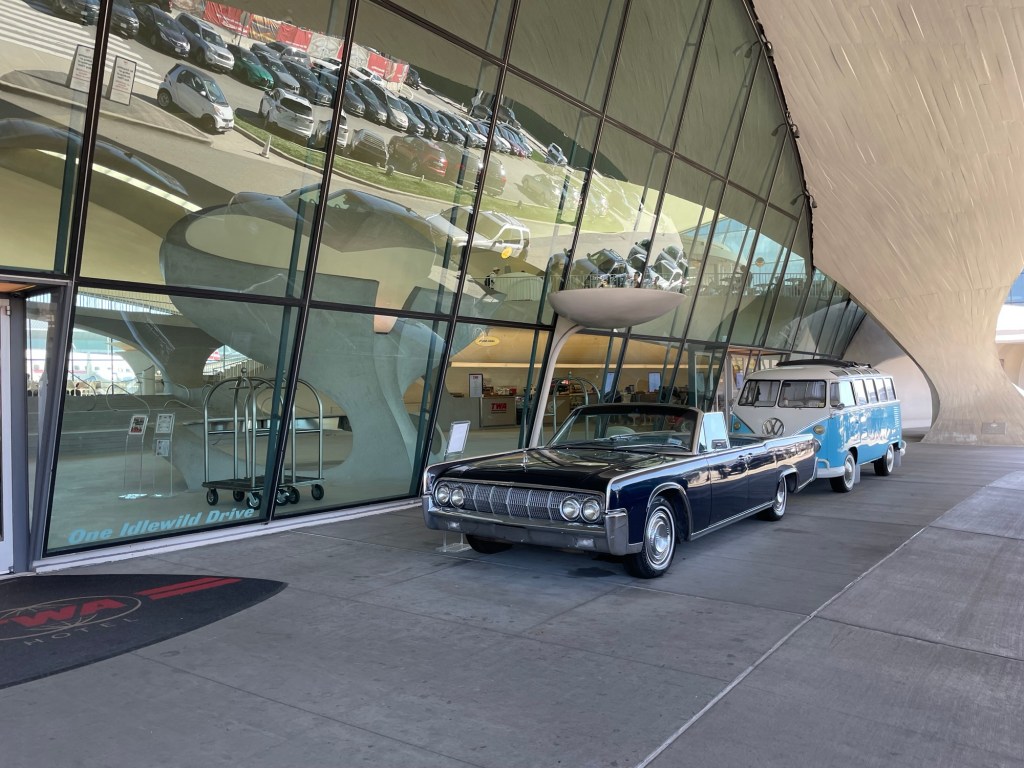
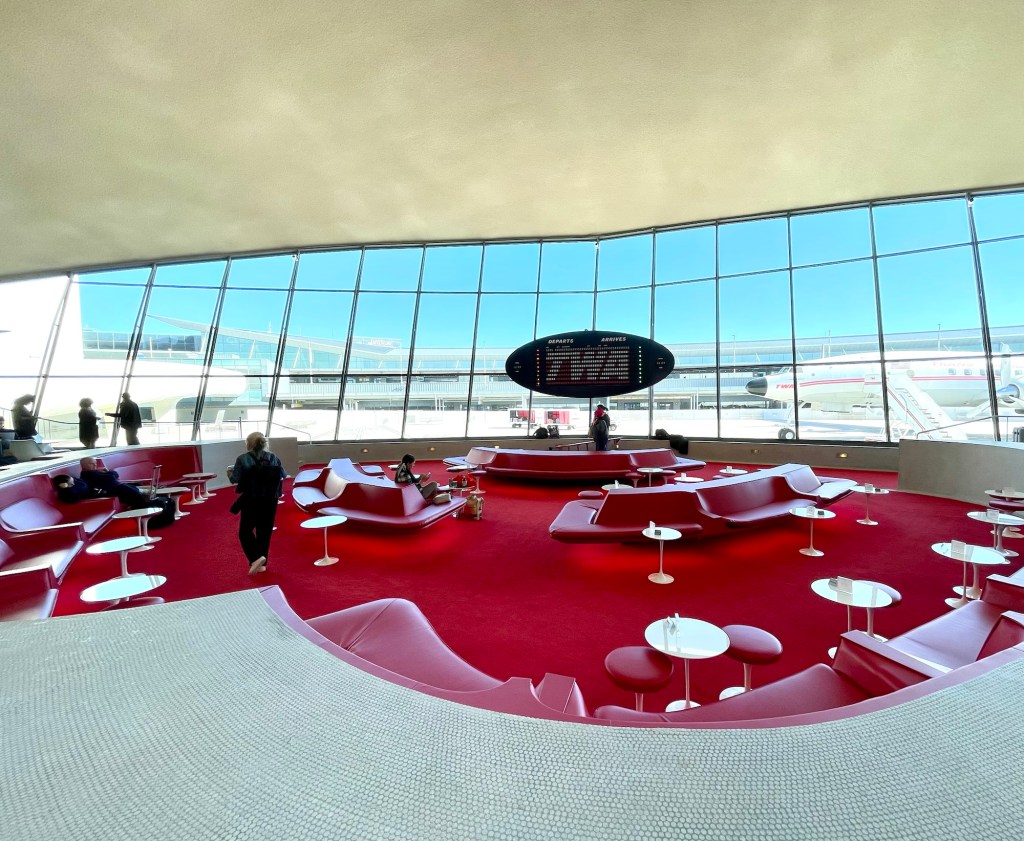
I heard that that old terminal has been preserved and turned into a hotel next to Terminal 5 at JFK.
Today Monte and I flew into Terminal 8 at JFK, and I just had to find this time capsule before we left the airport.
The flight to Madrid is boarding!
It was fun to see those old memories come back to life.
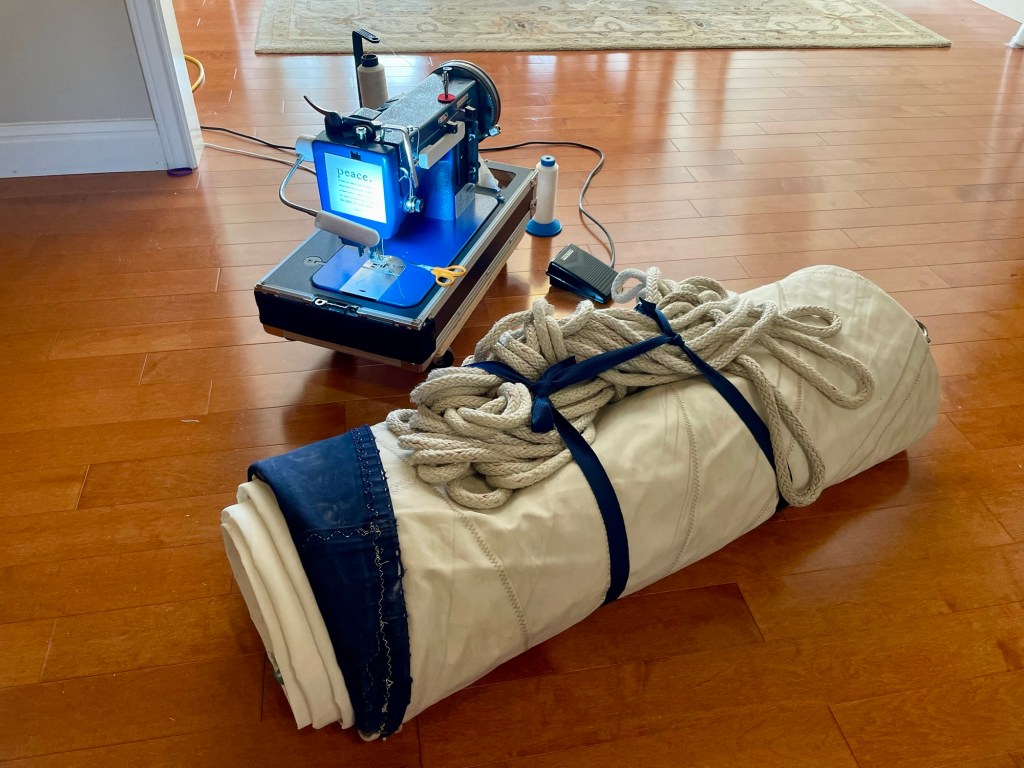
I finally got a couple of days to work on our jib. The sailcloth is in good shape for the most part. Except for the section along the leech that gets beat against the shrouds every tack, and pressed tight against the spreaders when close hauled. It has torn in several places.
After a discussion with the sailmaker at Sailrite I decided to go for a repair that replaced the first 30” or so on the leech end of 3 panels of the sail. Also patched the beat up sunbrella sun cover and made new spreader patches. And replaced a few well worn webbing strips at the head and clew as well.
It took me about 2 full days of my slow but steady mode of work. Also using PTFE thread in my LSZ-1 is a huge pain in the aft, but it’s a necessity for the UV-exposed stitching.
But it’s done and I like how it came out. And I have my living room back. Fingers crossed that it does the trick 🤞🏼
While I was doing this project, Monte was rebuilding and installing our autopilot wheel drive unit. ✅ and ✅
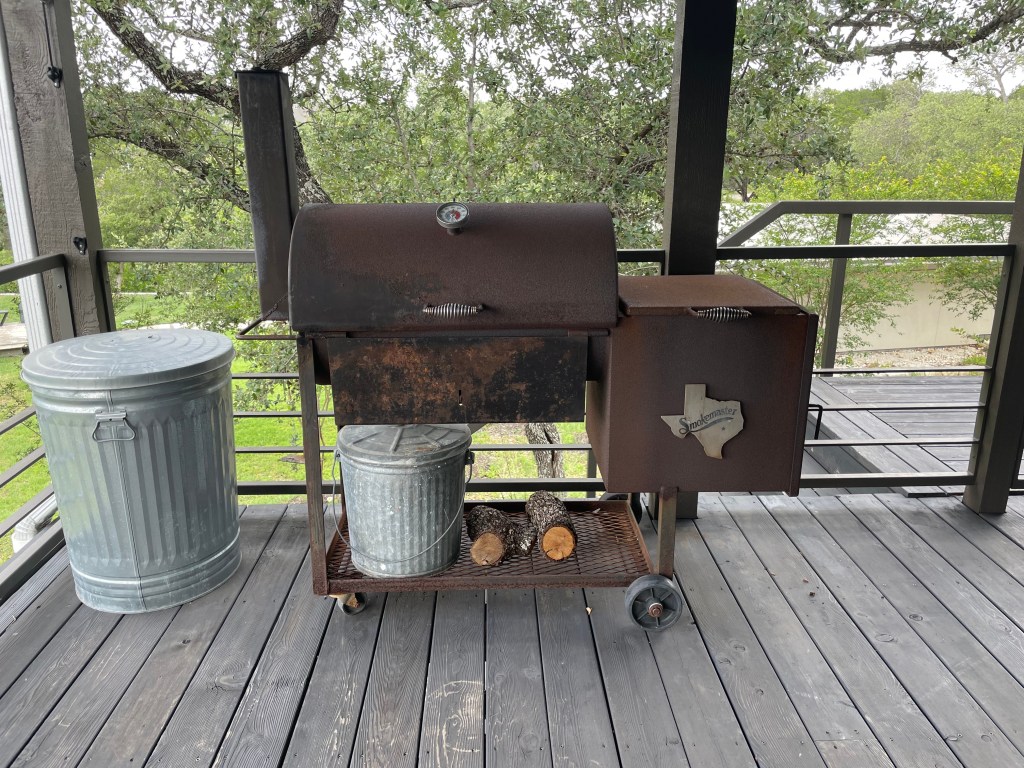
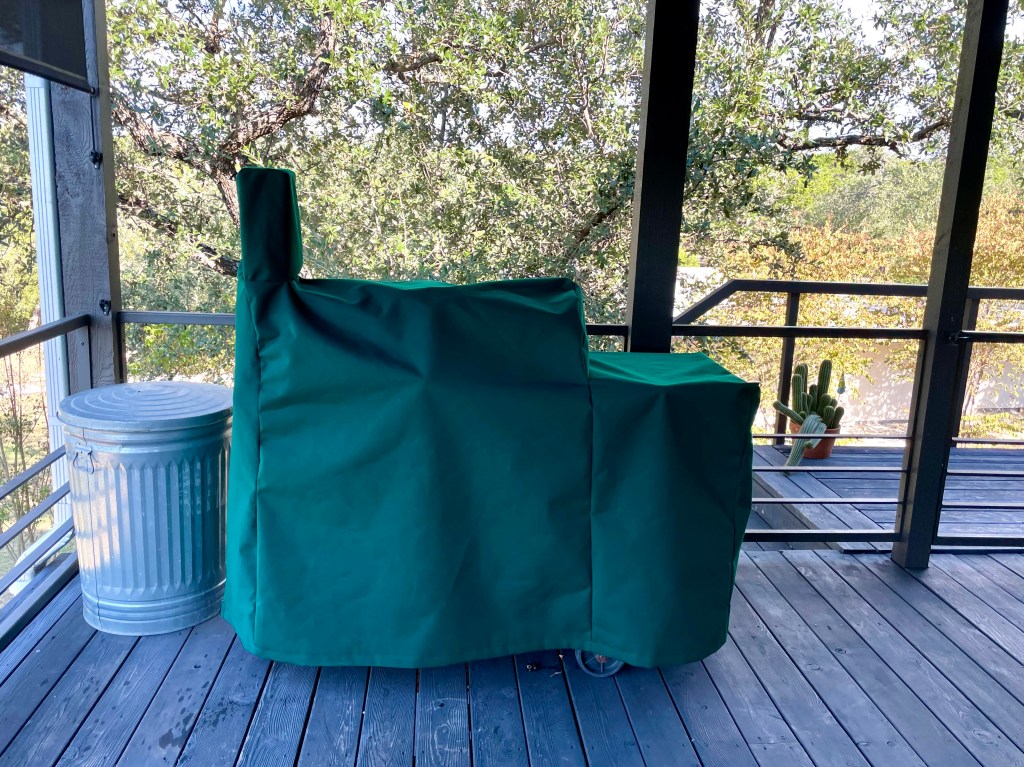
I just finished a cover for a smoker/grill for someone who lives out near Marble Falls. It was quite the puzzle requiring some mental gymnastics to get from taking measurements, to making a pattern, to assembly. It turned out great, I think.
The “before”The “after”
I had to visit the grill several times. It’s a 45-minute drive from my house, which takes me right past Balcones Canyonlands National Wildlife Refuge. So I popped in a couple of times to take in the view.
✅ That item is crossed off the list. Now, on to mending our jib (again).
We have acquired about 3 dozen Tervis brand drinking glasses over the years. They’re not fancy, but they keep cold drinks cold, and hot drinks hot. They’re supposed to be indestructible, but over time we’ve had several crack open, some get little spider cracks that let moisture in where it’s not supposed to be, the artwork in some has become loose, and we’ve found that the newer ones often get cloudy.
Tervis has a lifetime warranty, so when we have 5 or 6 that need repair, I send them in. I sent the last batch in 5 months ago. But they just arrived bac in the mail. I was a little nervous because MY first and favorite tervis was in this batch – I’m always the sand dollar 🙂 And a couple were ones that we bought in the Bahamas and the BVI, hard to replace. Another was one of Monte’s first tervis. And, my lucky Seahawks Tervis!
They were able to reclaim the artwork from each of the broken ones and put them in brand new, crystal clear glasses.
Christmas in November! Thanks Tervis.
What the old ones looked like when I sent them in:
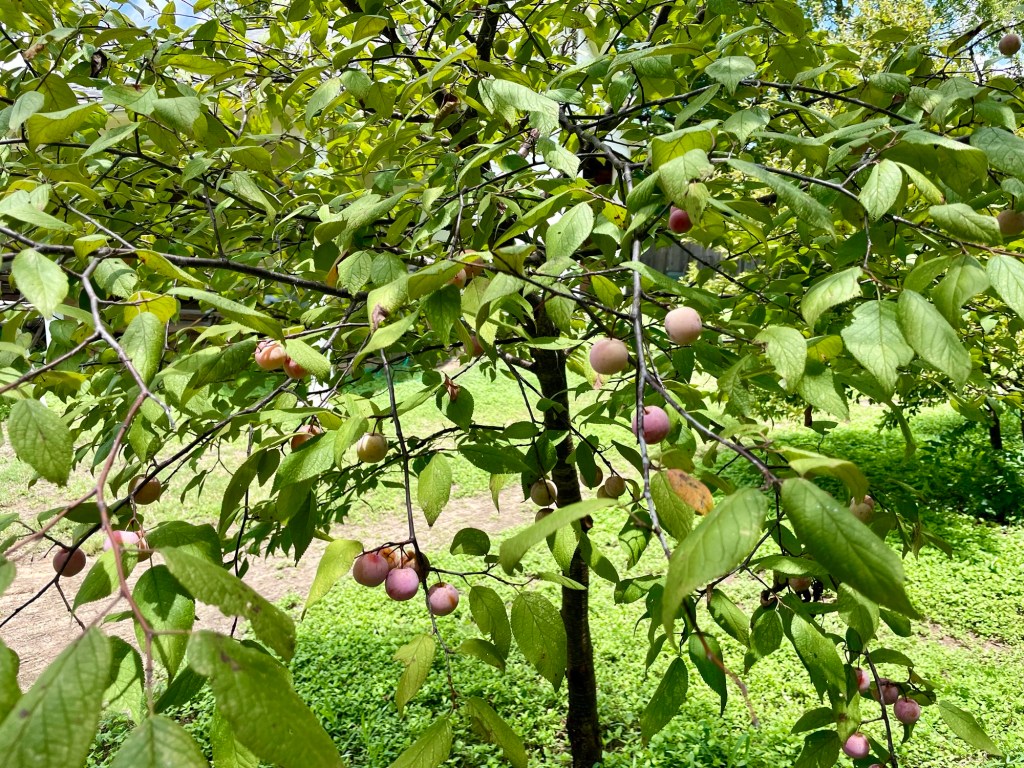
Several years ago we planted a few new trees in the way back. One is a Mexican plum (link here). It has established itself in the face of drought and recent hard freezes. I was excited to see that this year it has fruit on it!







 Sheila365