Tortilla Española.

Monte and I threw a party over the Christmas holidays. We got a leg of Jamón Serrano to get things started, and so we made tapas the theme for the rest of the nibblies that we served.

A mainstay in any tapas bar in Spain is the Tortilla Española, a traditional dish made with eggs and potatoes, with a little onion in most cases. When I lived in Spain, I remember spending a day learning how to cook it with my friend Conchita. I’ve made it a few times over the years. But it has been a very, very long time since I tried to again.

I made a practice one earlier in the week, to make sure I could still do it 🙂 That turned out ok, so I made a few more the day before the party. I thought they turned out great, so I’ll share the recipe here.

Ingredients:

The biggest mystery for me was getting the correct amount of ingredients for the specific skillet size I had at my disposal. In my case, it was a 10″ skillet. So the ingredient amounts here are for making a tortilla in a skillet of that size.

Potatoes: I swear by golden potatoes for pretty much any kind of potato dish I make – other than baked potatoes, that is, for which russets are the best. So this means yukon gold, Idaho gold, etc. The golden potatoes I found were small to medium-sized, as opposed to large. I found that starting with about 1.5 pounds of golden potatoes was more than enough for one tortilla and my 10″ skillet. This ended up being about 6 of my smallish gold potatoes, peeled and sliced thin.

Eggs: 6 large eggs worked nicely.

Onion: Sweet onions are my preferred variety. I used half of a medium-sized sweet onion, sliced thin.

Olive oil: You’ll need 1.5- 2 cups of Extra Virgin Olive Oil. You’ll know you have the right amount if it just covers the potatoes while they are cooking.

Salt: I like to use kosher salt. I didn’t measure the salt, but added it along the way as noted.

Kitchen Tools:

It’s important to make sure you have all the kitchen equipment that you’ll need beforehand (in addition to a potato peeler, knives, etc). Here’s a summary of what I used:

– Two 10″ skillets, one without non-stick (for the cooking of the onions, and the preparation of the potatoes) and one with non-stick (for the actual cooking of the tortilla after all the ingredients have been prepared). You can probably get away with one, but if you plan to make more than one tortilla, having two skillets allows you to overlap some steps.

– A mesh strainer and bowl to drain oil from the cooked potatoes after cooking them. You can reuse the strained oil if cooking more than one tortilla.

– A large bowl to hold the combined egg, potato, and onion mixture before the final cooking step.
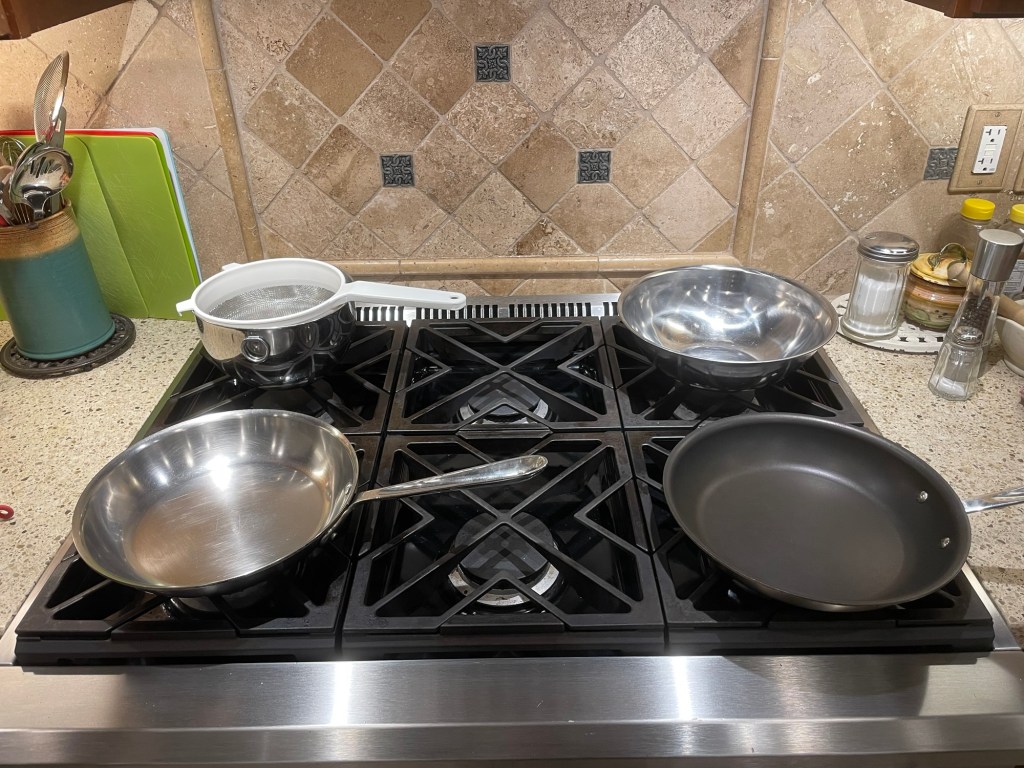
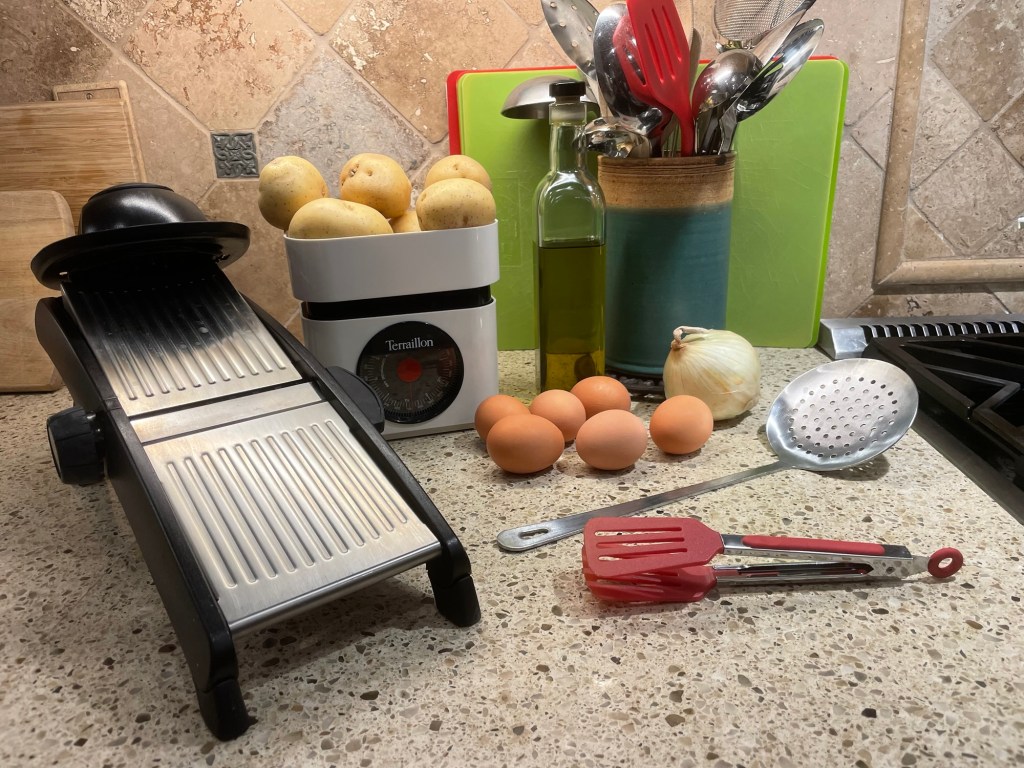
– A big, flat metal scoop with holes to transfer the cooked potato slices from the oil to the strainer. This is because you want to keep the potatoes flat when transferring them, or they will break up into small pieces, which you should try to avoid.

– A mandolin for slicing potatoes thin (I used the 3mm setting).

– A wide-ended set of tongs that can be used to grab the potatoes as they are cooking in the oil and flip them in place, for even cooking. These are the red tongs in my photo below. I wish I had something bigger/better, but these silicon spatula tongs worked ok for the task.
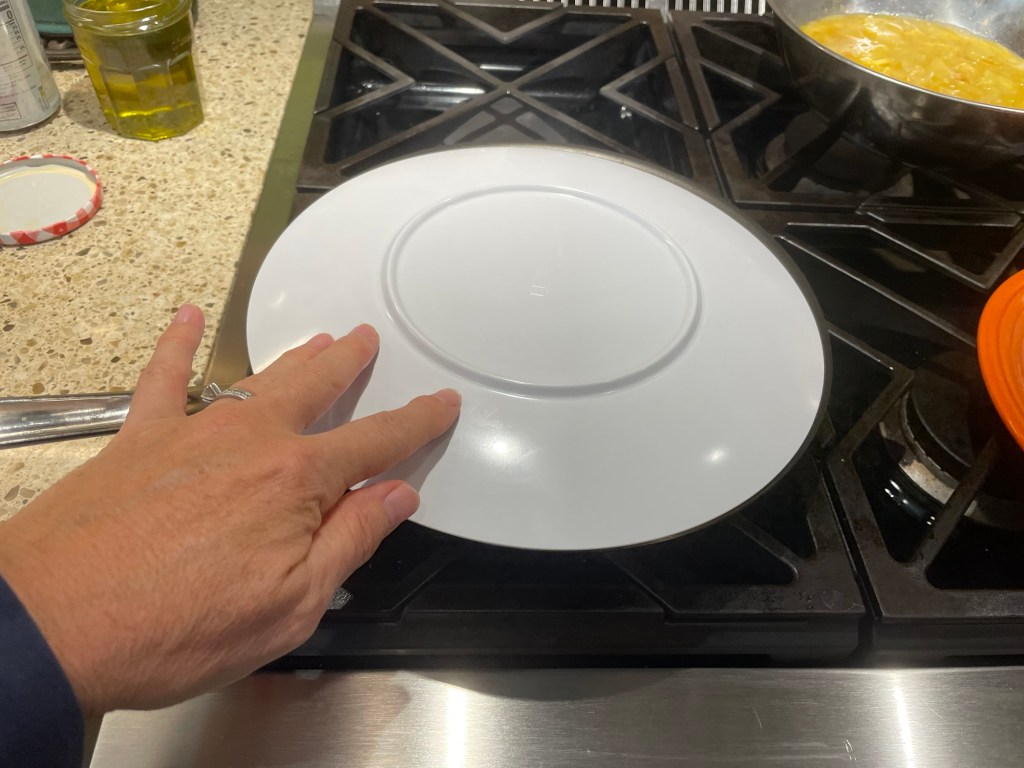
– A mostly flat plate, a little bigger than the top of your skillet, used to flip the tortilla. You don’t want a lip on the edge of the plate, as you want to be able to slide the tortilla from plate to pan easily.
Making the tortilla:

Makes 1 tortilla. Cooking time… more than you think. Probably about 1.5 hours overall, if you’re as slow as I am.

  • 1 1/2 lbs gold potatoes (weight before peeling), then peeled, and sliced 3mm (~ 1/8”) thin on a mandolin.
  • 6 large eggs
  • 1/2 medium sweet onion, sliced thin
  • 1 1/2 – 2 cups extra virgin olive oil

Peel potatoes, soak in a bowl of water for 5-10 mins before slicing.

Slice potatoes 3mm thin on a mandolin. Soak again in a bowl of water for 5-10 minutes after slicing. I like to think the soaking removes some starch, yielding more even cooking and a smoother texture. But who knows. 🙂

This next step may seem a little odd, but it’s important to dry the potatoes before cooking them in the hot oil. Lay out potatoes and pat both sides dry. Then toss with several pinches of kosher salt and set aside.

In a separate bowl, mix the 6 eggs, adding a pinch of kosher salt. Set aside.

Slice onion thin.

Saute sliced onion in 1 Tbsp of olive oil, until soft and caramelized. Set aside. When cool, stir the onions into the egg mixture. Set aside

Add about 1 1/2 cups of olive oil into skillet, and heat on medium-low until oil is shimmery, but not boiling. We are not frying the potatoes in the oil, we are poaching them til they are tender. When the oil is hot, add a slice or two of potato to see if the temperature is right. You don’t want it to fry like a McDonald’s french fry. Sizzle is ok. If it looks right, add the potatoes. Make sure that you have plenty of room above the potatoes in the skillet so as to not overflow the oil when flipping the potatoes. If not, you probably have too many potatoes. Add oil, if necessary, to cover the top of the potatoes.

Cook the potatoes til soft in the oil for about 25 minutes, carefully flipping the potatoes to ensure even cooking. You want them to be soft when you pierce them with a knife, but not crumbly. Think of the texture of scalloped potatoes when cooked – soft to the tooth, but still with some body.

When you think you’re there, carefully scoop the potatoes out little by little (using the flat scoop) into the mesh strainer, using a bowl to capture the strained oil. The potatoes need to sit til they are cool enough to add to the egg mixture without cooking the eggs (around 10 minutes)

When the potatoes are cool enough to touch, you can add them to the egg and onion mixture. Gently combine them. Then the combined egg, potato, and onion mixture must sit for 15 minutes. This is where the magic happens.
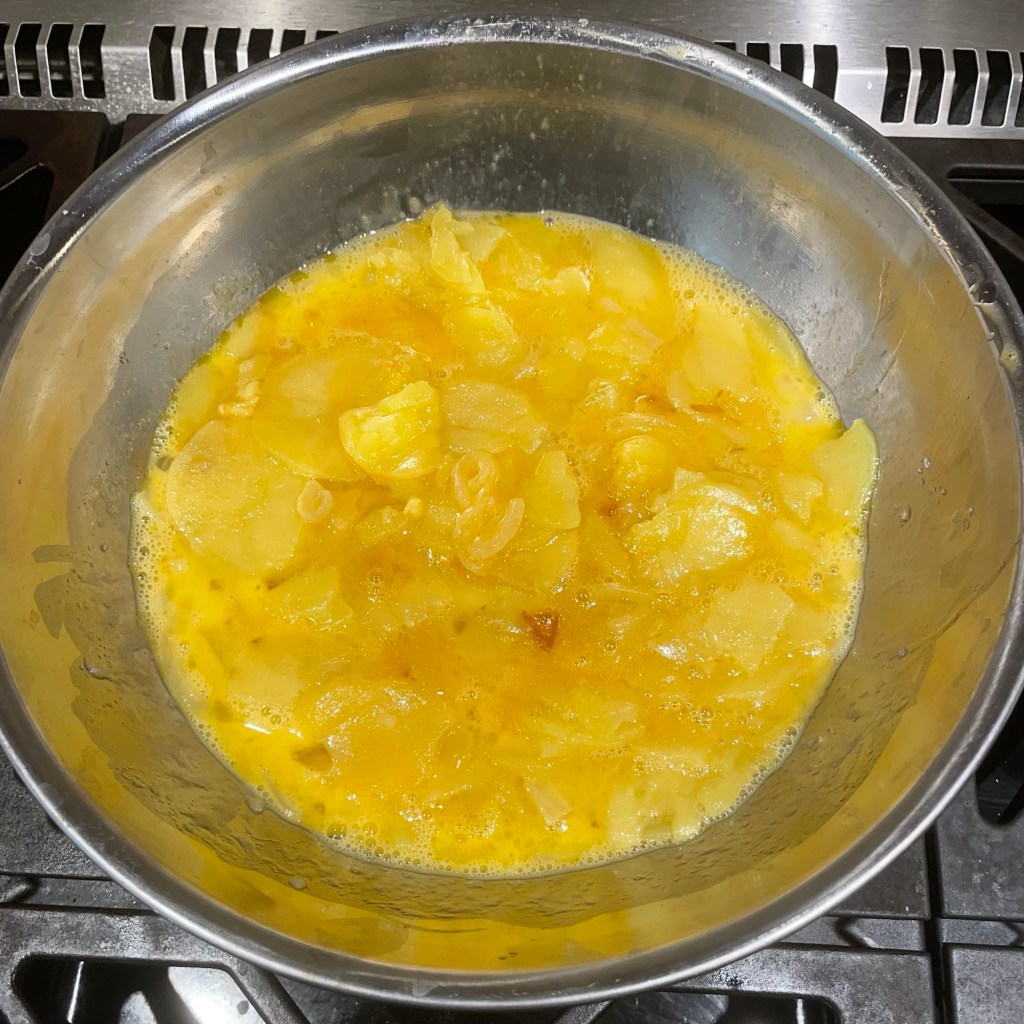
The egg, cooked potatoes, and onion mixture

Heat a non-stick skillet with a teaspoon or two of olive oil on medium-low heat. When the pan is hot, add the combined egg, potato, and onion mixture into the pan. Cook for 6-8 minutes. You can use a spatula to round the edges of the tortilla as it cooks.
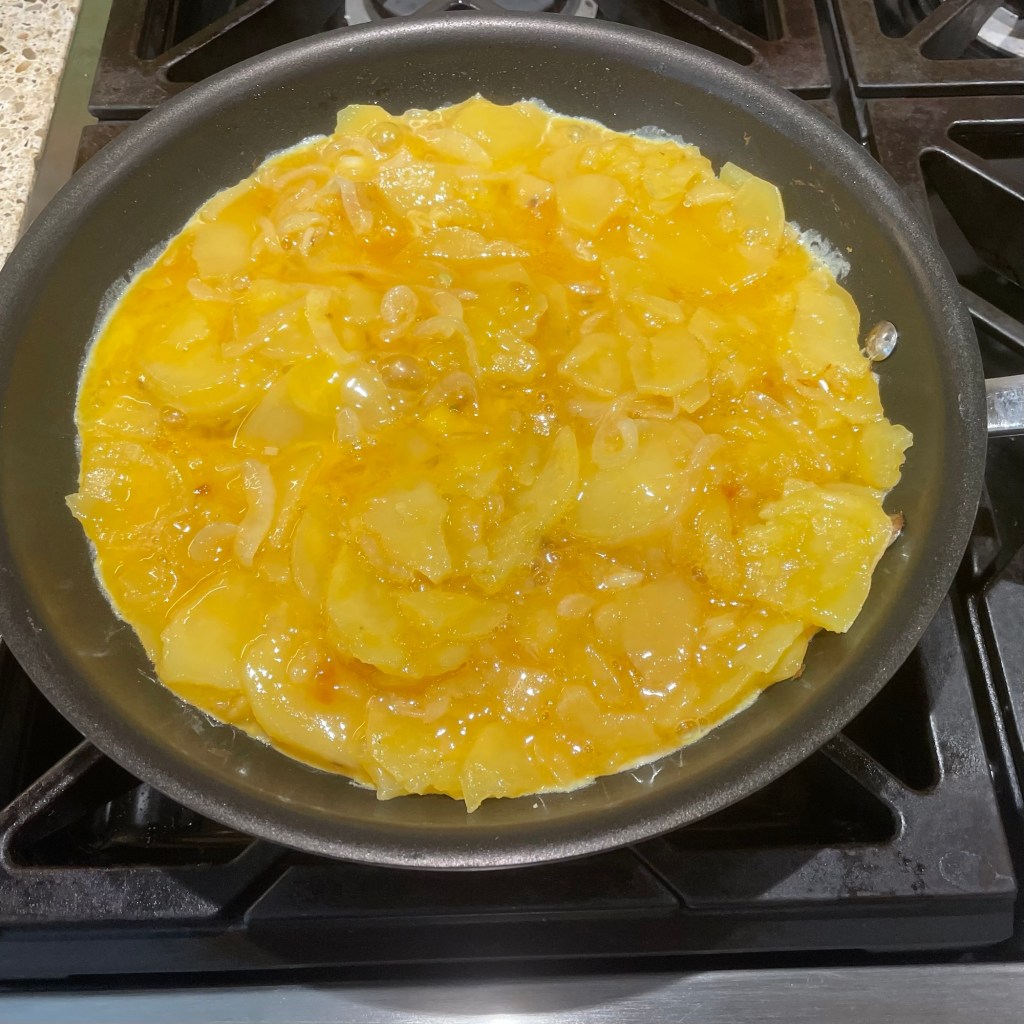
What this recipe’s amount of ingredients looks like in the 10″ skillet

After 6-8 minutes, see if you can insert a spatula under the tortilla to see the color of the bottom. If it is not browned a little it needs more time. If it is golden and a little browned, you can flip it to the other side. It can be a little runny on the top when you flip it. But it should be mostly cooked from the bottom up.

To flip the tortilla, place the flat plate upside down on top of the hot skillet. Using hot pads, grab both sides of the skillet and the plate at the same time, and invert the whole thing. Set the inverted pan and plate on the counter. Lift the pan and place it back on the stove to continue cooking the other side. Then gently slide the tortilla back into the skillet with the half-cooked side up. You may have a little bit of loose egg and potato left on the plate.
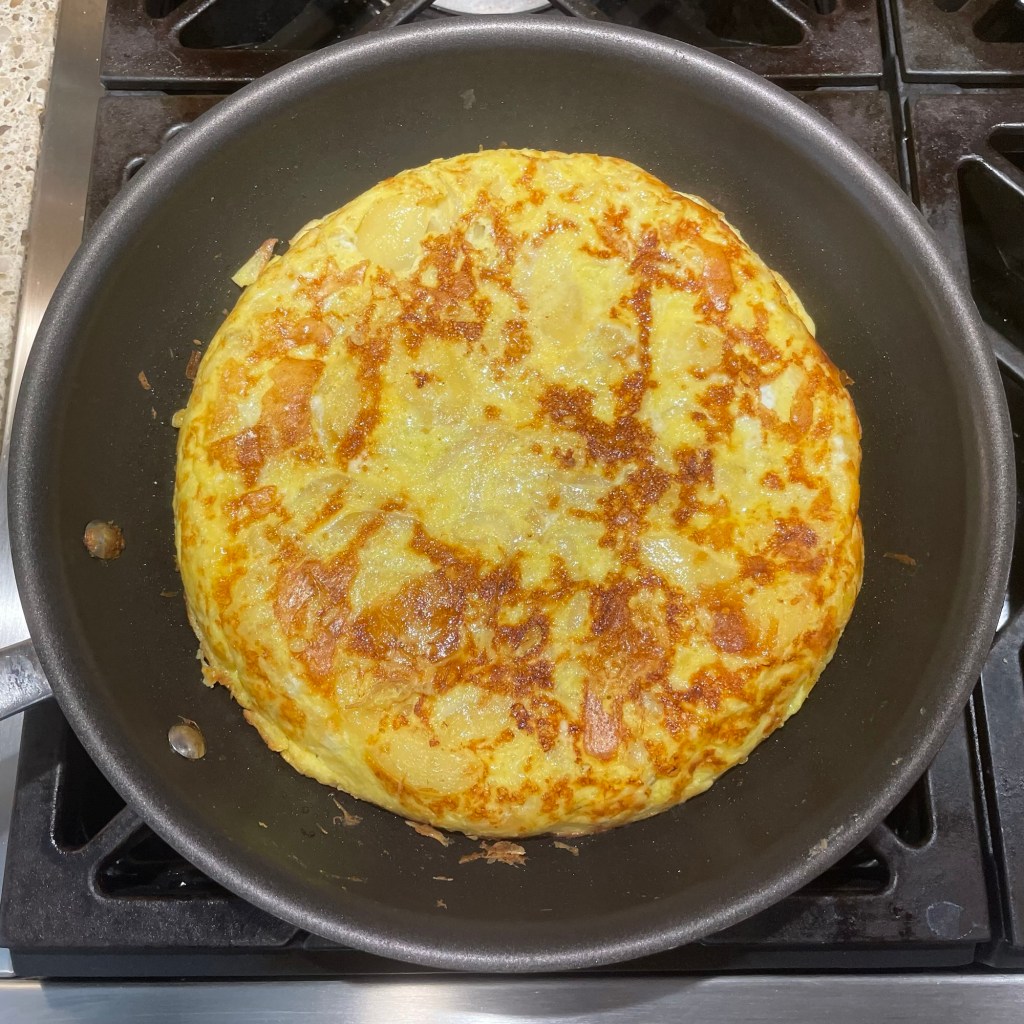
The tortilla cooking side 2 after flipping.

Cook the other side of the tortilla for another 6-8 minutes til firm and similarly browned.

When done, use a clean plate and use the technique above to flip the cooked tortilla onto it.

Et voila! The tortilla can be served hot, or at room temperature. Cooking it a day before you need it is just fine. Just let it cool before refrigerating. And then remove from the refrigerator a little while before serving so it can come up to room temperature.
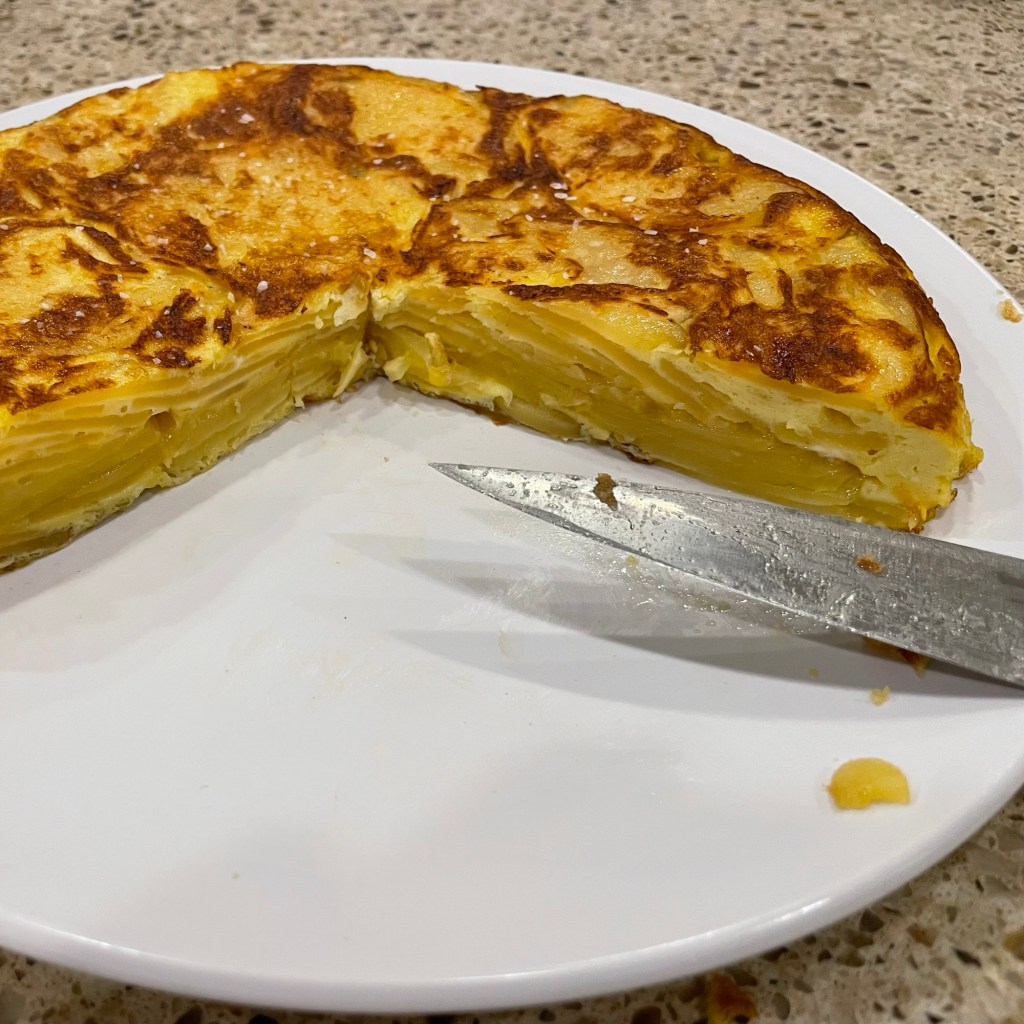
I wish I had taken more of the earlier steps. When I make another one, I’ll try to remember to take additional. If so, I’ll come back here and add them.

Til then, ¡Buen Provecho!
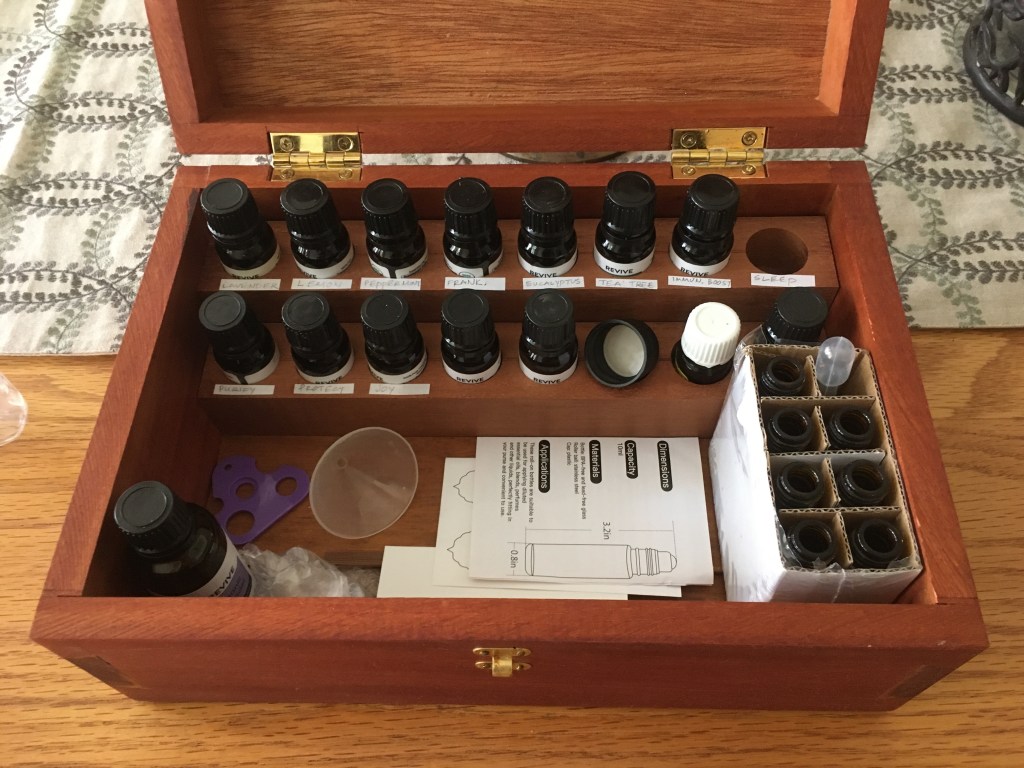
Essentials.

At the beginning of the year, I introduced myself to essential oils. I was curious about them and the purported benefits of aromatherapy. Until then, my only exposure to them was during visits to the day spa. Right before COVID was a thing, a neighbor invited me to attend an introductory session at her house, as she had just signed up to sell for one of the major essential oil multi-level marketing (MLM) companies. I learned the basics of essential oils during that session, and wanted to try some, but I’m not really a multi-level marketing kinda girl. Instead, I found Revive for my first purchase, an on-line retailer of high quality, 100% pure essential oils. No MLM-strings attached, with free shipping, too.

After 6 months of using them, I am a fan! Years ago, Monte made me a wooden box out of mahogany boat scraps. It would be a perfect storage box for my essential oils, as they need to be stored in a dry, dark place to maximize their shelf-life. I drilled out cylindrical voids in a few pieces of wood to create two tiered rows inside the box to hold the bottles of my essential oils. I’m in love with this storage box. It smells amazing every time I open it.

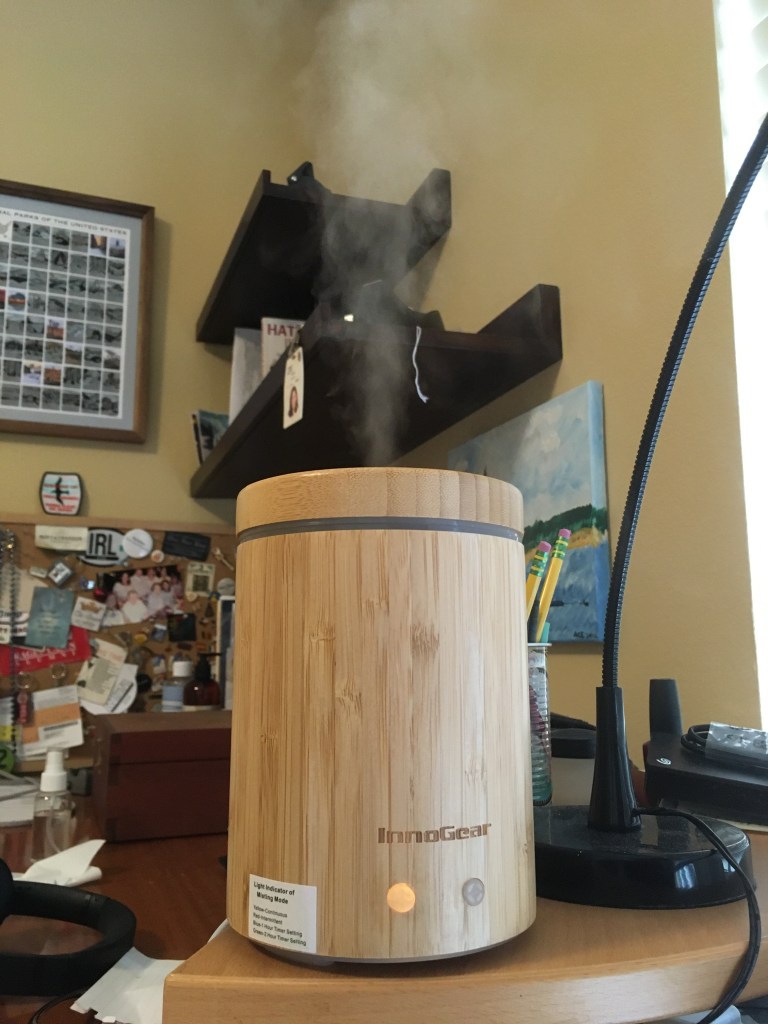
I have found various ways to enjoy my essential oils. I haven’t become a fan of ingesting them. But, I use a diffuser to disperse the oils in the air, especially when I am doing yoga, a workout, or just working in my office/studio at home. Sometimes I use a single oil, sometimes I blend a few together. Revive has their own blend called “Sleep” that I really enjoy diffusing around bedtime.

Please remember that 100% pure essential oils should not be applied to skin undiluted. They should be mixed with a carrier oil or other liquid.

Dabbling with essential oils (pardon the pun) has expanded my repertoire of DIY projects with these that each incorporate several drops of oil:

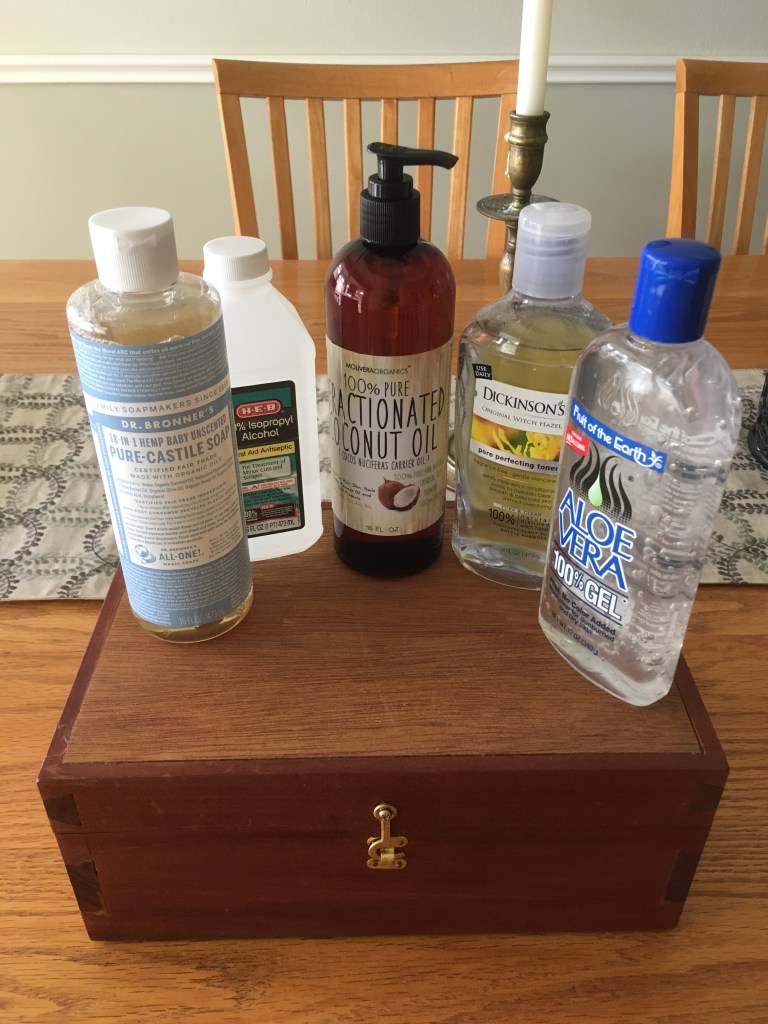
Yoga-mat de-funking spray

  • small spray bottle (mine holds about 4 ounces)
  • 3 parts distilled H2O
  • 1 part witch hazel
  • 5 drops tea tree oil (note, tea-tree oil may not be pet-friendly, eucalyptus is another option)
  • 5 drops lavender oil

Mix all together in a spray bottle. Just spray on your sweaty yoga mat and wipe off with a dry, clean towel.


Foaming soap

  • foaming soap dispenser (Note, make sure it is for foaming soap, which is different than a regular liquid soap dispenser.)
  • 3/4 cup distilled H2O (Put this in the foaming soap dispenser first to cut down on creating foam inside the bottle while mixing.)
  • 2 1/2 Tbsp pure-castile liquid soap
  • 1/2 Tbsp fractionated coconut oil
  • 5-7 drops of your favorite essential oil

My foaming soap dispenser holds 8.5 ounces and the above amounts work for that size dispenser. If yours is a different size, adjust quantities accordingly, but make sure to allow enough room for the foaming mechanism on the spray insert to fit without causing the contents of the bottle to overflow.


Hand-sanitizer (or hand-cleaner, whatever)

  • 2 parts rubbing alcohol (99%)
  • 1 part aloe vera gel

Mix together in dispenser of your choice.


Anti-chafe cream:

  • 1 part fractionated coconut oil
  • 1 part corn starch
  • 4-5 drops essential oil of your choosing

I find this helps alleviate chafing on my skin when working out. You may want to tweak the amount of corn starch to create a consistency you prefer. I keep mine in an old face cream jar and rub a little on my arms or my legs if things are experiencing a bit of friction.

Frosé in the house!

It is HOT in Austin this summer. A cool drink goes a long way to make you forget the temperature outside. I have recently been introduced to a lovely pink frozen beverage called Frosé, made from rosé wine, but presenting as a slushie. Brick Oven Pizza served up my first one (and several since then). Pretty good!

Ever since then I’ve wanted to try making my own. We have a Cuisinart electric ice cream maker which we use to make delicious sorbets. So, I asked myself, “Self, can our ice cream maker successfully make frosé?”

The answer is, “YES!”

Today I conducted a test run. Inputs:

    – 1 Bottle of chilled rosé wine
    – 1/3 c chilled simple syrup (see recipe below)
    – 1 Cuisinart ice cream maker w/ pre-frozen canister. Our model is ICE-25R but is likely replaced by a newer model by now.

Pour wine into the canister, add simple syrup, and stir. Put canister in ice cream maker and start her up. At 15 minutes it was freezing nicely.

I ran it for another 10 minutes and it looked ready.

I scooped some into a wine glass, added a paper straw (no plastic!), and put the rest into the freezer for later.

Delicious! I highly recommend. Cheers!

Simple syrup recipe:

– Heat 2 cups sugar and 2 cups water in a saucepan over medium heat. Boil 1 minute. Cool and refrigerate.

Year of the Rooster.

In honor of the 2017 Chinese New Year, the Year of the Rooster, I whipped up a little chicken stir fry.  Delicious.

Chicken Stir-fry (makes 4 servings)

  • 2 boneless, skinless chicken breasts (about 1lb), sliced thinly
  • 1 T corn starch
  • 1/4 c soy sauce
  • 1/2 c chicken broth
  • 2 T grated fresh ginger
  • 2 cloves garlic, minced
  • 1/4 t red pepper flakes
  • 1 medium onion, diced
  • 1 can water chestnuts
  • 1 head of cut broccoli florets
  • 4-6 oz mushrooms, sliced
  • 2-3 T oil with high smoke-point (e.g., peanut or sesame)
  • 3-4 cups cooked rice

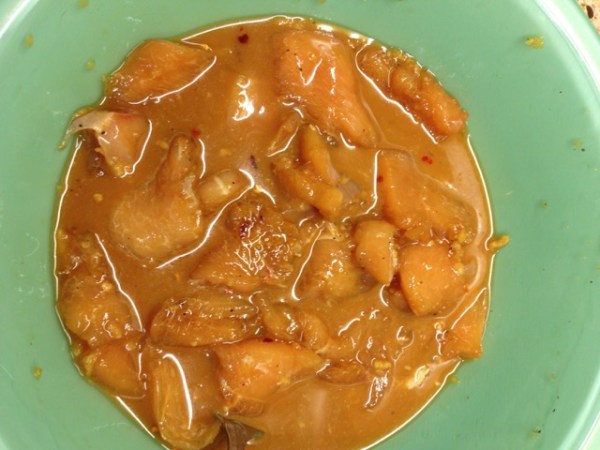
Combine corn starch, soy sauce and chicken broth in large bowl, and stir until smooth.  Add ginger, garlic and pepper flakes to liquid and stir.  Marinate sliced chicken in this mixture for at least 30 mins.  Stir occassionally.

img_1753

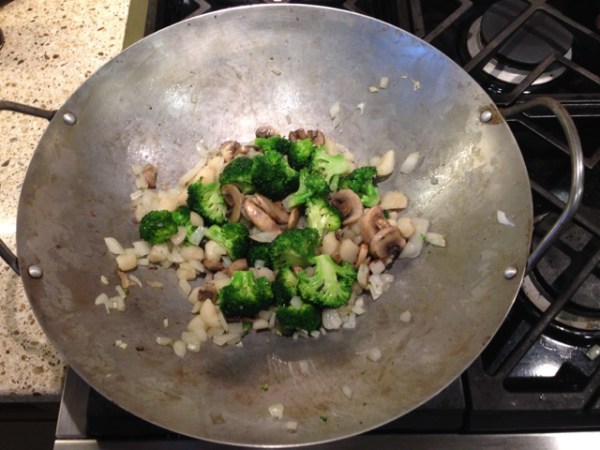
Place wok or saucepan over medium heat.  Add 1 T oil and saute onions, mushrooms, broccoli and water chestnuts, stirring, until tender (5-7 minutes).  Empty these cooked veggies into a clean bowl and set aside.

img_1752

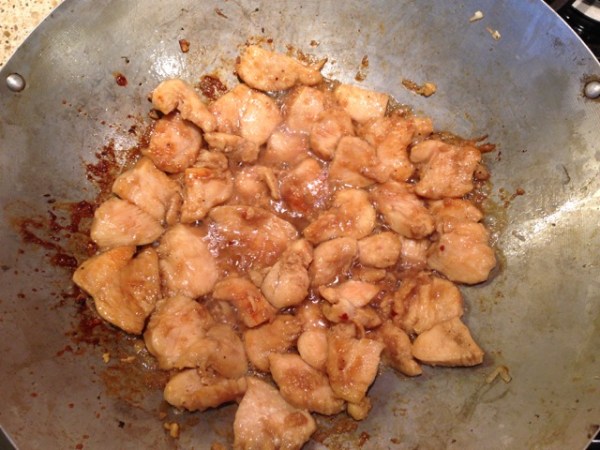
Add 1 T oil to wok/saucepan and add chicken slices, reserving liquid marinade until a bit later.  Brown chicken 2-3 minutes per side.

img_1754

img_1755

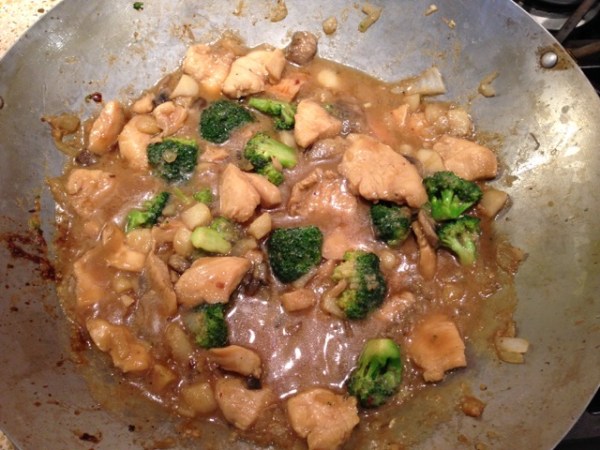
Add remaining liquid marinade and veggies back to wok/saucepan, bring to a boil, and simmer for 5-7 minutes, stirring occassionally, to allow sauce to thicken.

img_1756

Serve over cooked rice.

Add more/different veggies, cashews, or other favorite ingredients, to taste.


Say cheese!

I have a running list, mostly in my head, of things I want to try.   Homemade mozzarella cheese has been on the list for quite some time.   We go through enough of it, so I wanted to give it a shot and see how it turned out.   So here we go…

The recipe I used is here.  And it is a good one.  My additional notes with pics below.

I ordered some citric acid powder and Fromase rennet tablets (vegetable-based) from my trusty Amazon account. 

1 1/2 tsp citric acid powder dissolved in 1 cup of cold water.  I used bottled spring water, since chlorinated water is a no-no.  Set aside.

1/4 tablet Fromase rennet dissolved in 1/4 cup bottled spring water. Set aside.

1 gallon whole milk.   Homogenized but NOT Ultra High Pasteurized (UHP) – another no-no.  I used HEB-brand whole milk, and I will again.

1 tsp kosher (not iodized) salt

Pour milk and diluted citric acid unit a 5-quart or larger stainless steel or ceramic NON-REACTIVE pot.  Stir well.  Aluminum or iron are bad… from a cheese-making perspective.   I have a Le Crueset enamel-over-cast iron dutch oven that was a good size, and the enamel ensures it won’t interfere with the citric acid / milk reaction.

Raise heat, slowly, to 90 degrees Farenheit.  Remove from heat.  Add diluted rennet solution and stir, most lightly, for 30 seconds.  Cover and don’t disturb for 5 minutes as the curd sets and starts to separate from the whey liquid.   The consistency of curds you’re going for is soft tofu-ish.   After 5 minutes, mine wasn’t very solidified, so I covered again and let sit for another 3 minutes.

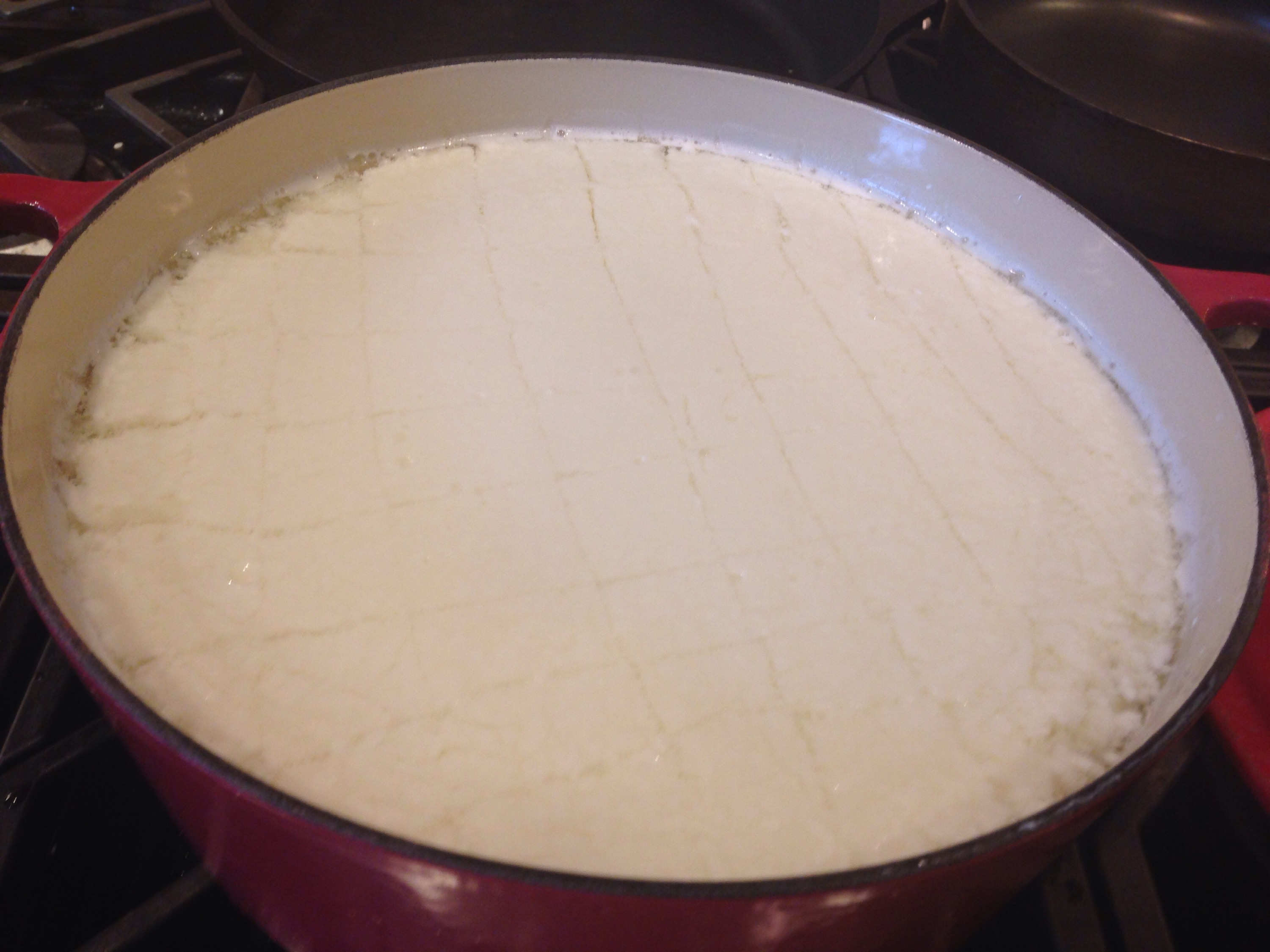
Uncover and make 1″ x 1″ cuts from top to bottom.  I used a stainless steel cake frosting spreader.

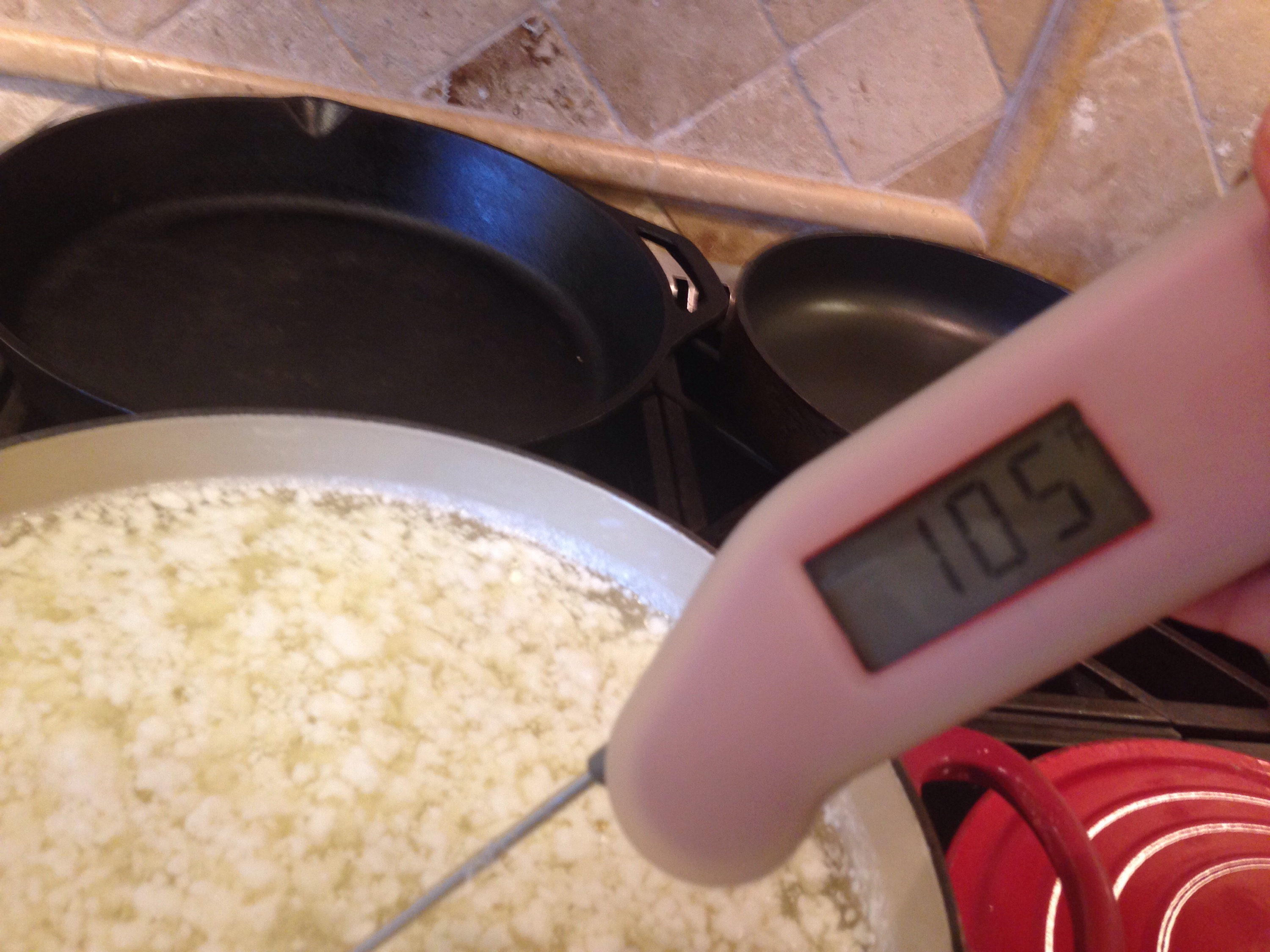
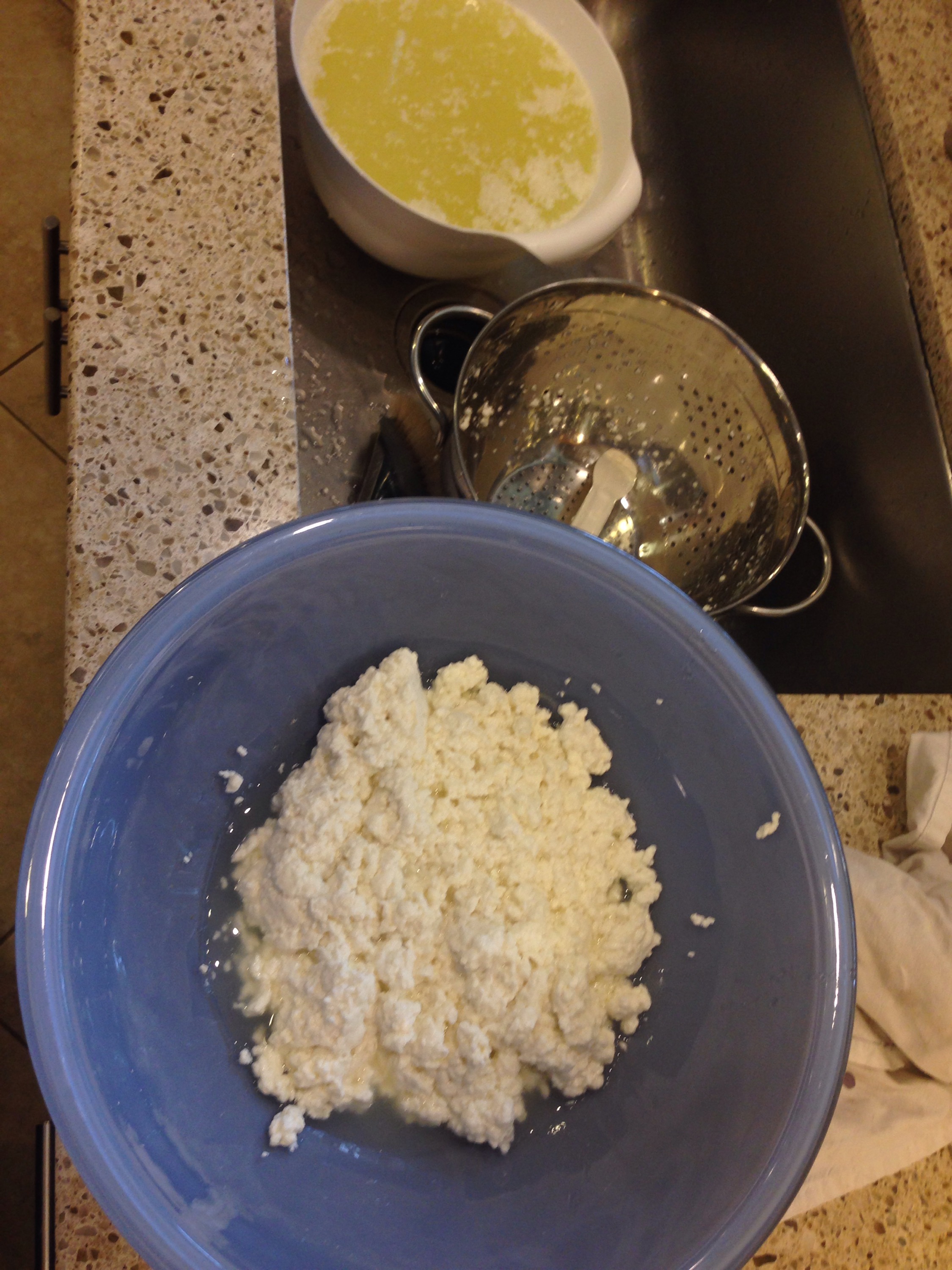
Return to low heat, stirring lightly, until temperature is 105 degrees farenheit.   Remove from heat and continue stirring for another minute or two.   The curds start separating from the liquid whey and will want to begin to clump together. Separate curds from whey.  I used a stainless steel colander on top of a large plastic bowl, and a stainless steel scoop.  The picture below shows the remaining whey at the top, and the glass bowl of almost-mozzarella curds in a microwavable bowl at the bottom – ready for the next step.
  Heat in microwave in small bursts, measuring temperature, and stirring in between bursts, until mixture reaches 135 degrees farenheit.   My microwave is pretty strong, so I used 20 second intervals of heating, and then stirring, until it reached 135 degrees. Strain off remaining whey.  Begin kneading (like dough) and stretching, alternating, until mixture becomes cohesive and stringy.

I forgot to add the kosher salt until after the cheese got to the ball stage.   So, this attempt yielded stringier portions than I had imagined.  But it held together alright.  Next time, I will use less salt than called for in the recipe (I’ll try 1/2 tsp next time).    I formed my first batch into 3 loaf-ish shapes.

And then I put in a container with part whey liquid / part water and covered in the fridge.

  First taste… caprese salad…. delicious!
I’m going to get another gallon of milk proto!  I’m hooked.

Sugar bombs.

I was introduced to cake pops recently, when a friend brought a dozen to a party.  They are an excellent sweet treat.   This weekend I took a stab at making a batch myself.    Here’s how they turned out:

IMG_8377

I did a little research beforehand, googling a few recipes and how-tos.   This is the one I picked to guide me, and pretty much followed it exactly.   I made one modification – I detest frosting-in-a-can, as its main ingredient is partially hydrogenated fat.   I bought a powder mix instead – which was basically powdered sugar, really.   I just had to add butter and a bit of milk.  And it worked great for the frosting.  I mixed up half a box (i.e., about as much frosting to cover half a cake), on the advice of the how-to that I was following.   And it worked fine.

I bought pure white Wilton candy chips, and added food coloring.  I have to say that the “dipping” phase is still a mystery to me.  No matter what I tried, the candy coating was always the consistency of frosting.  I tried both the microwave method, as well as the double boiler method.   It was still very thick.    So I couldn’t really “dip” the pops.  I spun them through the coating and had to smooth with a knife most of the time.   No matter, though, they turned out fine.

Some people recommend buying floral arrangement foam to use as a stand to hold your cake pops.  I asked Monte to make me a few stands with wood scrap he had laying around in the shop.  They worked great.

Literary inspiration.

I recently read Ernest Hemingway’s Islands in the Stream. I enjoyed it – set in the Caribbean, full of sea and salt and many an alcoholic beverage.
One of the favorite drinks of the main character in the book, Thomas Hudson, was a gin drink with coconut water, lime juice and bitters. It sounded interesting enough to me to concoct one and try it. And it was pretty good! We call it a “Tom Hudson.” There wasn’t a recipe in the novel, so the individual quantities are up to the bartender’s discretion. But here’s how I like them:

Tom Hudson
– 2 oz gin
– 4 oz coconut water
– juice of 1 lime
– a few (or many) drops of bitters
– serve on the rocks

Cheers, Ernest!

IMG_5920.JPG

Wine me, Marge!

Happy National Drink Wine Day!!! Of course, I obliged:

20140218-192913.jpg
For dinner, I made a side dish I’ve been wanting to try for a while.

20140218-193434.jpg
Roasted Curried Cauliflower
– 1 cauliflower head, cut into bite size pieces
– 1 tsp lemon zest
– 1 T curry powder
– 1 t garlic powder
– 1/2 t tumeric
– 1/4 t sumac
– 3 T olive oil
– 1 T coconut oil
– kosher salt and ground pepper to taste

Heat oven to 400 F. Combine spices and oil in large bowl. Toss cauliflower florets in spice mixture. Turn out onto jelly roll pan. Roast for 40 minutes, stirring and turning at halfway point.

Mmmmussels.

Super Bowl Eve dinner.

20140202-010933.jpg
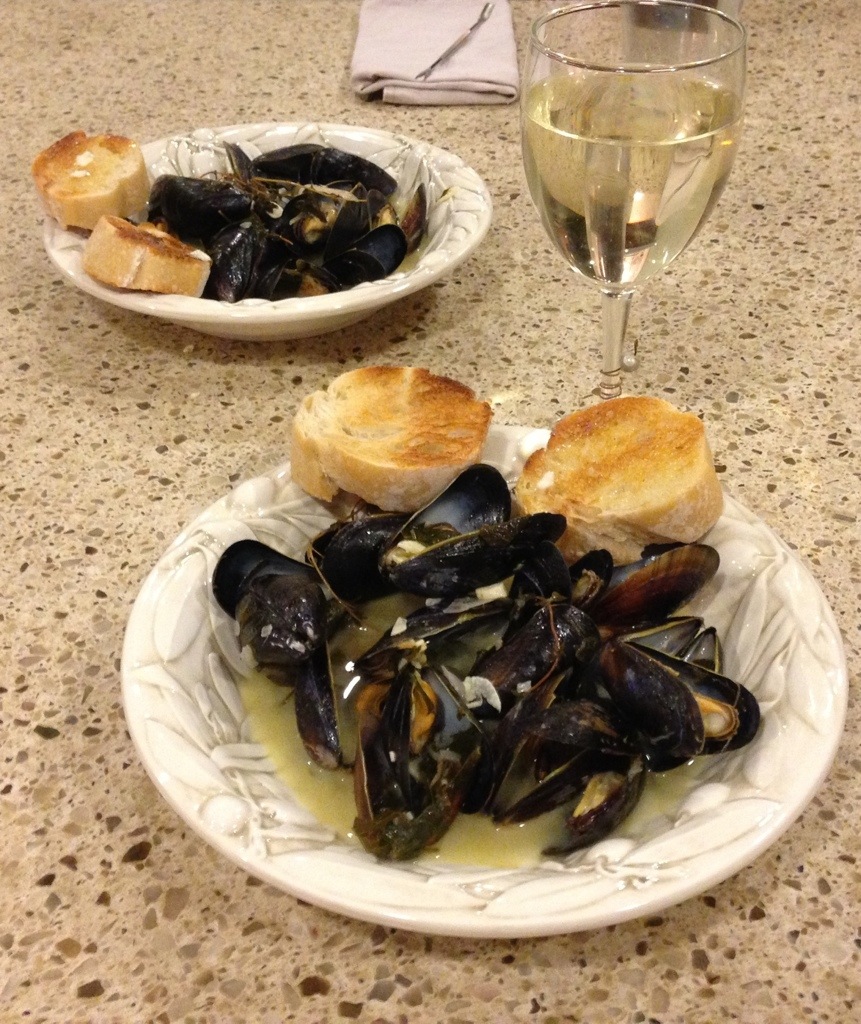
1 lb mussels, 2 cloves sliced garlic, 1 diced shallot, 1/4 c chopped parsley, several stalks of thyme, pinch of salt, dozen or so pieces of saffron, tbsp butter, 2 cups white wine.

Toss all but mussels in skillet, bring to low boil for 5 mins. Add cleaned mussels. Cover and cook for 10 mins til mussels are open. Shake pan a few times. Add a couple pieces of toast and yum!

Sweet red peppers.

Oh man, I love roasted red peppers. I made up a batch for dinner tonight.
20130219-215436.jpg

I blacken them whole right on top of the gas burner.

20130219-215449.jpg

Sweat them in a ziploc bag to allow the skin to separate while they cool to the touch.

20130219-215522.jpg

Cut them open to remove the stem and seeds.  Then scrape off the burnt skin leaving the sweet roasted meat.

20130219-215536.jpg

I warmed them again in a 200 degree oven before filling them

20130219-215546.jpg

For the filling I stirred up about an ounce of soft goat cheese per pepper, one minced clove of garlic and about a tablespoon of plain Greek yogurt and spread it on the insides of the peppers. Then folded them back up.

20130219-215627.jpg

The presentation here isn’t great, but they were delicious!!

Three P’s.

Yum!

We’ve been anxiously awaiting some, *any*, rain at our house for the last 72 hours or so.   In between weather radar checks, I cooked dinner tonight.  And as we were finishing, the rain started falling — yeah!!

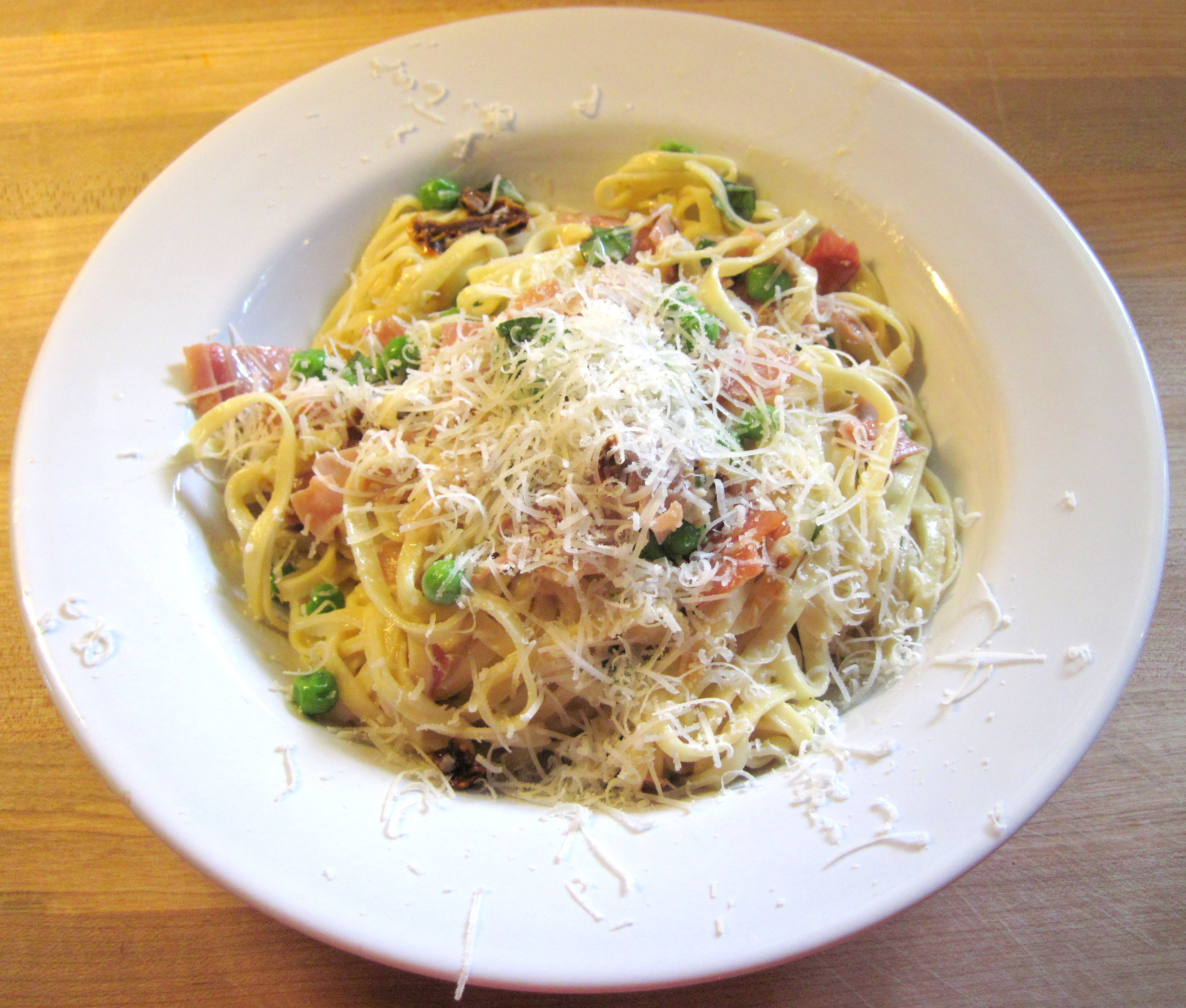
Pasta, Proscuitto & Peas

6 oz fresh pasta (I used linguine)
1 T butter
1 T olive oil
1 shallot,  finely diced
1 clove garlic, finely diced
2 oz sun-dried tomatoes, thinly sliced
4 oz prosciutto, sliced into long thin strips (I trim off fat to throw it in while sauteing the shallots and garlic)
1/2 c white wine
6 oz green peas (i used frozen, you can also use fresh)
1/2 cup heavy cream
6 oz parmesan cheese, finely shredded

Boil pasta in salted water.  Over medium heat, saute onions, garlic and sun-dried tomatoes til soft in butter, olive oil and trimmed fat from prosciutto. After a minute or two, add sliced prosciutto.   Stir for 2-3 minutes.   Add wine to de-glaze pan, stir and reduce by 1/2.  Add peas and cream.  Stir again for 2-3 mins. 

When pasta is done, strain (saving 1 cup pasta water in case sauce needs thinning). Remove sauce from heat and place strained pasta in cream sauce.  Toss pasta in sauce.  Add pasta water if needed to thin sauce.

Stir in cheese.   Serve!

Pizza night.

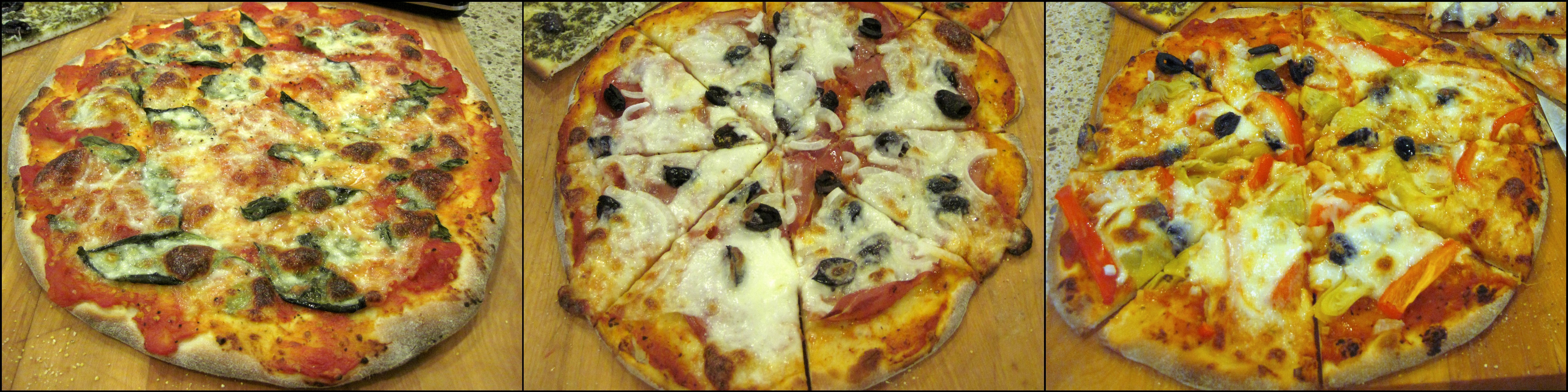
Pizzas 2-4

We made pizza for dinner tonight.  4 doughs.   I didn’t get a picture of the first one – with homemade pesto, olives, and parmesan cheese.  Delicious!  Pizza 2 was a margherita with homemade sauce with tomatoes from the garden, homegrown basil, and mozzarella cheese.  Pizza 3 was red sauce, proscuitto, black olives, onions and mozzarella, and pizza 4 was red sauce, artichoke hearts, red bell peppers, olives and mozzarella cheese.

The best part of pizza night are the leftovers.

Julie and I watched Wanderlust tonight.   You guys will just have to watch it and judge for yourselves.  🙂

TGIF!!!!

Daily bread.

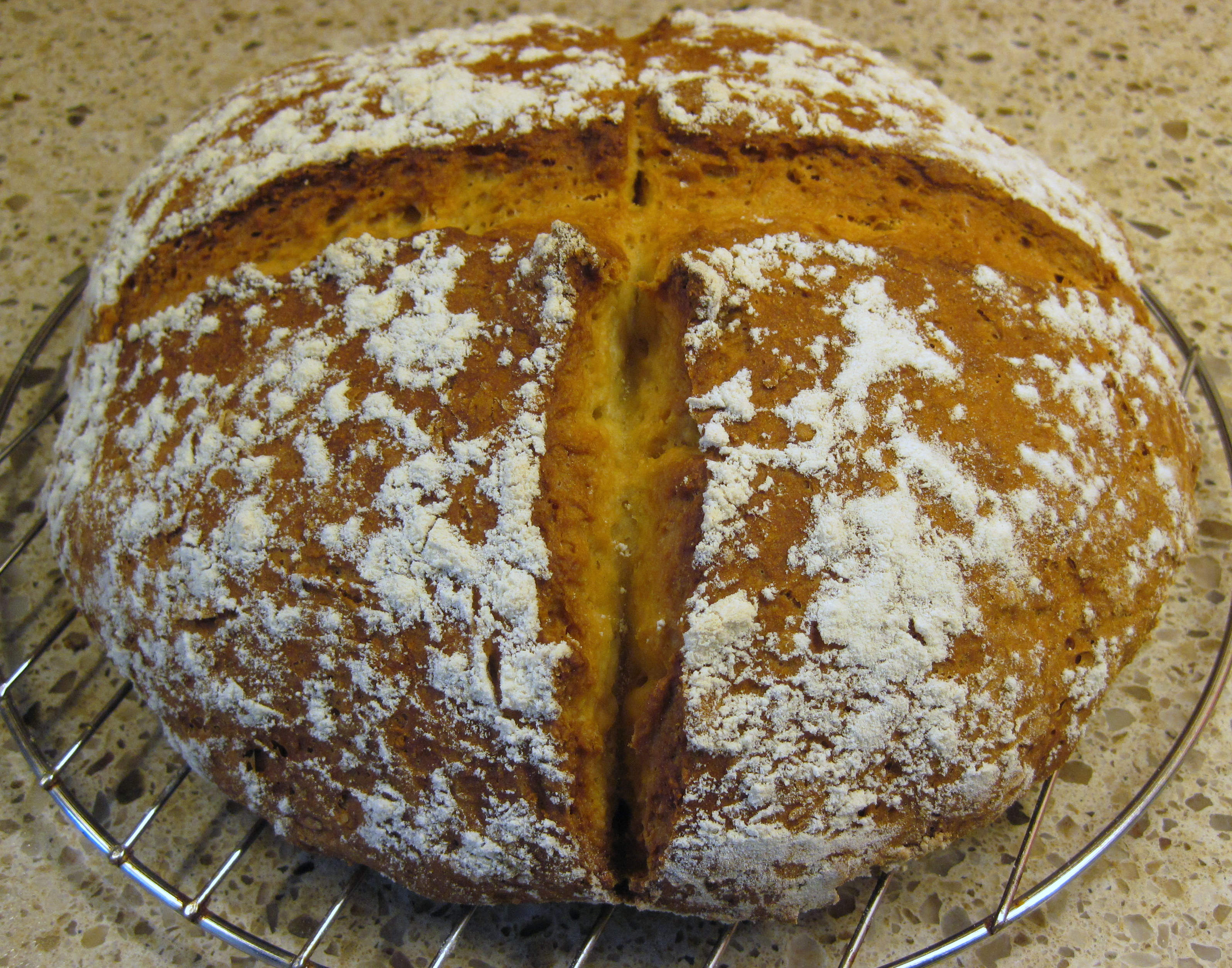
Soda bread.

Jacques Pépin‘s biggest fan may very well live under our roof.   Monte follows his show regularly.  Every once in a while we’ll try one his recipes out.

This is a soda bread recipe that I’ve tried, two ways.  Jacques says it can be made either with regular milk and baking powder, or with buttermilk and baking soda (the more traditional, I suppose).

Last week I made it with milk & baking powder.  Yesterday, (pic above) I made it with buttermilk and baking soda.  Both were good.  I think this last loaf cooked a little too long, though.  Either that or the fat in the buttermilk caused it to get more yellow than white inside.

You can watch the episode (link here), if you like.  Or, here’s the recipe, below.  If you want to try it w/ the milk and baking powder combo, just swap out the buttermilk and baking soda in equal quantities.

Soda Bread

1/2 tsp canola oil
3 c all-purpose flour
1 1/2 tsp salt
1 1/2 tsp baking soda
1 1/2 c buttermilk (room-temperature if possible)

Preheat oven to 425 degrees.  Cut sheet of parchment paper to cover baking sheet.  Coat parchment paper with canola oil.

Hold 1 Tbsp flour aside to dust loaf before placing in oven.  Sift the rest of the flour together with salt and baking soda in a large bowl.

Add buttermilk to dry mixture and stir til combined.   You want to make sure to add the buttermilk right before you’re ready to put it in the oven.   Don’t let it sit.   Turn dough out onto parchment paper.  It will be a bit sticky.  Cover with saran wrap and form into a round dough, about 7″ in diameter.  Remove saran wrap.  Dust with previously set aside flour, and cut a shallow x in the top of the loaf.

Cover with an upside down stainless steel bowl.   Cook in oven for 30 mins covered.  Then remove bowl and cook for another 30 mins.

Remove and place on rack to cool before enjoying.

Soup’s On!

Lentil soup.

With cooler weather in town, it’s time to make soup!  One of my favorites is lentil soup.  As I made this tonight I flashed back to 2 years ago when the kitchen remodel was finally over, this was the first thing I made on the awesome new gas range.

Here’s the recipe I mostly stick to each time:

Lentil Soup

1 lb dry lentil beans
2 Tbsp olive oil
salt & pepper to taste
1 cup chopped onion
1 cup chopped carrot
2 cloves garlic minced
1 14 oz can petite diced tomates
1 Tbsp tomato paste
8 cups chicken broth
4 oz diced lean ham

Rinse lentils well in colander.  Heat large sauce pan to medium high.  Saute onions and carrots in olive oil, add salt & pepper.   Add garlic a little later to prevent it from burning.  After about 5 minutes, add diced tomatoes & juice and tomato paste.  Stir for a few minutes and then add broth, lentils and ham.  Bring to a boil, and then lower heat to a simmer and cover.   Cook for about an hour.

Serve with grated parmesan cheese on top.   Makes 6-8 servings.