
We took Nirvana out for a sail in Sunday’s beercan. We didn’t win the race, but I won the latest battle in mending the jib. My latest repair held nicely in 20+ knot winds. 👍🏼

We took Nirvana out for a sail in Sunday’s beercan. We didn’t win the race, but I won the latest battle in mending the jib. My latest repair held nicely in 20+ knot winds. 👍🏼
While we were away, we left a key with our neighbors, so they could use the shop. When we got home, we found that they’d left us a bag of their home-roasted espresso beans on the counter. What a nice welcome home surprise. ☕️🤎

I thought I’d share a few takeaways from our trip on the Queen Mary 2 and our 9-day wander through British history.
October is a great month to book on the Queen Mary 2 and walk around southern England. Not too cold. Not too crowded.
Get a starboard cabin if you are on an eastbound transatlantic passage of the QM2, imho. The winds are usually blowing out of the north, so it made for more pleasant balcony experience.
Never leave home without a tiny tube of superglue. 🙂 On day 2 of our trip the earpiece on my eyeglasses broke off. The weld at the metal lens frame just gave way. I was on a boat for 7 days where the only stores sold expensive bags, art, and watches. Fortunately, the QM2 worker in the store who I asked was one of the jewelry designers. She whipped out her toolbox that had some flexible jewelers adhesive. A dab of that got me through the week, when they broke again. I hit the first Tesco on dry land for my own tube of superglue.
It isn’t always raining in England. For us, it only rained on two of our travel days, and one afternoon when we walked around Portsmouth Southsea along the coast. We, and our luggage, are pretty waterproof so it was fine. Ok, I just did the math, turns out it rained one third of the days we were in England. Which, in retrospect, is a lot. Oh well, it was nice to have the beautiful sunny days that we did. I remember them more vividly than the rainy days.
Be flexible.
Check closure schedules ahead of time for the places you plan to visit.
The British National Rail Two Together Railcard paid for itself several times over. A better deal than 2 Senior railcards, if you always travel together. We took the train 6 times.
Just do it.
Thanks for reading.

💙
This afternoon, we will check out of the hotel and hop on a train to Heathrow airport. I booked a room at the Sofitel at Terminal 5 for tonight so we could have a comfy last night in London, and an easy walk to our gate in the morning.
Our train leaves Greenwich at about 1pm, so we plan to spend this morning seeing a few more sights. The Painted Hall is supposed to be beautiful. It is the former dining hall of the 18th-century sailors’ hospital that the Old Royal Naval College occupies. Its ceilings and walls were painted in the 1700s with stunning scenes celebrating British history. People have compared it to the ceiling of the Sistine Chapel. This we have to see.
After paying about $50 entrance fee for both of us, it was a bit underwhelming. There was a large art installation of sorts inside that had just opened there that day.
What visitors to the Painted Hall expect to see (this is a photo of the brochure):

Nice, isn’t it? This is what we saw:

The giant lamps are nice, but I’d really rather see the ceiling. 🙂 Oh well.
That wraps up our visit to Greenwich. We’re walking to the train station, so of course it’s raining again. We transferred to the Elizabeth Line to LHR and experienced an ominous 20-minute delay about halfway there when the overhead electric lines stopped working. But we kept the faith and eventually made it to our comfy hotel room at the airport. We celebrated Halloween with Shepherd’s pie and a bottle of wine.
Our flight home tomorrow is a 10-hour direct flight to Austin. Nice and easy.

What a great trip.
Links for the curious:
The Painted Hall website to plan your visit. They have a well-done 3D virtual tour that’s worth a look, whether or not you’ve already visited in person.
Where to stay? If you want to stay at the airport, and specifically Terminal 5, Sofitel is your best bet. The Elizabeth Line from London runs to each terminal at LHR. It’s an elevator ride and an easy walk from the railway station to the hotel reception desk.
Up on the hill, behind the Queen’s house, is a large green space called Greenwich Park. I could have spent hours just walking around this park. It’s lovely. At the top of the hill sits the Royal Observatory, commissioned by King Charles II in 1675. This morning, we headed up the hill to see it.
Ok, first, some historical context. You’re a sailor in the late 1600s. Your ship navigates close to shore by piloting using well-documented coastal landmarks, bearings, and charts. When out of sight of land, your ship navigates using dead reckoning, which uses your last known position and your speed and heading to estimate your current position, but that is fraught with potential for error. Better, you can calculate your latitude (your north/south location on the globe) by measuring the angle of the sun at solar noon at your location using a quadrant and declination tables. But accurately determining your east/west position at sea, your longitude, was not yet an easy thing to do. On dry land, one could measure the transit of moons across the face of Jupiter and use celestial tables to calculate longitude. But it’s not easy to do on a boat moving on the sea.
The Royal Observatory was established in 1675 with the express charter to “find out the so much desired Longitude of Places for perfecting the art of navigation.” Work began at the Flamsteed House, by the first Astronomer Royal and his successors, to accurately map the celestial bodies. This culminated in the publication of the first Nautical Almanac in 1767. This aided in estimating longitude based on celestial observations, but still difficult to do at sea.
A second, more desirable method to determine longitude would be based on timekeeping. The Earth is divided into 360 degrees of longitude. The Earth turns 360 degrees in a 24-hour day. 360 degrees / 24 hours = 15 degrees of longitude per elapsed hour. The British Navy arbitrarily established Greenwich as its 0 degrees longitude, for the purposes of maritime navigation and charting. If you know the time at Greenwich when you observe local solar noon where you are, you can calculate your longitude. For example, if it is solar noon where you are (12:00pm), and you know that it is also 2:00pm in Greenwich, you can calculate your longitude as 2 hours x 15 degrees per hour, or 30 degrees earlier than (or west of) Greenwich. In the 17th century, though, to know the time in Greenwich required a timepiece that you set to Greenwich time when you left England, and which kept time accurately while at sea months later. In 1675, such a clock did not exist. That was the longitude problem.
In 1714, the British Parliament introduced the Parliament Act, which put up a prize of 20,000 pounds (about $2M today) to whoever could create a timepiece that met specific criteria of accuracy at sea.
In 1730, a woodworker named John Harrison attempted to build a timepiece to meet the criteria of the challenge. It took him 5 years and required learning the principles of metallurgy, but he did it. His first prototype was called “H1.”

Time trials proved it worked. However, he was paid only 500 pounds of the 20,000-pound prize. Harrison thought he could improve upon it, so he created three more prototypes over the next 25 years.


After H3, he changed his design altogether, from a clock to a watch. The result was H4.

Time trials on the H4 proved its accuracy, and work began on making additional copies, to prove how replicable the design was. Only after entreaties to the king was John Harrison eventually paid the full 20,000-pound prize, when he was in his eighties.
It’s all history now, but the next time you pull out a GPS to find your lat/long position on your boat, think about the work of John Harrison.
So, let’s discuss time a little bit more. By the 1800s, Britain’s nautical charts, which all used Greenwich as the 0 degree meridian, were becoming the global norm, though there were numerous other meridians used by other countries. In 1884, there was a global conference to declare what would become the Prime Meridian going forward. At the end, Greenwich’s meridian was declared as the Prime Meridian, to be used not only for navigation, but to establish a global basis (Greenwich Mean Time) for the 24 global time zones going forward. The location of the Prime Meridian is marked at the Royal Observatory by a metal line that intersects the observatory where the equatorial telescope sat that was used to create all the celestial tables, and proceeds out through the courtyard, and across the globe.

Greenwich Mean Time impacted everyday life beyond navigation at sea. After the Meridian Conference of 1884, the Prime Meridian at Greenwich was used as a global zero degrees longitude for navigation. Prior to that, individual towns maintained their own local times based on local solar noon, with some amount of error, obviously. But the trains must run on time! By 1847, the expanding railways had adopted GMT as their standard for timekeeping as well. By 1855, most public clocks were using GMT as well. To facilitate this, the Royal Observatory established a clock that kept official GMT time, and which emitted electrical impulses that went out on wires, to sync clocks across the country.

A red Time Ball was added to the top of the Royal Observatory that would raise to the top of a mast at 12:55pm each day, and fall at 1:00 pm GMT. It was observed by ships in the Thames below to synchronize their timepieces on board before setting out to sea – so they could reliably calculate their longitude on their journey.

Pretty damn cool.
I have often thought out loud that I have lived during one of the most exciting times – with the evolution of technology, computing, and the internet, and whatever else is happening these days. But as I think about the history I’ve absorbed over the last week, there has been no shortage of innovation across the centuries brought to life by meticulous and hard-working people that just wanted to solve the problem at hand.
By the end of a full day, the clouds were gathering again with rain, so we headed back down the hill to our hotel.

Links for the curious:
Royal Observatory Greenwich website, to plan your visit.
About 10 years ago I read a book by Dava Sobel, called “Longitude.” It tells the story of John Harrison and his quest to solve the longitude problem. Check it out if you’re interested in more information. I enjoy her books, which I would classify as scientific non-fiction (?). She delves into historical figures and science topics. “Galileo’s Daughter” was the first of her books that I read, and I try to read the rest of them as I find them.
We went to Portsmouth to see the Ships. We went to Salisbury to see the Stones. Now we are headed to Greenwich to see the Clocks. We took the train from Salisbury to London Waterloo Railway Station on the first rainy day of our trip. There are multiple ways to travel from Waterloo, in Central London, to Greenwich, in Southeast London. We are taking the easiest route by catching a ride on the Uber Boat run by Thames Clippers. It is a foot ferry that runs up and down the Thames. The closest ferry stop is right underneath the London Eye, the giant Ferris wheel along the river. The very short walk from the train station to the Eye took us right by the IBM London office building. It must be a new location; I remember it being in a slightly different location on my last business trip there, about a kilometer to the east.

The ferry was comfy. And we could grab a beverage and snack on board, and just enjoy the sights on the 45 minute trip over to Greenwich without getting wet on this rainy day.


The Cutty Sark is a beautifully restored clipper ship built in 1869 for the China tea trade; the last of its kind. It sits at Greenwich Pier, where we got off the ferry.

When fully rigged, the ship flew over 30,000 square feet of sail, with over 11 miles of running rigging.

The inside of ship was a tad unremarkable, with empty wide open space, as it was basically made to hold as much cargo as possible; densely stacked chests of tea, and later wool. A typical crew size was 20-25 men.

We toured the National Maritime Museum on the grounds of the Old Royal Naval College. It is the largest maritime museum in the world, and admission is free! Its exhibits pretty comprehensively cover British seafaring over the years, and across the globe.

Greenwich has long been a center of Royal activity. Greenwich Palace is no more, but it was the birthplace of Henry VIII in 1491 and his daughters, Mary and Elizabeth, who became queens. It was the Tudor base during his lifetime. Since that time, the Queen’s House was built here in 1619. It is now a museum and art gallery. Admission to the Queen’s House is also free, amazingly.


Probably the most famous painting in the Queen’s House is their Armada portrait of Queen Elizabeth I, but I didn’t take a photo. Here’s a link. It’s beautiful. It commemorates the failed invasion of Britain by the Spanish Armada.
The current grand buildings along the Thames were built in 1694 as a hospital for injured and aging seamen. The buildings’ layout was designed to not block the view from the Queen’s House to the Thames.

The seaman’s hospital closed in 1869, after which the site became the home of the Royal Naval College up until 1997. Now it is a cultural and historic site and foundation called the Old Royal Naval College, and it is the the heart of Maritime Greenwich.
We stayed at the Admiral Hardy, two blocks from the Greenwich pier, next to the Greenwich Market, and a short walk to all things in historic Greenwich.

The Admiral Hardy is a large public house that dates back to the late 1800s. They have 7 very nice rooms upstairs. Hotel guests “check in” at the bar. 🙂 Our room was very nice and large. No elevator, though, FYI. The hotel is adjacent to the Greenwich Market, full of food and retail vendors. The sign on the outside of the market’s current location says 1831. Inside it says “Est. 1737.” Either way, it’s been around a while.

At the end of our first day in Greenwich, we were a little damp and a little tired. On day two in Greenwich, we will see the Clocks!
Links for the curious:
Uber Boat’s Thames Clipper website, for an easy way to get from place to place in London via the Thames. Or you can just stay on and do a loop.
The National Maritime Museum website to plan a visit.
The Royal Museums Greenwich website to plan your visit.
We couldn’t leave Salisbury without visiting its Cathedral. Salisbury Cathedral construction began in 1220 and was completed in 1258. The pointy bits, the tower and spire, were added by 1330, but 38 years is a very short time to construct a working cathedral!

We took a tour of the Cathedral and saw its copy of the Magna Carta of 1215, one of only four surviving copies.
The Magna Carta was created in 1215 and established core rights for the people to protect them from overreach by the King. Tenets of the Magna Carta exist in British law today, as well as in the US Constitution, such as the idea that no man (or king) is above the law, and rights such as due process and speedy trial by jury.
The document is written on a single piece of sheepskin parchment, in very tiny Latin text. The overall parchment is about 18″ x 24″.

Salisbury Cathedral is beautiful and built in the Gothic style. It is special in its double transept design. Viewed from above, you’d see two north-south cross bars in the typical cross-shaped layout of a cathedral, instead of one.

Like other English cathedrals, Salisbury Cathedral experienced some damage during the Reformation and the English Civil War. But, it is said to be not as extensive as what other cathedrals experienced. Likewise, it was spared damage in WWII.


The Cathedral has a beautifully designed modern baptismal font, the design of which is echoed in several altars throughout.


On our way out, we strolled through the Cloisters of the Cathedral as the sun began to set.

After thoroughly exploring two cathedrals in two days, we were glad to head back to the hotel for our last night in Salisbury.

We took one last walk through the market square and found a lovely wine bar with nibblies for dinner.

Tomorrow… Greenwich!
Links for the curious:
Salisbury Cathedral’s website to plan your visit.
Salisbury Magna Carta history and information.
We arrived in Salisbury by train late in the afternoon, so we headed right to the hotel, the Red Lion Inn. Salisbury has a Cathedral, too (shocker). In the 13th century, the Red Lion was built to house stonemasons who were working on the Cathedral.
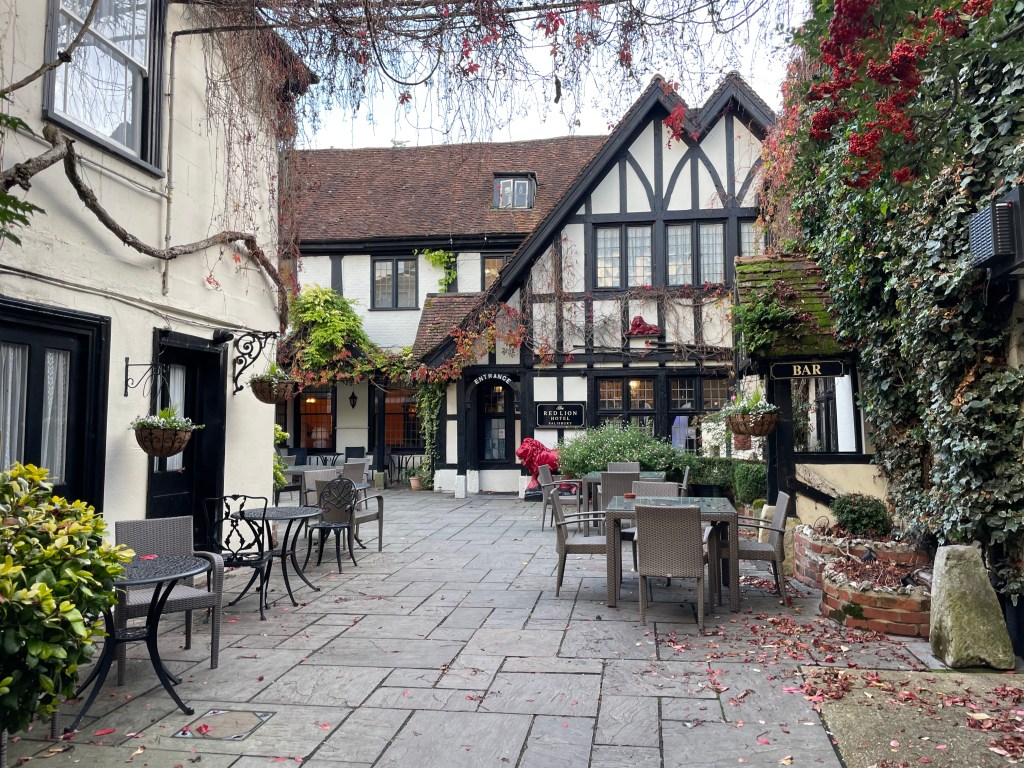
Salisbury is very walkable, too. We were a block away from the busy market square, which was full of cafes, restaurants, and stores. On Tuesdays and Saturdays, market stalls fill the square. Luckily, our stay included a Tuesday, so we were treated to a stroll around the market.
Salisbury’s River Avon and its tributaries run through the town.
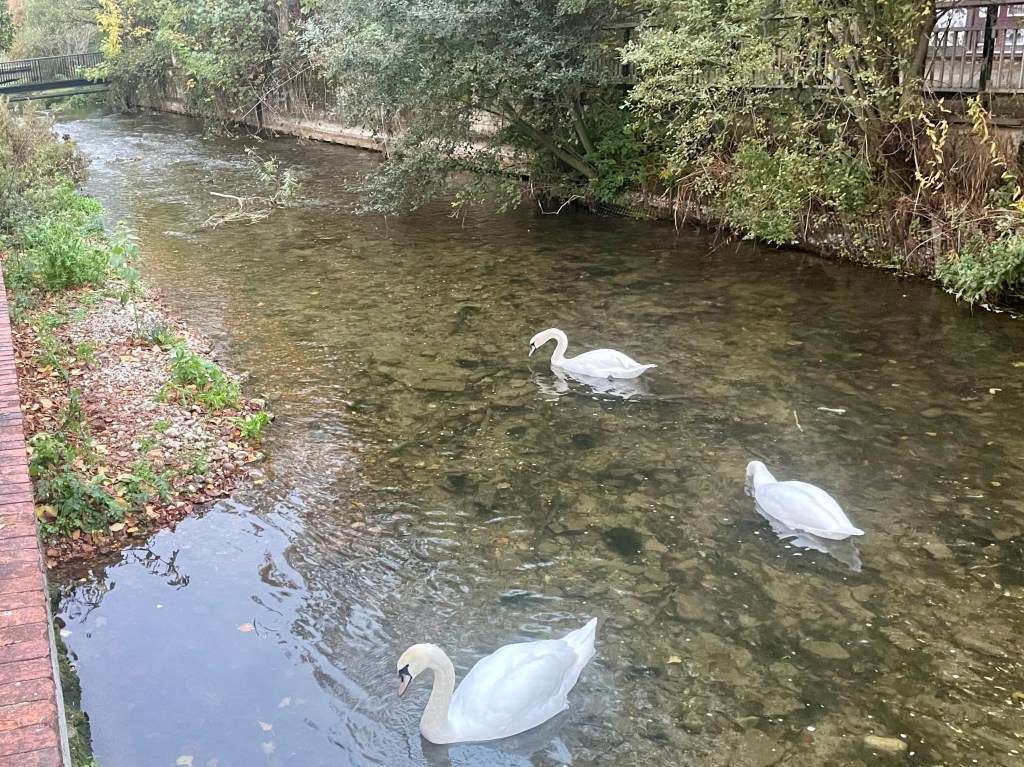
After enjoying a walk around town, we stopped in for a drink in the pub and enjoyed dinner at a nearby Italian restaurant.
Monte says that we went to Portsmouth to see the Ships. Well, we came to Salisbury to see the Stones. So, the next morning, we got up and caught the bus to Stonehenge, which stops a block from our hotel.
It was very windy, and therefore quite chilly. But we were treated to another sunny day in England.
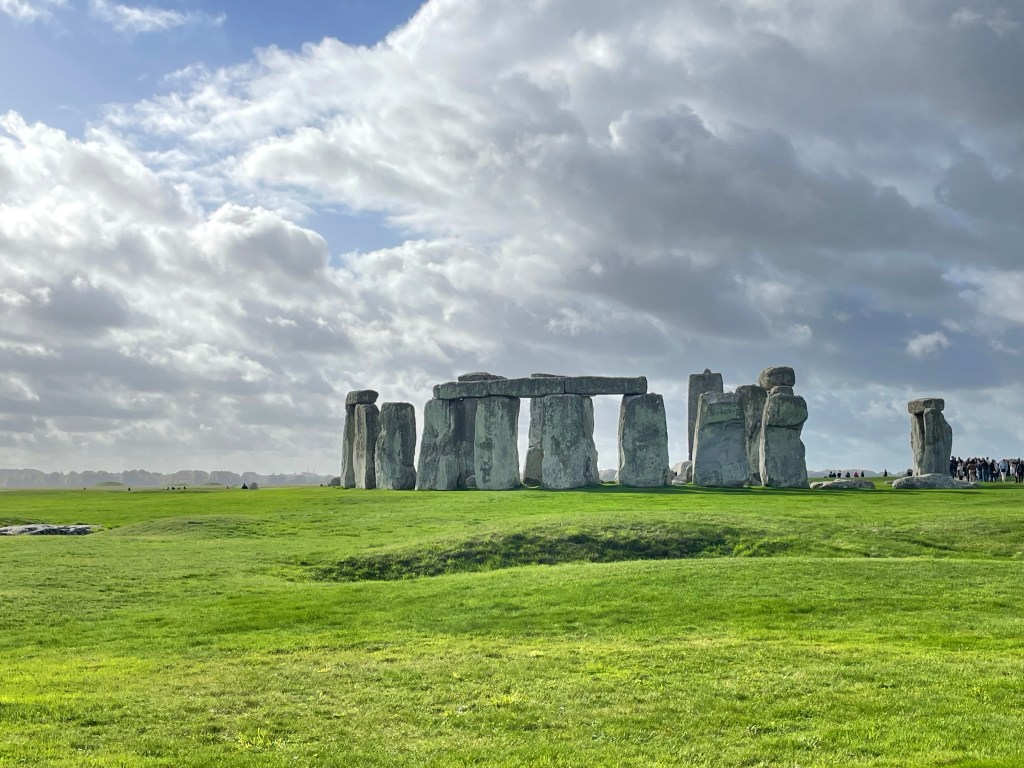
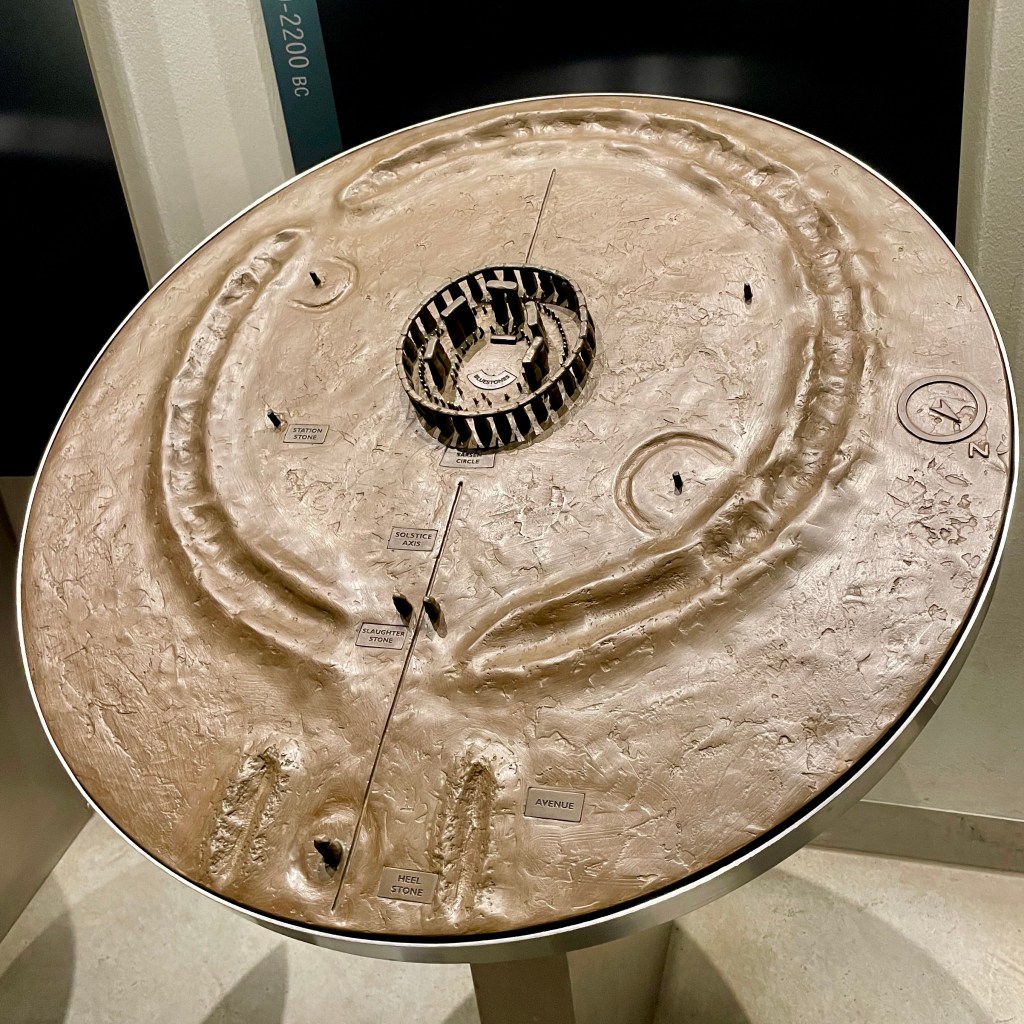
Stonehenge is the current monument at this location, estimated to have been erected around 2500 BC. As early as 3000 BC, other monuments were built here, beginning with a circular earthen ditch, and then a circle made with smaller stones. Eventually, the current stone arrangement was erected and aligned with the sun on the spring and summer solstices.
The purpose of the stones is a mystery. The leading theories include being a burial site or an astronomical calendar. It is also thought to have been an ancient pilgrimage destination, as evidence of an “avenue” can be seen that extends from the site to the River Avon. If that is true, the river may have carried visitors to the site, as well as the stones used to construct it. Many other burial sites have been discovered in the immediate area. Whatever the reason, it is truly something to walk near them (walking through the stones is no longer allowed due to preservation efforts). If it had been a warmer day, we would have walked along one of the field paths from the visitor center to the monument. But it was just too windy and chilly, and the shuttle bus was a better option.
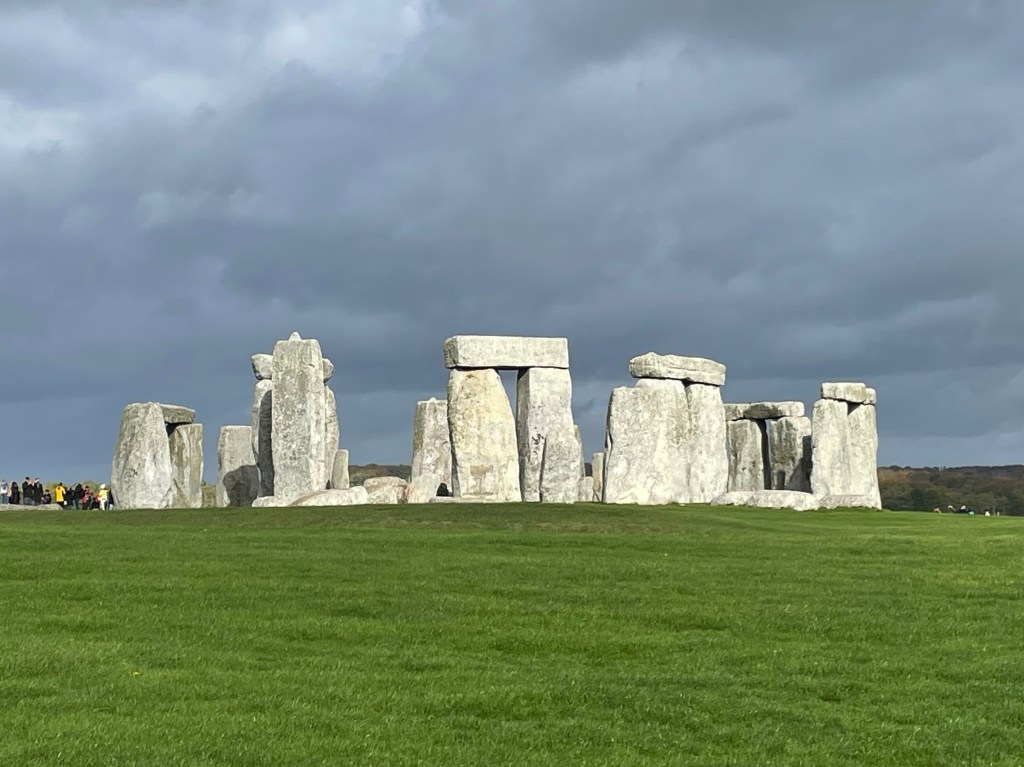
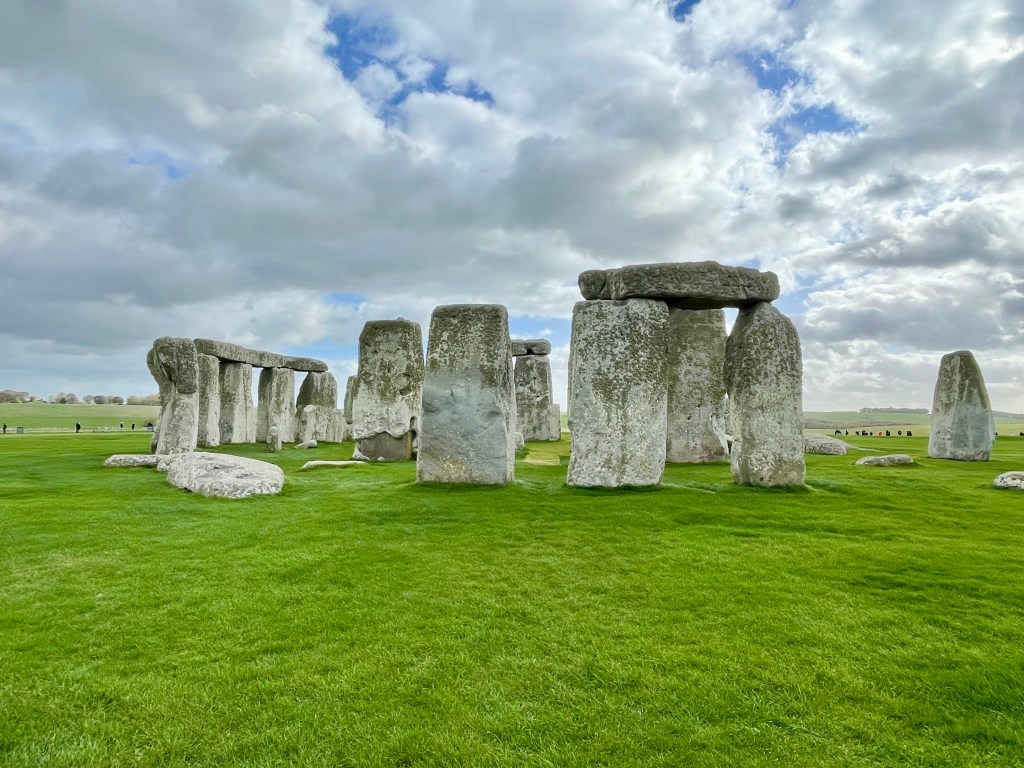
At the site, there is a circular path that goes all the way around the stones. There is an audio walking tour that you can download (ahead of time!) and listen to descriptions of the site as you walk around the monument.
After admiring the stones, we spent time in the visitor center to take in even more history of the site.

On the way back to Salisbury from Stonehenge, the bus goes by Old Sarum, which was the original name and location of the town now called Salisbury. There are ruins of an old Iron Age castle and fortifications there, along with the footings of the original Norman cathedral that stood at that site. The legend goes that the monks at Old Sarum, who lived in the cathedral, had ongoing conflicts with the soldiers who lived in the castle. They fought over water, which was in short supply. So they petitioned the Pope to move the cathedral (and the town). So they shot an arrow into the air, and where it landed would be the location for the new cathedral. The arrow allegedly struck a deer and was carried some distance. Where it eventually fell, construction on the new cathedral began in 1220. More on the Salisbury Cathedral in another post.
Links for the curious:
The English Heritage web site with information on Stonehenge history and information to plan a visit. And the English Heritage’s Stonehenge audio tour app. Download the audio before you set out for the stones.
Where to stay? We stayed at the Red Lion. Great location, great room.
After Portsmouth, we will stay in Salisbury for a couple of nights. But we decided to make another attempt to see the inside of Winchester Cathedral. So we boarded the train to Winchester again. This time, the Cathedral was open and glorious.

Inside the Cathedral, we were able to view the 12th-century Winchester Bible. We also took a guided tour and soaked up the history of the place. The Cathedral’s construction began under William the Conqueror in 1079 and was completed in 1532. During that period, architectural techniques evolved. The Cathedral’s construction began with Norman features (rounded arches, thick walls) on the central tower and transepts, later adopting Gothic features (pointed arches and flying buttresses) in its wide open nave.


Jane Austen is buried here, though the tribute on her gravestone omits any mention of her literary achievements.

The Cathedral was not damaged during World War II. But it experienced destruction from the British themselves during the English Reformation in the 1500s, when Henry VIII broke with the Roman Catholic Church and created the Church of England. The patron saint of Winchester Cathedral was St. Swithen. During the Reformation, a shrine to St. Swithin in the Cathedral that had become a destination for many religious pilgrims was destroyed and removed. The “Holy Hole” still remains, marking the entrance to his former shrine. I think it would be a great place for a geocache. 😮

And more destruction followed in the mid-1600s, after the Parliamentarians defeated the Royalists in the English Civil War. Not only did they execute King Charles I, but they also trashed most religious icons in churches across the country. In Winchester Cathedral, they broke statues and mortuary chests, smashed just about all the stained glass, and used the Cathedral as a stable for the army’s horses. A few years later, Charles II took his father’s throne, restoring the monarchy and a bit of order. In 1660, the current wall of stained glass at the Cathedral’s west entrance was constructed using shards of the broken, original stained glass windows.

That’s the end of the history lesson, and enough of all the death and destruction, already!
Oh, one other thing I found interesting…. At the beginning of the 20th century, the southern and eastern walls of the Cathedral were found to be sinking under their own weight. This was due to the high water table in the area and being built on peat. Since the water table couldn’t be lowered, someone would have to do the work underwater. A Navy diver named William Walker came to the rescue. From 1906 to 1911, he single-handedly dove down in water up to 20′ deep, to shore up the foundations with bags of cement, concrete blocks, and bricks. He’s remembered as “The diver who with his own hands saved Winchester Cathedral.”
At the end of the tour, we went down into the Crypt under the Cathedral floor. Unlike most other churches, this crypt is virtually empty, due to nearly constant flooding. In the 1980’s a sculpture by Anthony Gormley was installed. The statue is, more often than not, standing in water.

Ok, that is all for Winchester. Since we are bound for Salisbury by nightfall, we headed back to the train station and got back on board. More to follow on our visit to Salisbury.
Links for the curious:
Winchester Cathedral’s website to plan your visit.
Portsmouth Harbour lies on the northeast shore of The Solent, on the southern coast of England. We actually sailed by it before dawn as the Queen Mary 2 navigated up into Southampton. It is an important port, naval base, and home to many historic Royal Navy ships – which is the reason for our visit. I’ll share some of our highlights.


Monte has read novels about real British maritime battles and victories, and so is familiar with the history here. Me, not so much. But after our visits to the fantastic exhibits in the Portsmouth Historic Dockyard, I am now up to date on quite a few details. 🙂 The HMS Victory is probably one of the most well-known ships, and it is in Portsmouth in a drydock at the Historic Dockyard.
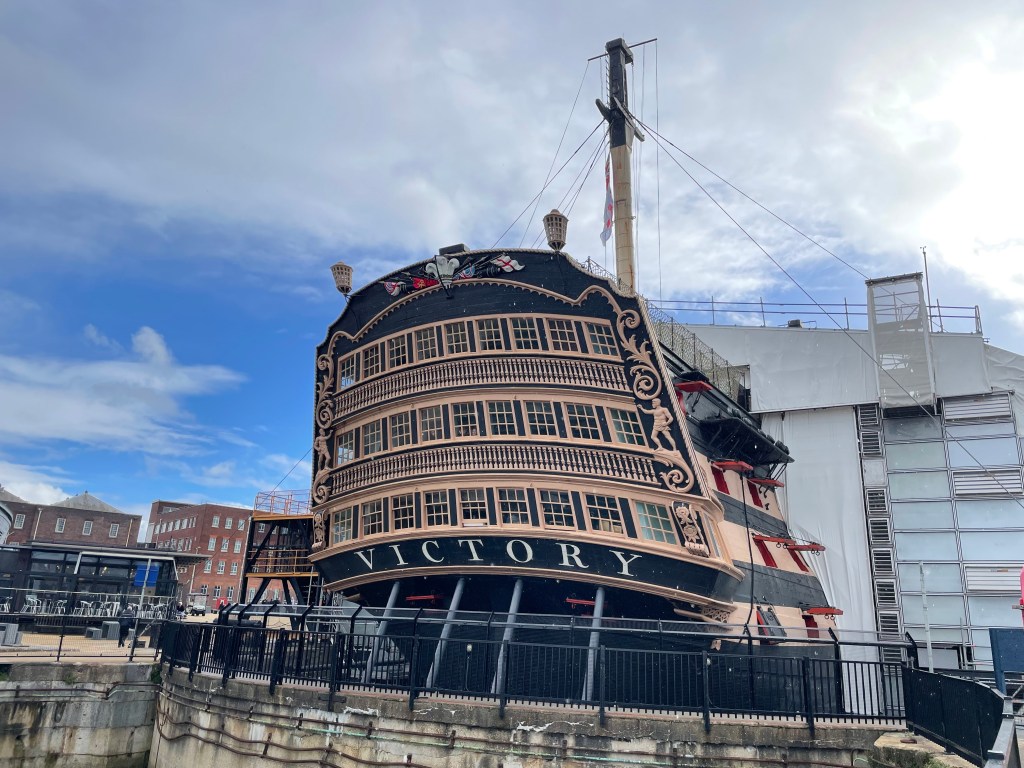
The HMS Victory was launched in 1765, and was the flagship for Admiral Horatio Nelson in the Battle of Trafalgar in October 1805 (when it was already 40 years old!) Trafalgar was the location of the British Navy’s greatest victory. The British fleet decisively defeated the combined fleets of Spain and France in the waters off of Cape Trafalgar, on the southwest coast of Spain. The Battle of Trafalgar was significant not just because it was a victory, but because Admiral Nelson was shot in that battle, died on the ship, and was transported back to England after the battle for a hero’s burial. He was, and still is, England’s most beloved sailor.

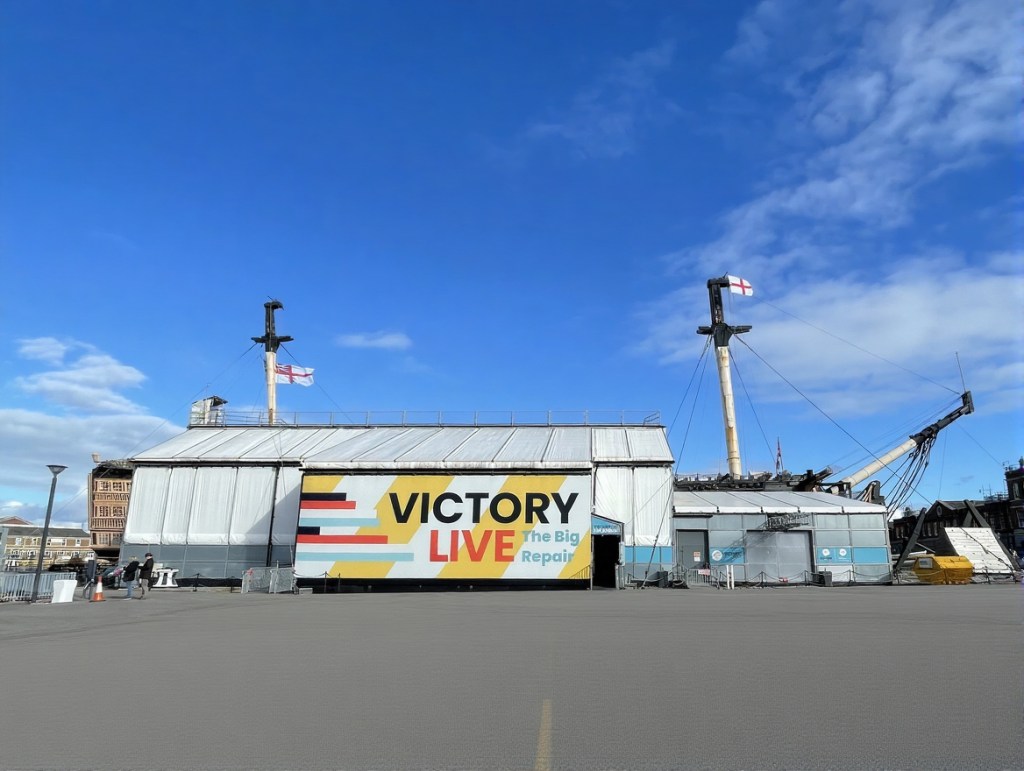
The Victory is midway through a 20 year restoration. The repair work is actually one of the exhibits – Victory Live. It doesn’t hinder seeing and touring the rest of the Victory as the work proceeds.
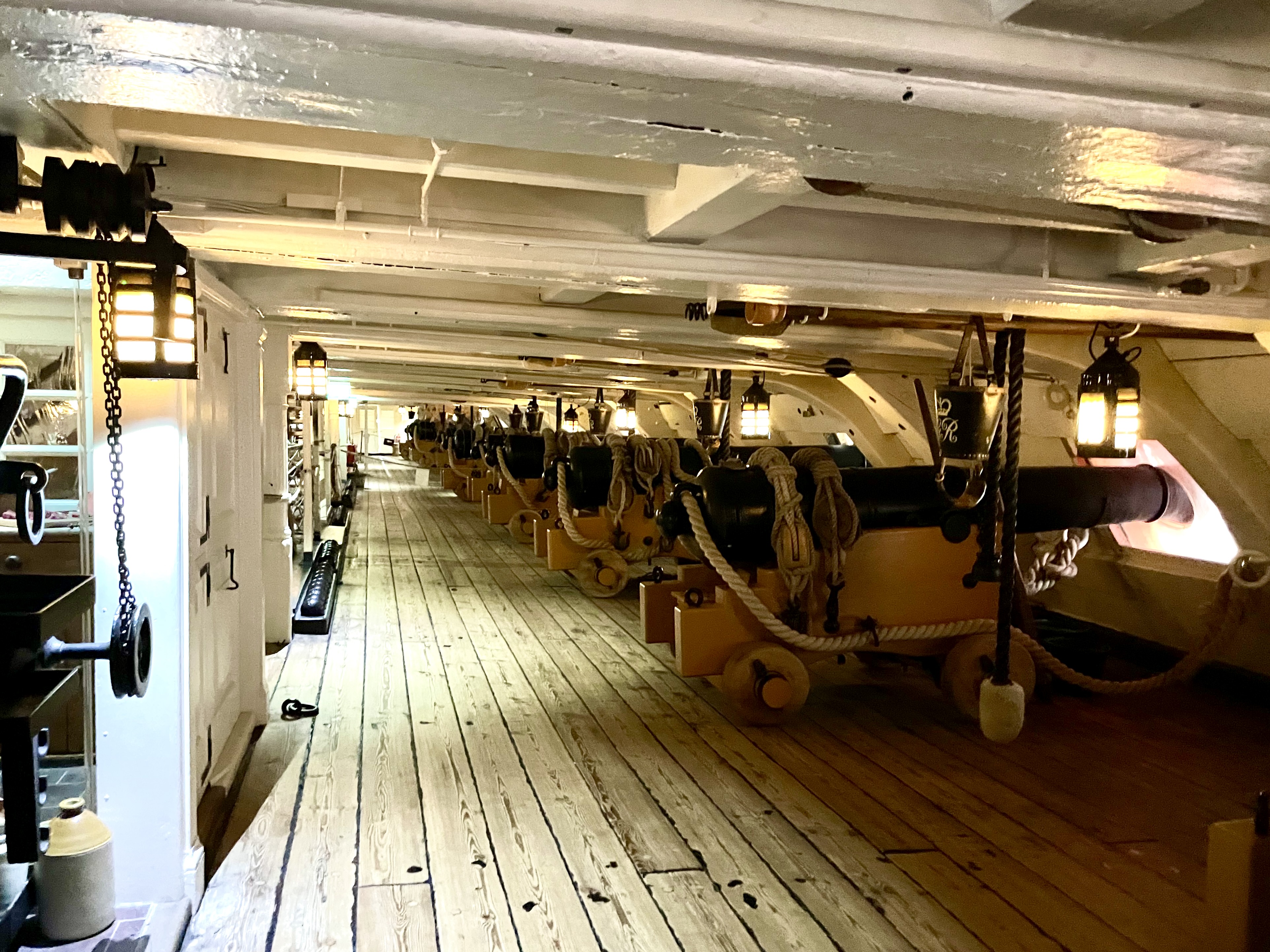

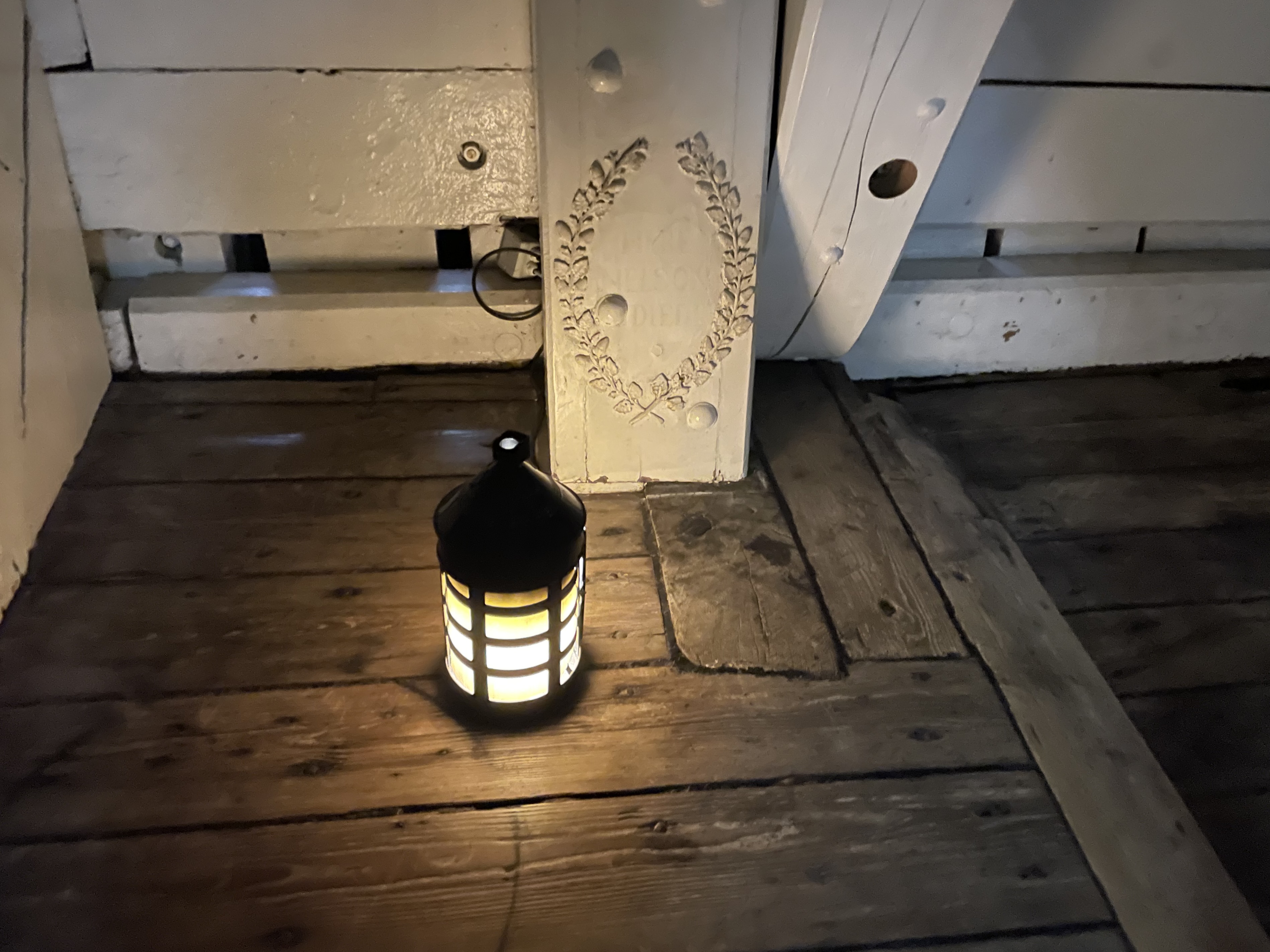

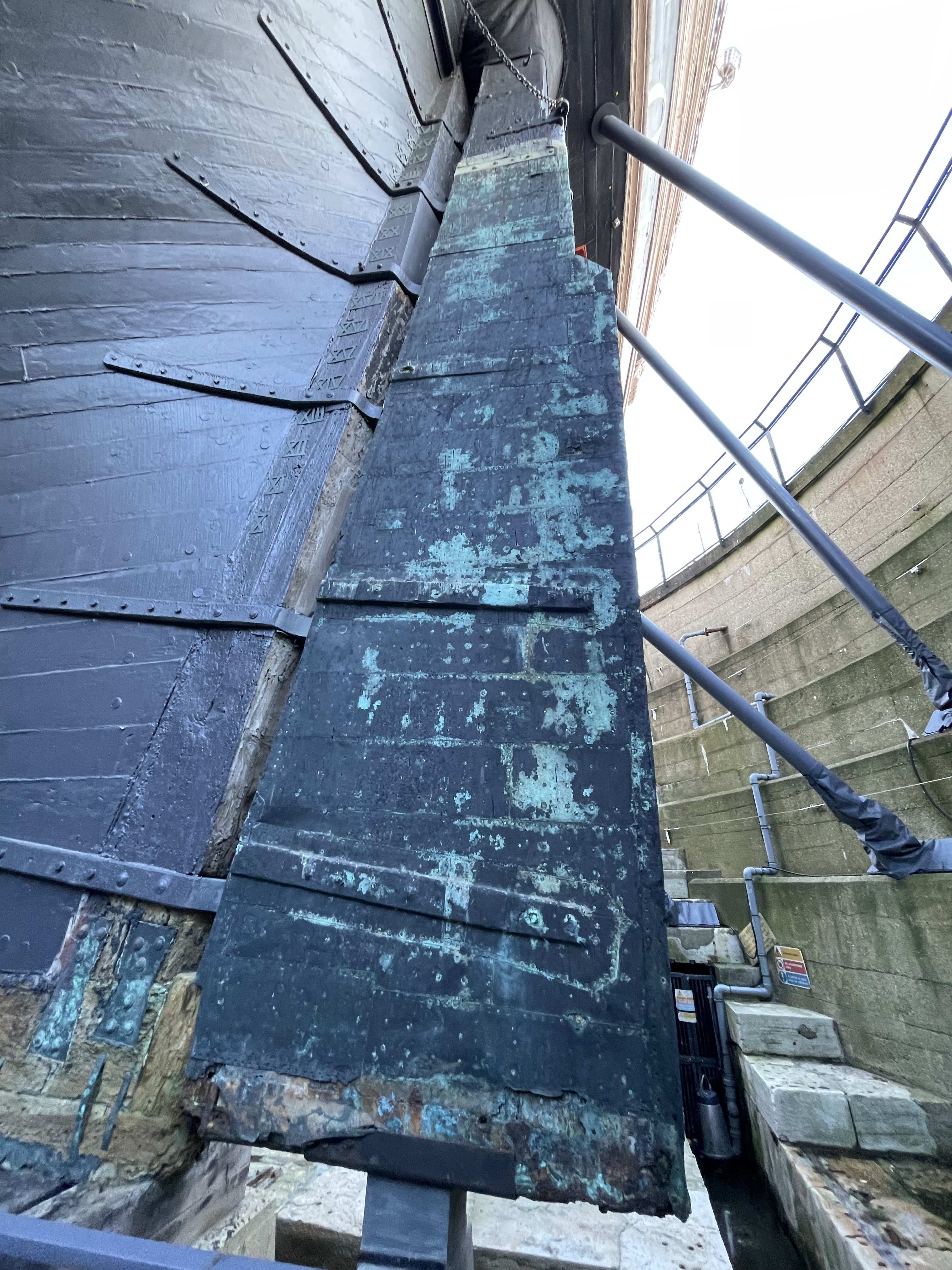
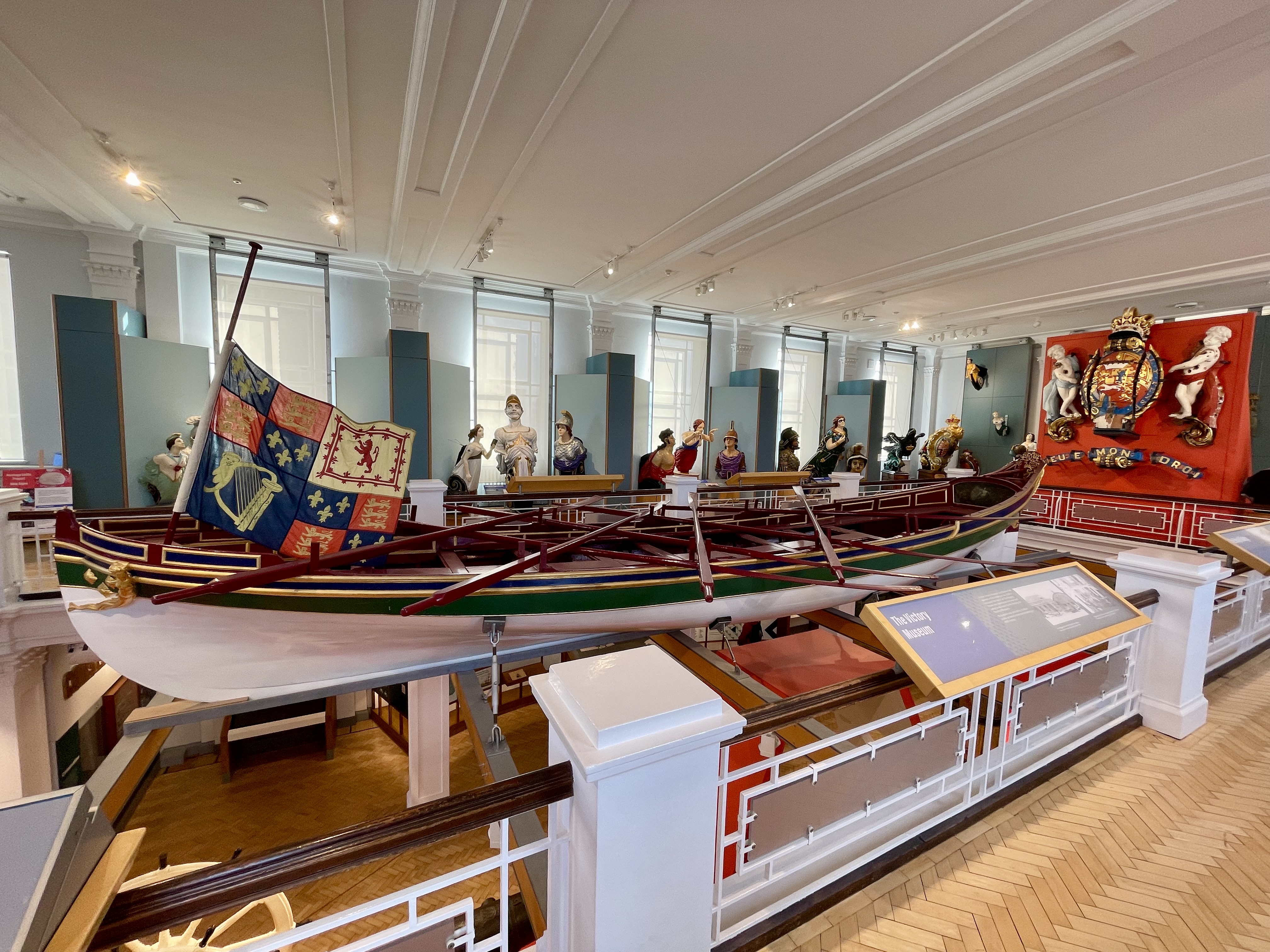
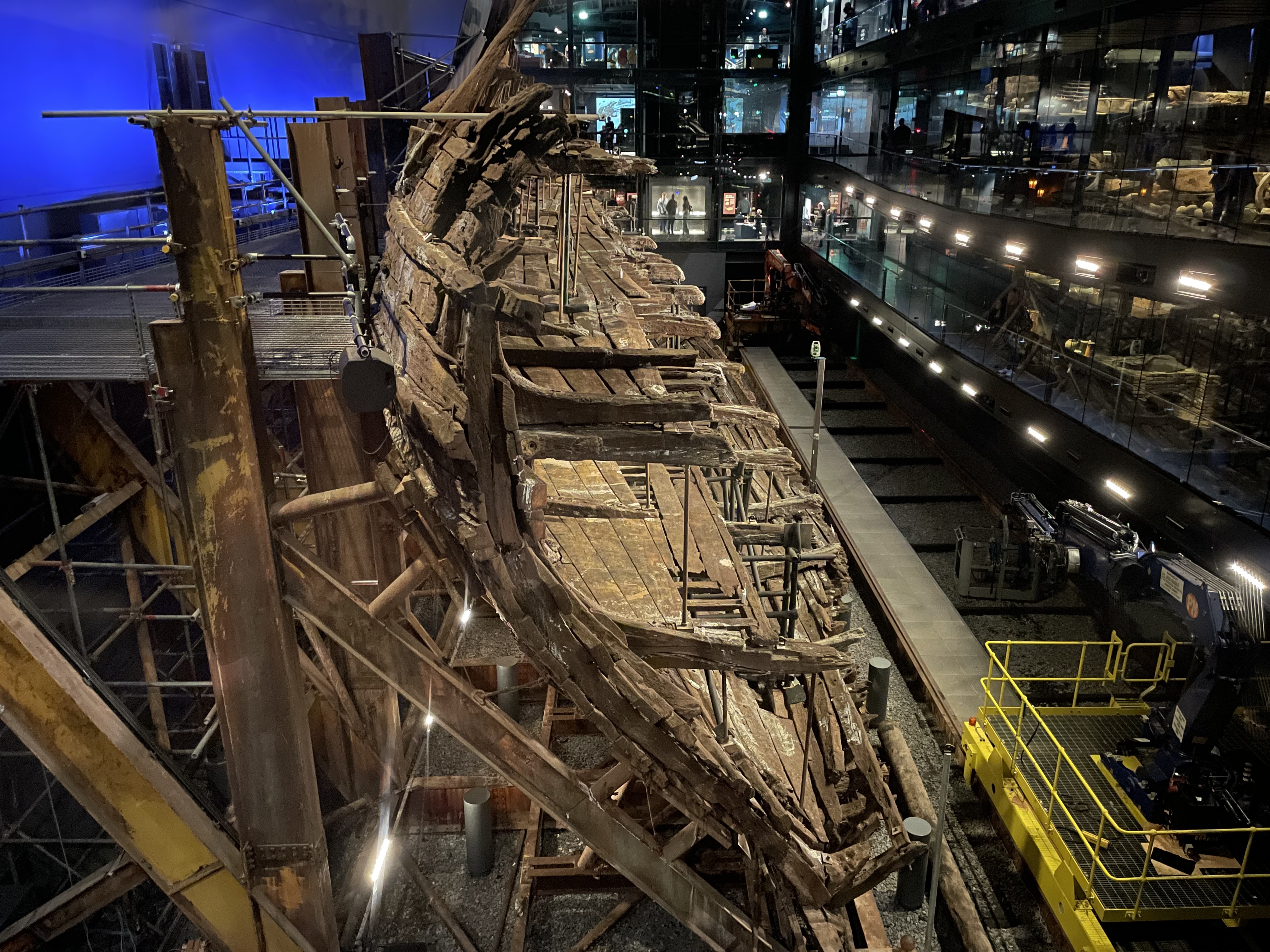
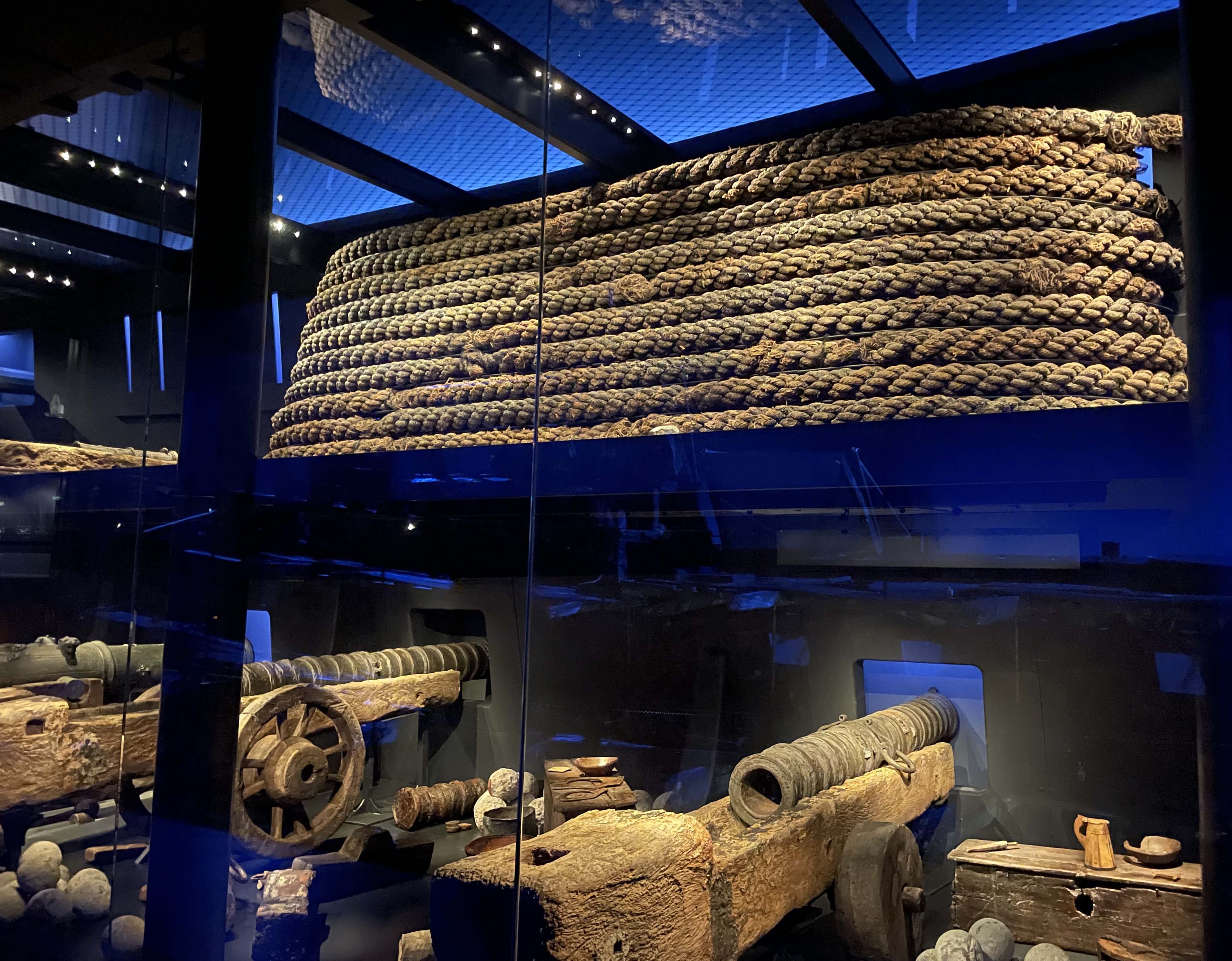
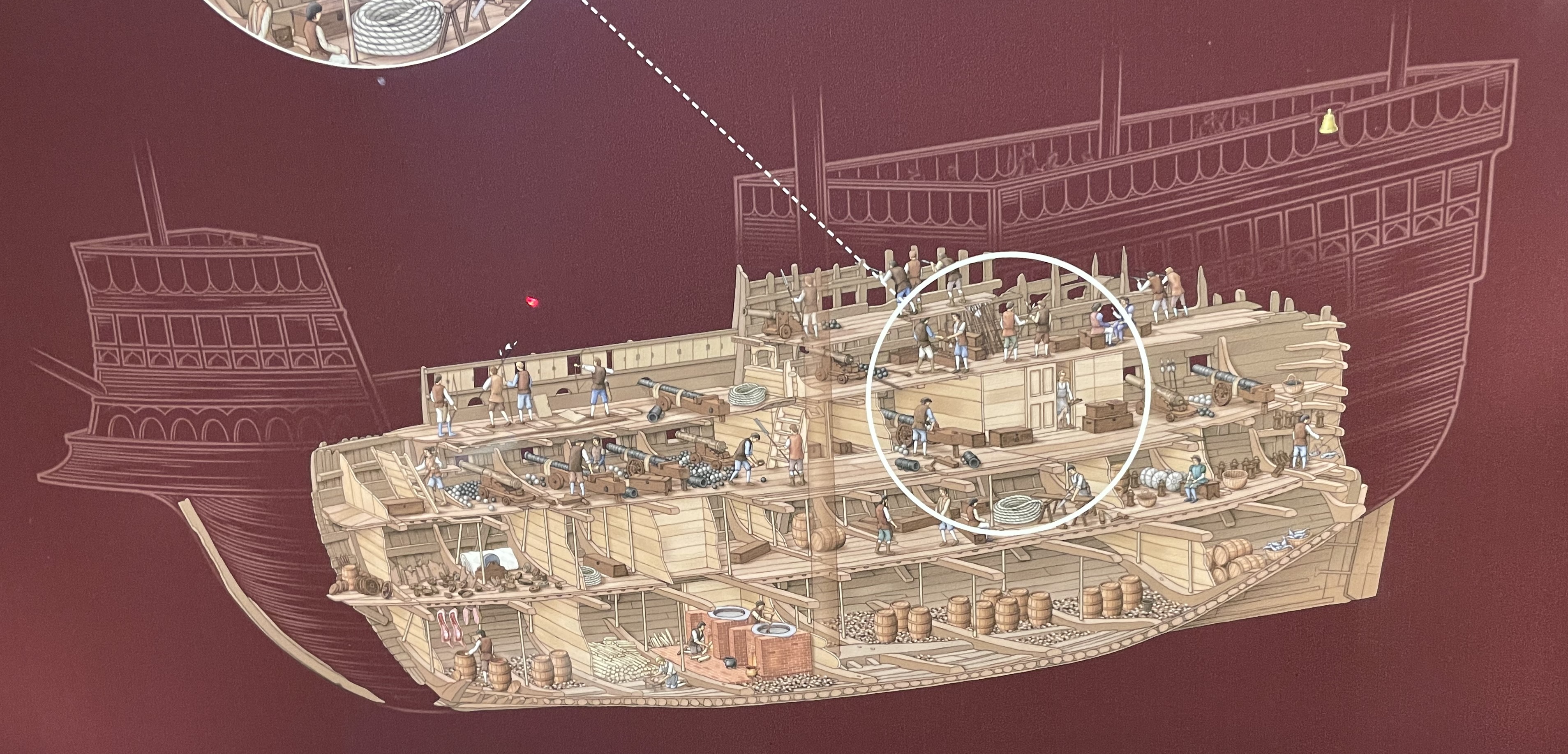
Another fascinating exhibit was of the Mary Rose, commissioned by King Henry VIII in 1510 as a flagship. It sank in 1545 during the Battle of the Solent by the French, just a mile offshore of Portsmouth, in 40 feet of water. It sat on the seabed, half buried in silt until it was discovered and eventually raised in 1982.
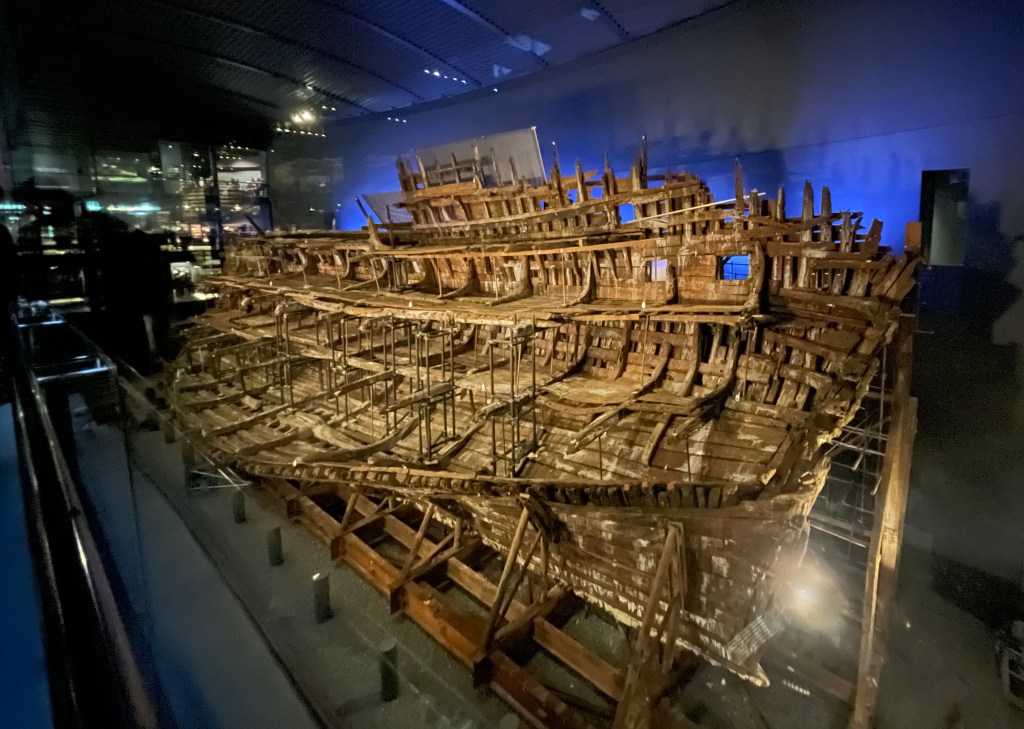
The exhibit does a great job of showing just how much of the ship is still intact, and an astounding amount of items that survive.

The HMS Warrier is a battleship built for Queen Victoria’s Navy, launched in 1860. We toured her as well.
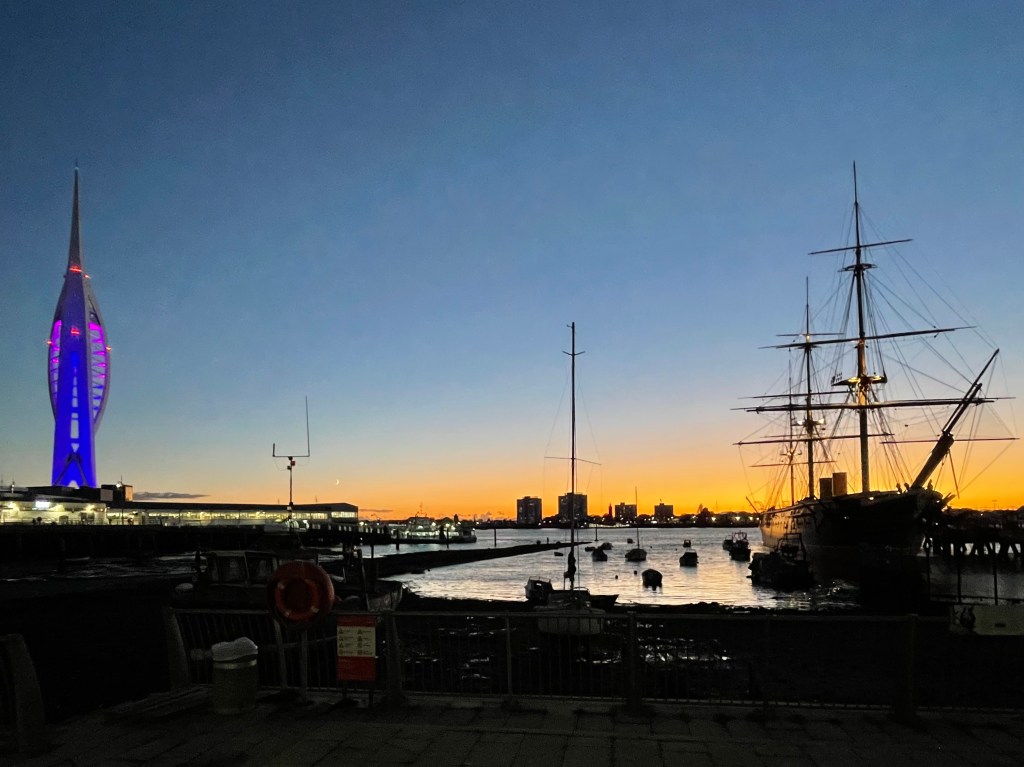
We spent two whole days exploring all the things to see at the Dockyard. We took a harbor tour, water taxi over to Gosport to tour a WWI submarine (Holland 1) and a WWII submarine (HMS Alliance), toured Boathouse 4, a working shop that restores small craft. We walked through the multiple other museums that are there. The weekend we were there it was “half-term” for the school kids, so the dockyard was teeming with British families as well.
We took a city bus down to see Southsea, and Henry the VIII’s castle there, from which he watched the sinking of the Mary Rose. There is also a D-Day Museum there, but we arrived after closing time.

By the time we checked out of our hotel and hopped a train to our next destination, I felt we had spent just the right amount of time in Portsmouth to soak up all the history there.
Links for the curious:
Portsmouth Historic Dockyard visitor info and tickets. They have so much to experience there. The Ultimate Explorer pass includes entry to 13 attractions. We visited 11 of them, and it was well worth it for us.
Where to stay? There are lots of choices nearby. We stayed at the Ship Leopard, which was a great location. Our room overlooked the harbor and had a view of Spinnaker Tower and the HMS Warrior. It is across the street from the Portsmouth Harbour Rail station, and the Isle of Wight Ferries, a block away from Gunwarf Quays, and a block away from the Historic Dockyard gate.
We disembarked the Queen Mary 2 at the Mayflower Cruise Terminal in Southampton on a sunny, brisk day. Our travel plans typically include train travel, which we prefer to rental cars. So we waved goodbye to the grand ship and grabbed a cab to Southampton Central Rail Station. We headed out on a day trip to Winchester.

We stowed our bags at a business near the rail station to explore the 10th-century, medieval capital of England on foot.
Our goal was to visit beautiful Winchester Cathedral, whose construction began in 1079 and was completed in 1532. When we arrived, we learned it was closed because it was hosting back-to-back graduation ceremonies for the various colleges of the University of Winchester. Doh!

I did try to breach their defenses several times, but the Cathedral is still well-defended. So we admired it from outside and decided to make another visit later in our trip to see its grand medieval architecture from the inside.


After our consolation lap around the Cathedral grounds, we toured the City Museum, which tells the history of Winchester from its Iron Age, Roman, and Anglo-Saxon origins to the present day.

We then headed off to find what remains of the ancient Winchester Castle. Its Great Hall still stands, adjacent to the modern-day Crown Court. Inside is the Round Table of the legendary King Arthur’s Knights. The massive oak table is thought to be one that the real King Alfred had built for a wedding celebration in the 13th century, but King Henry VIII in the 16th century had it painted with the Tudor rose, the names of 24 knights, and the character of King Arthur said to be in his own image to link him to the legend. Or so one story goes.

Stained glass just loves a sunny day!

Nearby stands the West Gate of the former Castle. Modern-day traffic just zips by.

We grabbed lunch in a nearby pub and then caught a train headed to Portsmouth Harbour Rail Station. Portsmouth is home to the Royal Navy’s Historic Dockyard, and our base for the next 3 days.

More historic ships and ancient architecture to come!
Links for the curious:
British National Rail website. Install their app on your phone for easy access to timetables, real-time train status, and online tickets. I used it every day. There are multiple local railways (South Western Railway, Great Western Railway, etc) that have their own websites, but the National Rail app integrates them all.
British National Rail’s Railcard information. This is a railcard that you purchase for a one-time fee, valid for a year. In return, it gives you 1/3 off train fares in off-peak times. We bought the “Two Together” railcard for 35£ and it paid for itself several times over. It’s a digital card, so you should install the Railcard app on your phone to show at ticket offices and to ticket inspectors on the trains.
Radical Storage website for luggage drop/pickup locations. They also have an app, but I just purchased via their website on my phone. This worked great for us. Their location in Winchester that we used was a vape shop 🙂 But it was very convenient to get to from the train station. The system is easy to navigate and use, and I felt our bags were very secure both times we used it. They have locations worldwide! I’d definitely use them again.
Winchester Cathedral visitor info. Make sure to check for scheduled closures 🙂
The Explorer Pass to visit Winchester’s City Museum, the Great Hall, and Westgate.
The reason Monte and I were in NYC was to board the Queen Mary 2 for a week-long transatlantic cruise to Southampton, in the UK. Over the years, we had always pooh-poohed the idea of taking a cruise, being little boat sailors. But we really had a great time.
This’ll be a long post, so for the TL;DR crowd: if you’re on the fence about going on a cruise on the Queen Mary 2, you should just do it. 🙂
We boarded Pier 12 at the Brooklyn Cruise Ship Terminal, an easy walk from our hotel in Red Hook. The weather was brisk, but it was bright and sunny most days.

The Queen Mary 2 (QM2) is a Cunard ocean liner. One of the many things I’ve learned over the last week or two is that an ocean liner is different than a cruise ship in many ways; most importantly, their speed, hull strength for long ocean passages, and stability. These ocean liners have hydraulic stabilizers below the water line that attempt to counteract the ship’s roll, pitch, and yaw. I believe we averaged 21 knots on our eastbound crossing, and this was in what a sailboat would consider very challenging conditions (4-6 meter seas and 25-40 knot winds), but the Queen Mary 2 made it along very comfortably.

Launched in 2003, the QM2 is a beautiful ship inside and out. And the Cunard standard of service is legendary. This was our first ever cruise, so we did a little research prior to leaving. They suggest dressing in “smart attire” for dinner, and have two gala nights where gowns and black tie is encouraged. We somehow found a way to pack for that in our carry-on sized roll aboards. And it was fun.
The sail away celebration above-decks was festive and we got great views of NYC as we left at 5 pm.


We chose a balcony-cabin and loved it. I booked one midships on the starboard side, so we would not be exposed to the fall north winds, and to be able to see the sunrise most mornings on our northeasterly heading.

Deck 5 was very quiet. I know this crossing was probably fully booked, but we heard no one and nothing except the ocean when the door to the balcony was open. They have bigger suites, but ours worked out perfectly for us. Air temps were in the 50s, so it was chilly in late October. Even so, I found myself enjoying our balcony everyday.

We crawled all over the ship each day and I think we found and spent time in just about all the public spaces – some were harder to find than others, but all so lovely.

The cruise departs NYC on a Friday evening, and arrives in Southampton the following Friday morning. I wondered how well I’d handle all those idle hours on board for a week. But I was not idle in the least. There are loads of activities and entertainment from morning through night everyday: classes, speakers, musical performers, exercise sessions, theatrical and comedy performers, too many to list.

Since we were traveling eastward, for 5 of the days at sea, the ship clock moved forward one hour at noon, so when we arrived in the UK, we’d already be on local time.
The food was delicious and always available. We had the same table for two in the restaurant each night, so we got to know our servers. We met different people every day on board which was also a hoot.
There is a formal afternoon tea every day in the Queen’s Room, which we took part in several times.

We attended some of the various entertainment every evening, but we always ended up in the Chart Room where the Vlad Zinchenko Trio played jazz all night long.

The promenade is on Deck 7, and 3 laps around it make a mile. Even though it was very windy, we made it out there several days to get our steps in. There’s also a great gym aboard that’s much warmer 🙂

I had hoped to take in some star gazing at night but boy was it windy on the top deck at night! I could have been easily blown off if I wasn’t paying attention. I’ll stick to dry land for celestial viewing.
But while up there I walked by the “Queen Mary 2” sign lit up below the smoke stack and was transported back to the night Lori and I left NY Harbor at sunset headed down to Cape May on Trident when I saw this same sign through the binoculars as I tried to read the name of that pretty ship that sailed by us at a distance as it left NY Harbor.

I just went back through my photo archive and found a picture from that very night on Trident, October 7, 2022. I remember telling Monte about it after I got home, and where it was headed, and he said, “we could do that.” And so we did 🙂

While sailing along the US coast from a sailboat, I’ve also seen, through binoculars, pilots boarding tankers while underway before entering a major harbor. So I wanted to try to get a glimpse of the pilot boarding the QM2 outside of the Solent strait before our arrival in Southampton. I got up very early and was fortunate to find they were boarding right below our cabin. I had a front row view. 🙂 What a job they have.

We planned to stay in England for 9 more days after disembarking; more on that later. I made use of the onboard laundry so our suitcases were full of clean clothes again when we arrived.
We had a blast. Until next time, Mary!

Links for the curious:
Cunard’s transatlantic cruise website. You can call them and they will answer any questions you have, before or after you book.
Where to stay the night before departure? We stayed at Lodge Red Hook. Not fancy, but an easy walk to the Cruise Terminal. They also have a nice breakfast included. We flew in the day before, and it made for a stress-free transfer without worrying about unexpected travel delays. The Uber from JFK to the hotel was about $100.
There is also a convenient South Brooklyn-Manhattan foot ferry at the cruise terminal, which we used while we were there. To go to Manhattan, get on at Red Hook towards Corlears Hook. You can purchase tickets from a machine at the dock.
Red Hook visitor info. Red Hook is very walkable, and we found several nice restaurants and wine stores near the hotel.
Pro Tip: You can bring 1 bottle of wine/alcohol per passenger onto the QM2 in your carry-on luggage, so we made sure to pick up a couple of nice bottles in Red Hook before heading to the cruise terminal.
I’ve been to NYC too many times to count, but I’ve never spent time in Brooklyn. We had a quick visit here, this time we stayed in Red Hook.

We enjoyed walking around the neighborhood, finding a nice lobster pound.

And we took a nice tour up and down the East River.


We ran across this pretty boat, the SV Clearwater, getting some paint touch up. The Clearwater is the sloop Pete Seeger raised money for, and had built, to raise awareness of the pollution in the Hudson River back in the 1960s. It is still actively promoting environmental education as a floating classroom, and has inspired countless other efforts across the country. More info here: https://www.clearwater.org/the-sloop/

Forty-six years ago, in a galaxy that seems oh so far away, I took my first airplane trip. I remember sitting for hours in the terminal at JFK waiting on our connecting flight. The big board continually clicked and flipped to show flight status and gate updates.
I heard that that old terminal has been preserved and turned into a hotel next to Terminal 5 at JFK.
Today Monte and I flew into Terminal 8 at JFK, and I just had to find this time capsule before we left the airport.
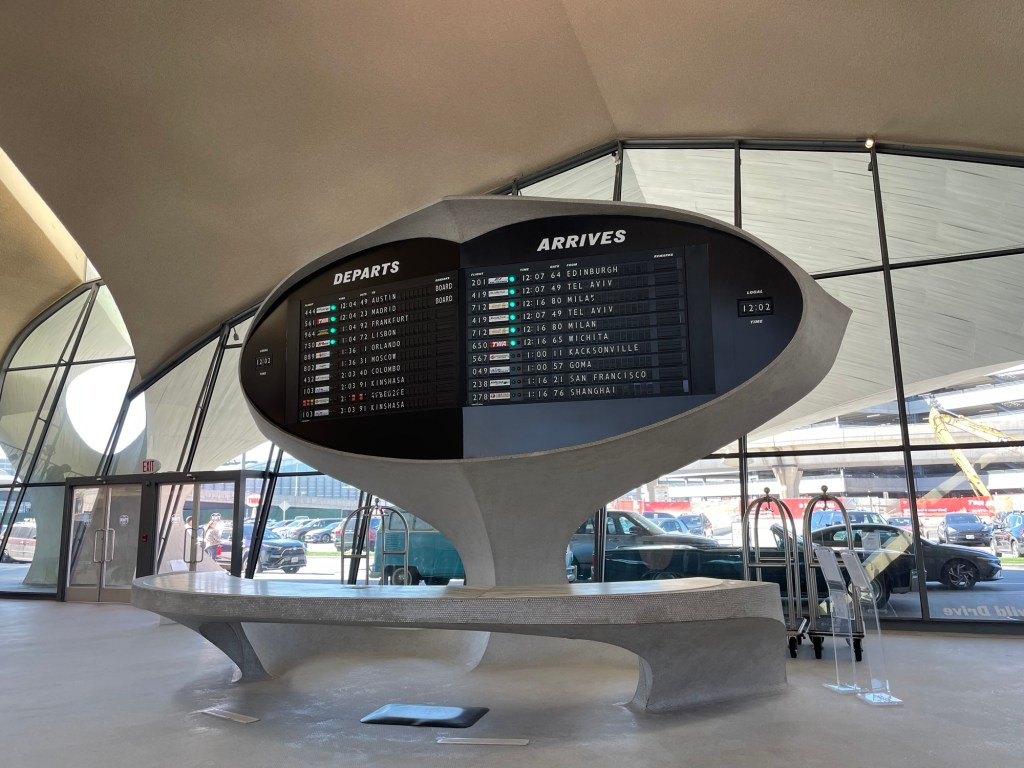
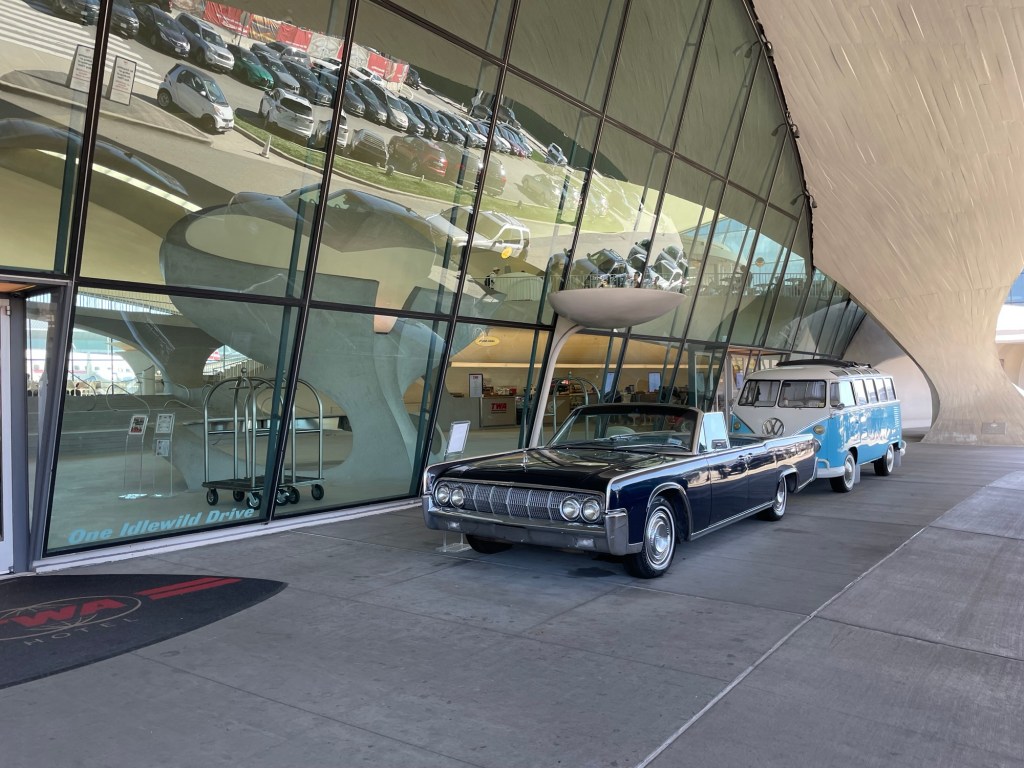
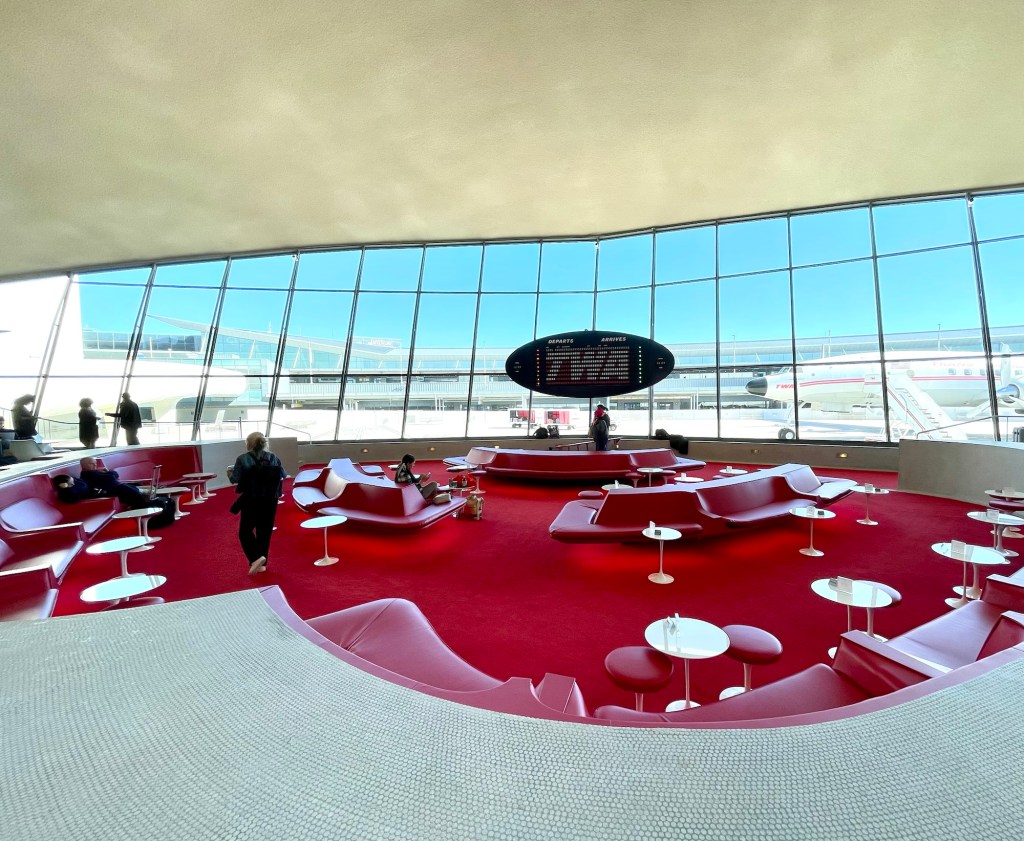


It was fun to see those old memories come back to life.
 Sheila365