I thought I’d share a few takeaways from our trip on the Queen Mary 2 and our 9-day wander through British history.
October is a great month to book on the Queen Mary 2 and walk around southern England. Not too cold. Not too crowded.
Get a starboard cabin if you are on an eastbound transatlantic passage of the QM2, imho. The winds are usually blowing out of the north, so it made for more pleasant balcony experience.
Never leave home without a tiny tube of superglue. 🙂 On day 2 of our trip the earpiece on my eyeglasses broke off. The weld at the metal lens frame just gave way. I was on a boat for 7 days where the only stores sold expensive bags, art, and watches. Fortunately, the QM2 worker in the store who I asked was one of the jewelry designers. She whipped out her toolbox that had some flexible jewelers adhesive. A dab of that got me through the week, when they broke again. I hit the first Tesco on dry land for my own tube of superglue.
It isn’t always raining in England. For us, it only rained on two of our travel days, and one afternoon when we walked around Portsmouth Southsea along the coast. We, and our luggage, are pretty waterproof so it was fine. Ok, I just did the math, turns out it rained one third of the days we were in England. Which, in retrospect, is a lot. Oh well, it was nice to have the beautiful sunny days that we did. I remember them more vividly than the rainy days.
Be flexible.
Check closure schedules ahead of time for the places you plan to visit.
The British National Rail Two Together Railcard paid for itself several times over. A better deal than 2 Senior railcards, if you always travel together. We took the train 6 times.
We went to Portsmouth to see the Ships. We went to Salisbury to see the Stones. Now we are headed to Greenwich to see the Clocks. We took the train from Salisbury to London Waterloo Railway Station on the first rainy day of our trip. There are multiple ways to travel from Waterloo, in Central London, to Greenwich, in Southeast London. We are taking the easiest route by catching a ride on the Uber Boat run by Thames Clippers. It is a foot ferry that runs up and down the Thames. The closest ferry stop is right underneath the London Eye, the giant Ferris wheel along the river. The very short walk from the train station to the Eye took us right by the IBM London office building. It must be a new location; I remember it being in a slightly different location on my last business trip there, about a kilometer to the east.
The London Eye at Waterloo.
The ferry was comfy. And we could grab a beverage and snack on board, and just enjoy the sights on the 45 minute trip over to Greenwich without getting wet on this rainy day.
Big Ben and Westminster on the north shore of the Thames.The ferry took us under about 10 bridges, including Tower Bridge.
The Cutty Sark is a beautifully restored clipper ship built in 1869 for the China tea trade; the last of its kind. It sits at Greenwich Pier, where we got off the ferry.
The Cutty Sark once was the fastest ship of its time ~max speed 17.5 knots
When fully rigged, the ship flew over 30,000 square feet of sail, with over 11 miles of running rigging.
The inside of ship was a tad unremarkable, with empty wide open space, as it was basically made to hold as much cargo as possible; densely stacked chests of tea, and later wool. A typical crew size was 20-25 men.
The copper/zinc-clad keel of the Cutty Sark from below. The ship is suspended in space to see the topsides, the insides, and the bottom, 280′ long, 36′ wide, 21′ of draft.
We toured the National Maritime Museum on the grounds of the Old Royal Naval College. It is the largest maritime museum in the world, and admission is free! Its exhibits pretty comprehensively cover British seafaring over the years, and across the globe.
National Maritime Museum
Greenwich has long been a center of Royal activity. Greenwich Palace is no more, but it was the birthplace of Henry VIII in 1491 and his daughters, Mary and Elizabeth, who became queens. It was the Tudor base during his lifetime. Since that time, the Queen’s House was built here in 1619. It is now a museum and art gallery. Admission to the Queen’s House is also free, amazingly.
Probably the most famous painting in the Queen’s House is their Armada portrait of Queen Elizabeth I, but I didn’t take a photo. Here’s a link. It’s beautiful. It commemorates the failed invasion of Britain by the Spanish Armada.
The current grand buildings along the Thames were built in 1694 as a hospital for injured and aging seamen. The buildings’ layout was designed to not block the view from the Queen’s House to the Thames.
The view from Water Gate on the Thames looking south past the twin towers of the Old Royal Naval College to the Queen’s House
The seaman’s hospital closed in 1869, after which the site became the home of the Royal Naval College up until 1997. Now it is a cultural and historic site and foundation called the Old Royal Naval College, and it is the the heart of Maritime Greenwich.
We stayed at the Admiral Hardy, two blocks from the Greenwich pier, next to the Greenwich Market, and a short walk to all things in historic Greenwich.
The Admiral Hardy and the entrance to Greenwich Market on the right.
The Admiral Hardy is a large public house that dates back to the late 1800s. They have 7 very nice rooms upstairs. Hotel guests “check in” at the bar. 🙂 Our room was very nice and large. No elevator, though, FYI. The hotel is adjacent to the Greenwich Market, full of food and retail vendors. The sign on the outside of the market’s current location says 1831. Inside it says “Est. 1737.” Either way, it’s been around a while.
At the end of our first day in Greenwich, we were a little damp and a little tired. On day two in Greenwich, we will see the Clocks!
Links for the curious:
Uber Boat’s Thames Clipper website, for an easy way to get from place to place in London via the Thames. Or you can just stay on and do a loop.
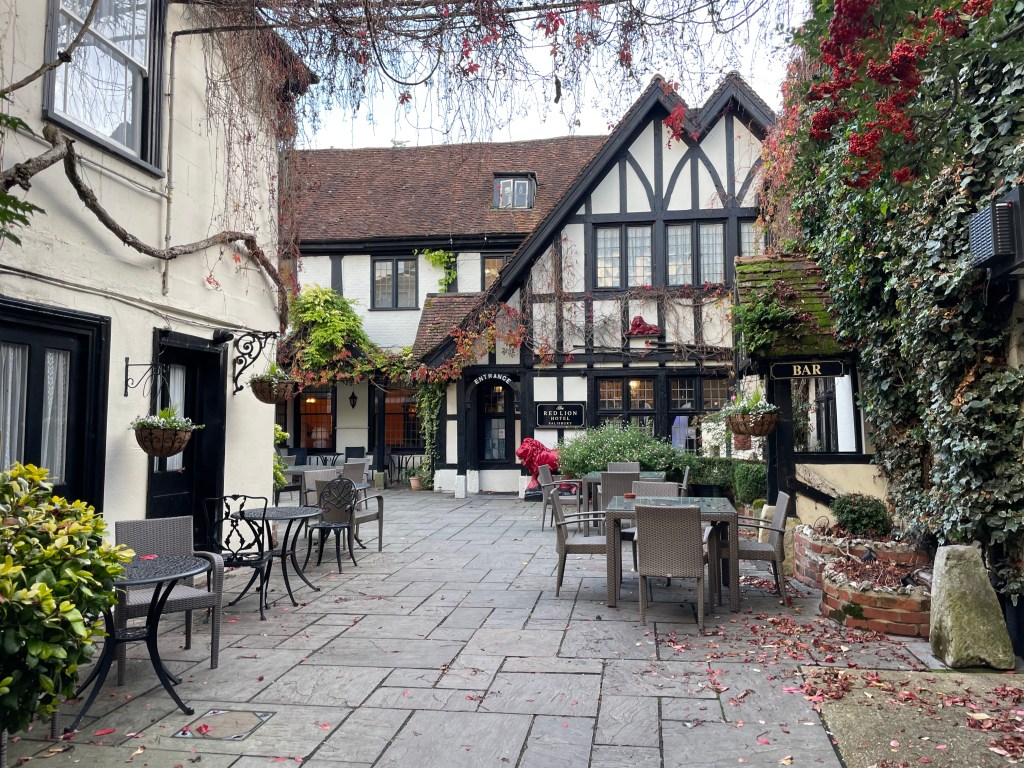
We arrived in Salisbury by train late in the afternoon, so we headed right to the hotel, the Red Lion Inn. Salisbury has a Cathedral, too (shocker). In the 13th century, the Red Lion was built to house stonemasons who were working on the Cathedral.
The hotel’s courtyard – I loved our hotel before we ever walked through the door.
Salisbury is very walkable, too. We were a block away from the busy market square, which was full of cafes, restaurants, and stores. On Tuesdays and Saturdays, market stalls fill the square. Luckily, our stay included a Tuesday, so we were treated to a stroll around the market.
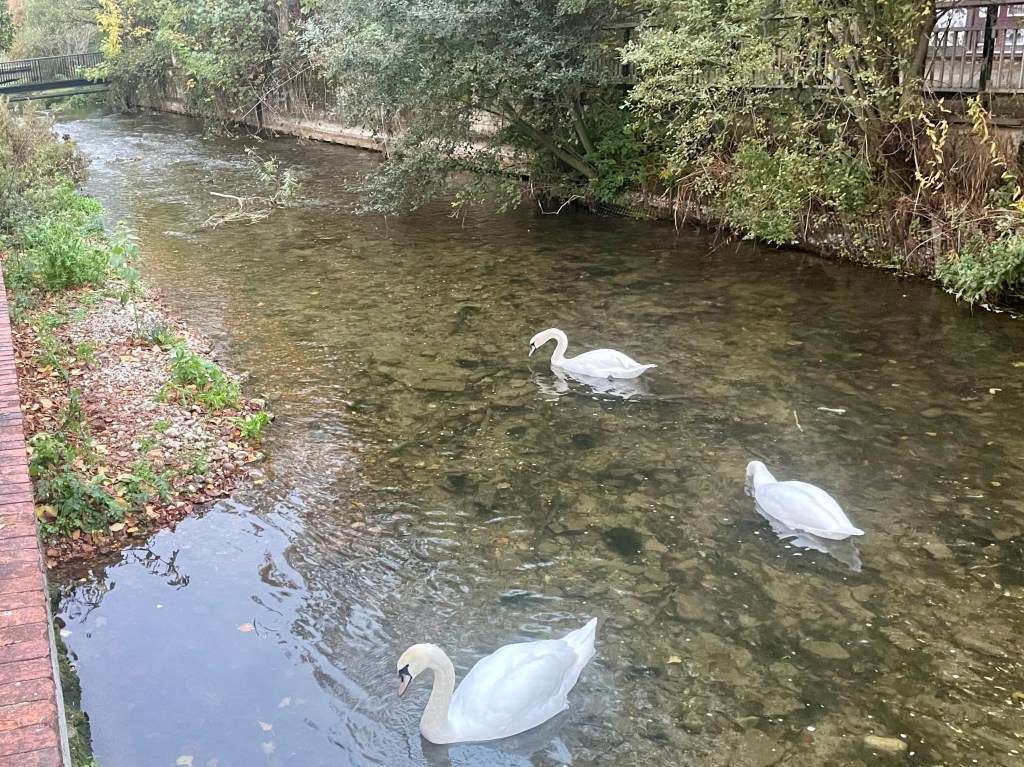
Salisbury’s River Avon and its tributaries run through the town.
After enjoying a walk around town, we stopped in for a drink in the pub and enjoyed dinner at a nearby Italian restaurant.
Monte says that we went to Portsmouth to see the Ships. Well, we came to Salisbury to see the Stones. So, the next morning, we got up and caught the bus to Stonehenge, which stops a block from our hotel.
It was very windy, and therefore quite chilly. But we were treated to another sunny day in England.
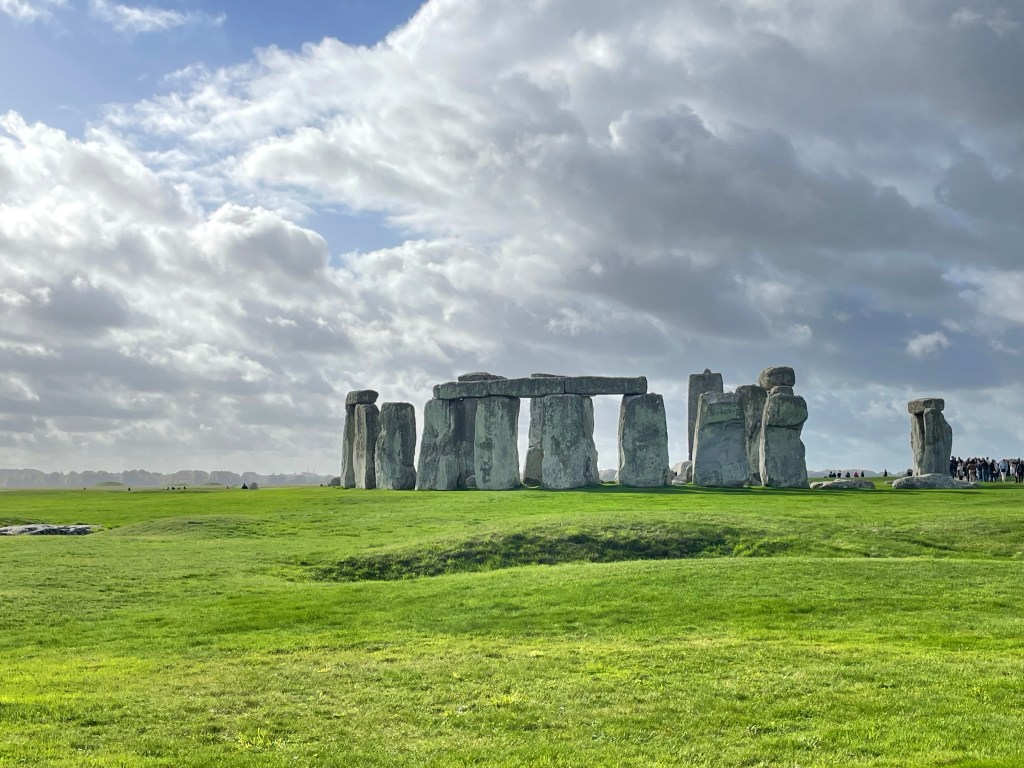
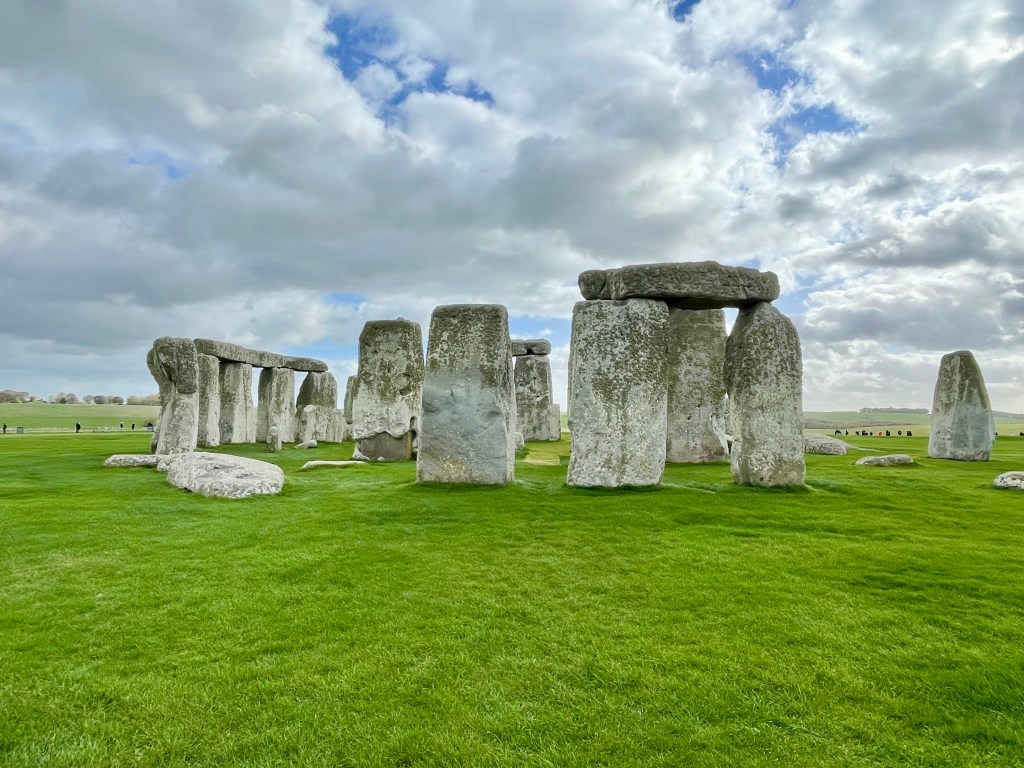
A view of Stonehenge from the northeast, near the Heel Stone, looking southwest through the stones towards where the sun would set on the summer solstice. The “Avenue” extends behind us to the northeast
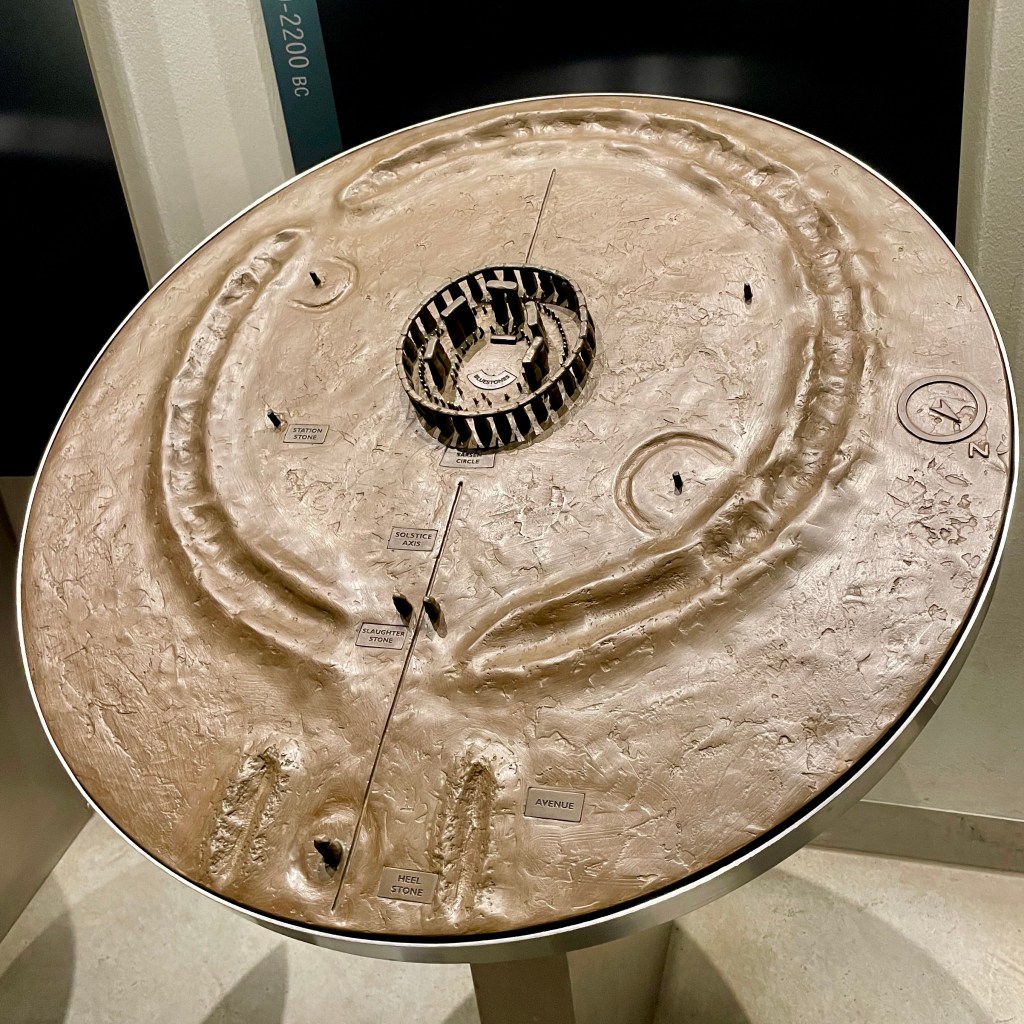
Stonehenge is the current monument at this location, estimated to have been erected around 2500 BC. As early as 3000 BC, other monuments were built here, beginning with a circular earthen ditch, and then a circle made with smaller stones. Eventually, the current stone arrangement was erected and aligned with the sun on the spring and summer solstices.
The purpose of the stones is a mystery. The leading theories include being a burial site or an astronomical calendar. It is also thought to have been an ancient pilgrimage destination, as evidence of an “avenue” can be seen that extends from the site to the River Avon. If that is true, the river may have carried visitors to the site, as well as the stones used to construct it. Many other burial sites have been discovered in the immediate area. Whatever the reason, it is truly something to walk near them (walking through the stones is no longer allowed due to preservation efforts). If it had been a warmer day, we would have walked along one of the field paths from the visitor center to the monument. But it was just too windy and chilly, and the shuttle bus was a better option.
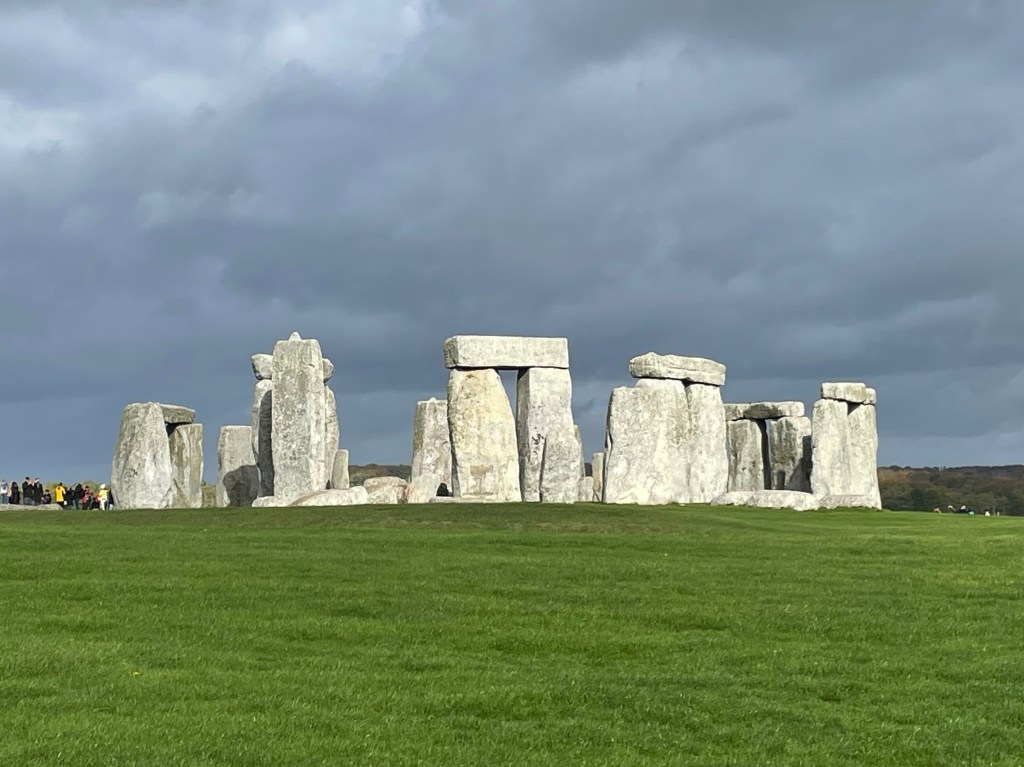
A view from the southwest, with the sun shining on the stones.A view from the northwest – this is the closest the walkway gets to the stones, about 35′ away.
At the site, there is a circular path that goes all the way around the stones. There is an audio walking tour that you can download (ahead of time!) and listen to descriptions of the site as you walk around the monument.
After admiring the stones, we spent time in the visitor center to take in even more history of the site.
A photo of a film in the visitor center showing what a winter solstice sunset could have looked like in the full stone circle circa 2500BC.This exhibit shows what the original stone circle would have looked like circa 2200 BC.
On the way back to Salisbury from Stonehenge, the bus goes by Old Sarum, which was the original name and location of the town now called Salisbury. There are ruins of an old Iron Age castle and fortifications there, along with the footings of the original Norman cathedral that stood at that site. The legend goes that the monks at Old Sarum, who lived in the cathedral, had ongoing conflicts with the soldiers who lived in the castle. They fought over water, which was in short supply. So they petitioned the Pope to move the cathedral (and the town). So they shot an arrow into the air, and where it landed would be the location for the new cathedral. The arrow allegedly struck a deer and was carried some distance. Where it eventually fell, construction on the new cathedral began in 1220. More on the Salisbury Cathedral in another post.
After Portsmouth, we will stay in Salisbury for a couple of nights. But we decided to make another attempt to see the inside of Winchester Cathedral. So we boarded the train to Winchester again. This time, the Cathedral was open and glorious.
The west entrance of Winchester Cathedral
Inside the Cathedral, we were able to view the 12th-century Winchester Bible. We also took a guided tour and soaked up the history of the place. The Cathedral’s construction began under William the Conqueror in 1079 and was completed in 1532. During that period, architectural techniques evolved. The Cathedral’s construction began with Norman features (rounded arches, thick walls) on the central tower and transepts, later adopting Gothic features (pointed arches and flying buttresses) in its wide open nave.
The view from the south transept looking north shows the Cathedral’s Norman architecture.Looking east from the Cathedral’s west entrance down the massive Gothic nave.
Jane Austen is buried here, though the tribute on her gravestone omits any mention of her literary achievements.
The Cathedral was not damaged during World War II. But it experienced destruction from the British themselves during the English Reformation in the 1500s, when Henry VIII broke with the Roman Catholic Church and created the Church of England. The patron saint of Winchester Cathedral was St. Swithen. During the Reformation, a shrine to St. Swithin in the Cathedral that had become a destination for many religious pilgrims was destroyed and removed. The “Holy Hole” still remains, marking the entrance to his former shrine. I think it would be a great place for a geocache. 😮
The “holy hole” in the wall through which Pilgrims could access the bones of St Swithen.
And more destruction followed in the mid-1600s, after the Parliamentarians defeated the Royalists in the English Civil War. Not only did they execute King Charles I, but they also trashed most religious icons in churches across the country. In Winchester Cathedral, they broke statues and mortuary chests, smashed just about all the stained glass, and used the Cathedral as a stable for the army’s horses. A few years later, Charles II took his father’s throne, restoring the monarchy and a bit of order. In 1660, the current wall of stained glass at the Cathedral’s west entrance was constructed using shards of the broken, original stained glass windows.
The current west window, built using glass shards from windows broken during the English Civil War.
That’s the end of the history lesson, and enough of all the death and destruction, already!
Oh, one other thing I found interesting…. At the beginning of the 20th century, the southern and eastern walls of the Cathedral were found to be sinking under their own weight. This was due to the high water table in the area and being built on peat. Since the water table couldn’t be lowered, someone would have to do the work underwater. A Navy diver named William Walker came to the rescue. From 1906 to 1911, he single-handedly dove down in water up to 20′ deep, to shore up the foundations with bags of cement, concrete blocks, and bricks. He’s remembered as “The diver who with his own hands saved Winchester Cathedral.”
At the end of the tour, we went down into the Crypt under the Cathedral floor. Unlike most other churches, this crypt is virtually empty, due to nearly constant flooding. In the 1980’s a sculpture by Anthony Gormley was installed. The statue is, more often than not, standing in water.
Ok, that is all for Winchester. Since we are bound for Salisbury by nightfall, we headed back to the train station and got back on board. More to follow on our visit to Salisbury.





 Sheila365